

Introduction
Fiberglass is one of the most widely used engineering materials in water storage, wastewater treatment, chemical containment, and industrial infrastructure. In Saudi Arabia and the GCC, it is the preferred material for tanks, covers, manholes, and structural components that must resist heat, corrosion, and UV exposure for decades.
But most buyers, engineers, and procurement teams do not fully understand what fiberglass is made of — or how the choice of raw materials directly affects the performance, strength, and service life of the finished product.
Fiberglass is not a single material. It is a composite — a combination of two or more materials that work together to produce properties neither material can achieve alone.
The two primary components are:
- Resin — the polymer matrix that binds everything together, provides chemical resistance, and protects against environmental exposure.
- Glass fiber — the reinforcement that provides mechanical strength, stiffness, and impact resistance.
Beyond these two, several other raw materials play critical roles: gelcoat for surface protection, catalysts and accelerators for curing, fillers for cost and property optimization, and pigments for color.
The terms FRP (Fiber Reinforced Plastic), GRP (Glass Reinforced Plastic), and fiberglass all refer to the same family of composite materials. FRP is the broader term — it can include carbon fiber or aramid fiber composites. GRP specifically refers to composites reinforced with glass fibers. In the water tank and industrial equipment industry, FRP and GRP are used interchangeably because glass fiber is the standard reinforcement.
This article explains each raw material used in fiberglass manufacturing, what role it plays, and why it matters for the performance of FRP/GRP products in Saudi Arabia’s demanding environment.
Glass Fiber: The Reinforcement
Glass fiber is the structural backbone of every fiberglass product. Without glass fiber, the resin matrix would be brittle and weak. The glass fiber provides tensile strength, flexural strength, and impact resistance.
Glass fiber is manufactured by melting raw glass (silica sand, limestone, alumina, and other minerals) at temperatures above 1,500°C and drawing the molten glass into extremely fine filaments — typically 9 to 23 microns in diameter. These filaments are then bundled, treated with a sizing agent for resin compatibility, and processed into various product forms.
Types of Glass Fiber
The most common glass type used in FRP/GRP manufacturing is E-glass (electrical glass). E-glass offers an excellent balance of mechanical strength, chemical resistance, electrical insulation, and cost. It is the standard reinforcement for water tanks, chemical tanks, covers, and structural components.
Other glass types include:
| Glass Type | Key Property | Common Use |
|---|---|---|
| E-glass | Best all-round balance of strength, chemical resistance, and cost | Water tanks, chemical tanks, covers, structural FRP |
| C-glass | Superior chemical resistance, especially to acids | Inner corrosion barrier liners for chemical tanks |
| S-glass | Higher tensile strength and temperature resistance | Aerospace, high-performance applications |
| ECR-glass | Enhanced corrosion resistance over E-glass | Aggressive chemical environments |
For the vast majority of FRP tanks and GRP products manufactured in Saudi Arabia — including water tanks, diesel tanks, wastewater covers, and manholes — E-glass is the standard and correct choice.
Glass Fiber Product Forms
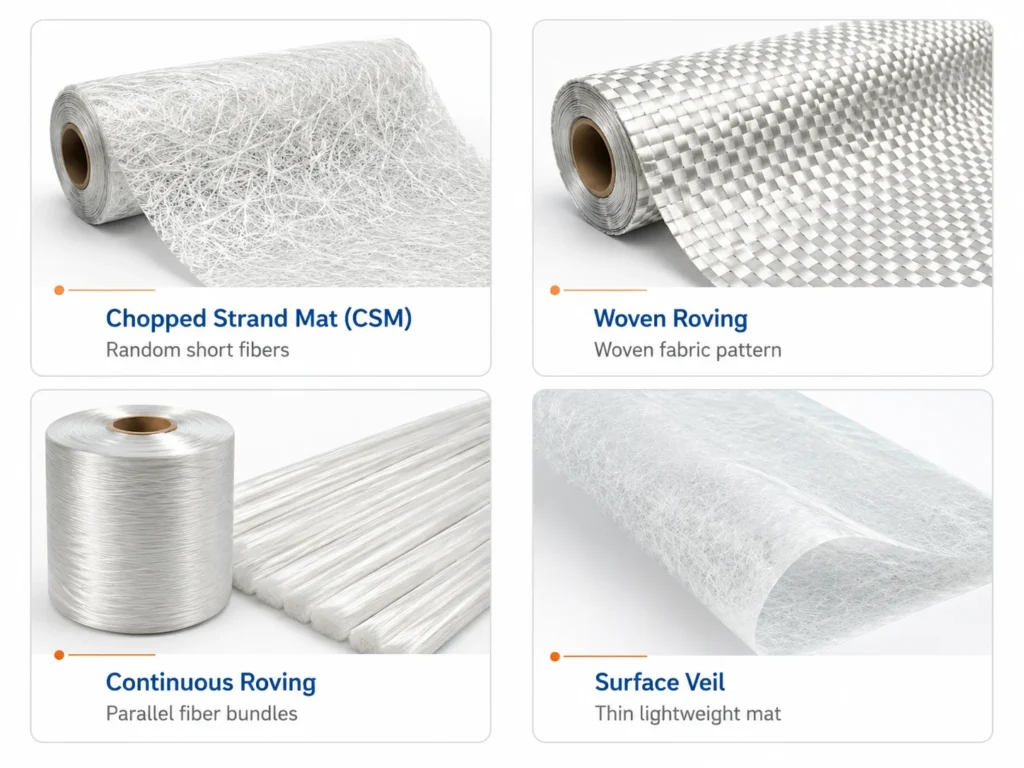
Raw glass fiber filaments are processed into several product forms, each designed for a specific manufacturing method and structural purpose:
Chopped Strand Mat (CSM) — Short glass fibers (typically 25–50 mm long) randomly oriented and held together by a chemical binder. CSM provides isotropic (equal in all directions) strength and is the most common reinforcement for hand lay-up manufacturing. Typical weights are 300 g/m² and 450 g/m². CSM is used in corrosion barrier layers and general structural laminate.
Woven Roving — Continuous glass fiber rovings woven into a fabric in a 0°/90° pattern. Woven roving provides high bidirectional strength and is used in structural layers where greater mechanical performance is needed. Typical weights are 400–800 g/m².
Continuous Roving — Uncut bundles of glass filaments used in filament winding and pultrusion processes. Continuous roving provides the highest strength-to-weight ratio and allows precise fiber orientation.
Surface Veil / Tissue Mat — Very thin, lightweight mat (typically 30–50 g/m²) used as the innermost layer against the mold or as a surface layer. It creates a resin-rich surface for chemical resistance and a smooth cosmetic finish.
Combination Mat — A product that combines woven roving on one side with chopped strand mat stitched to the other side. It saves lay-up time by combining two reinforcement types in a single layer.
Resin: The Matrix
Resin is the second essential component of fiberglass. The resin matrix binds the glass fibers together, transfers loads between fibers, provides chemical resistance, and protects the glass from environmental damage (moisture, UV, chemicals).
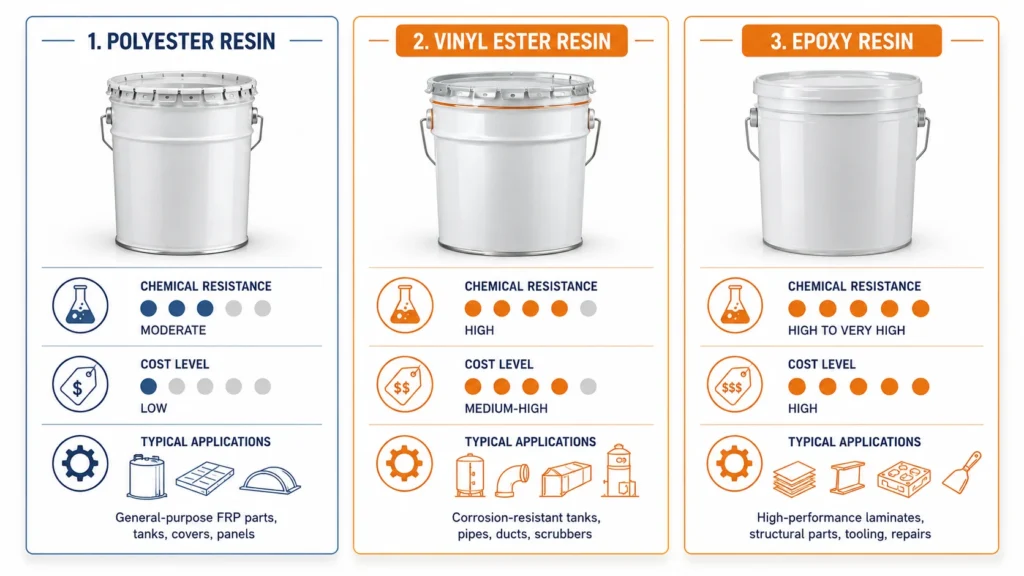
In FRP/GRP manufacturing, three families of thermosetting resin are used:
Polyester Resin
Polyester resin is the most widely used resin in the fiberglass industry. It is cost-effective, easy to process, and provides good mechanical properties and adequate chemical resistance for most water storage and general-purpose applications.
There are two main types of polyester resin:
- Orthophthalic polyester — The most economical option. Suitable for general-purpose applications, potable water tanks, and non-aggressive environments.
- Isophthalic polyester — Higher chemical resistance and better water resistance than orthophthalic. Used for corrosion barrier layers, marine applications, and environments with moderate chemical exposure.
For potable water storage tanks in Saudi Arabia, food-grade isophthalic polyester resin is the standard choice, as it meets FDA and food-contact safety requirements.
Vinyl Ester Resin
Vinyl ester resin provides significantly better chemical resistance than polyester resin, especially against strong acids, alkalis, solvents, and oxidizing chemicals. It also has superior fatigue resistance and higher elongation, making it more resistant to cracking under thermal and mechanical stress.
Vinyl ester is the standard resin for:
- Chemical storage tanks (sulfuric acid, hydrochloric acid, sodium hypochlorite, caustic soda)
- Desalination plant chemical containment
- Wastewater treatment environments with H₂S exposure
- Industrial applications with aggressive chemical contact
Vinyl ester is more expensive than polyester but provides a longer service life in chemically demanding applications. Using polyester where vinyl ester is required is one of the most common and most expensive specification mistakes in FRP procurement.
Epoxy Resin
Epoxy resin provides the highest mechanical properties, best adhesion, lowest shrinkage, and excellent chemical resistance. It is used in high-performance applications where maximum strength, dimensional stability, and long-term durability are required.
Epoxy is less common in standard FRP tanks due to higher cost and more demanding processing requirements. It is primarily used in structural FRP components, aerospace applications, and specialty high-performance laminates.
| Resin Type | Chemical Resistance | Cost | Typical Applications |
|---|---|---|---|
| Orthophthalic polyester | Moderate | Lowest | General-purpose, potable water tanks |
| Isophthalic polyester | Good | Moderate | Potable water, moderate chemical exposure |
| Vinyl ester | Excellent | Higher | Chemical tanks, H₂S environments, desalination |
| Epoxy | Excellent | Highest | High-performance structural, specialty applications |
Gelcoat: The Protective Surface Layer
Gelcoat is a specialized resin-based coating applied to the outer or inner surface of a fiberglass product. It is typically 0.4–0.6 mm thick and provides several critical functions:
UV protection — Gelcoat contains UV inhibitors and stabilizers that protect the underlying laminate from ultraviolet degradation. In Saudi Arabia, where UV exposure is among the highest in the world, gelcoat is essential for any FRP product exposed to direct sunlight.
Chemical barrier — Gelcoat creates a dense, resin-rich surface that resists chemical attack, moisture ingress, and environmental exposure.
Smooth finish — Gelcoat provides a smooth, non-porous surface that resists algae growth, is easy to clean, and gives a professional appearance.
Color — Gelcoat can be pigmented to any color, providing permanent color that does not require painting.
For FRP water tanks, gelcoat is applied to the exterior surface to protect against UV and weathering. For chemical tanks, gelcoat or a resin-rich corrosion barrier is applied to the interior surface in contact with the stored chemical.
Tanks manufactured without gelcoat will show surface fiber exposure, moisture wicking, and UV degradation within 2–5 years in Saudi conditions. This leads to fiber blooming (white patches of exposed glass fiber), surface cracking, and eventually structural weakening.
Catalysts and Accelerators: The Curing System
Thermosetting resins do not harden on their own. They require a curing system to initiate and control the chemical reaction (crosslinking) that transforms liquid resin into a solid, rigid matrix.
Catalyst (hardener) — Typically MEKP (methyl ethyl ketone peroxide) for polyester and vinyl ester resins. The catalyst initiates the crosslinking reaction. The amount of catalyst controls the gel time (how quickly the resin begins to set) and the peak exotherm (heat generated during curing).
Accelerator (promoter) — Typically cobalt naphthenate or cobalt octoate. The accelerator works with the catalyst to enable room-temperature curing. Without an accelerator, polyester resin would require heat (oven curing) to cure.
The catalyst-to-resin ratio is critical. Too little catalyst results in incomplete cure — soft, under-cured laminate with poor mechanical properties. Too much catalyst causes excessive exotherm, rapid gelation, cracking, and internal stress.
In Saudi Arabia’s high ambient temperatures (often 40–50°C in summer), the curing system must be adjusted seasonally. Summer requires reduced catalyst levels and sometimes the addition of retarders to prevent premature gelation. Winter may require increased catalyst or warming of the work area.
Fillers and Additives
Beyond the primary raw materials, several fillers and additives are used to modify specific properties of the fiberglass composite:
Calcium carbonate (CaCO₃) — The most common filler. Reduces cost, improves surface finish, and increases compressive strength. Used in non-critical structural areas and general-purpose products.
Alumina trihydrate (ATH) — A fire-retardant filler. When exposed to heat, ATH releases water vapor, which absorbs heat and reduces flame spread. Used in fire-rated FRP products and applications requiring fire resistance.
Thixotropic agents — Fumed silica or other thixotropes are added to resin to prevent draining on vertical surfaces during lay-up. They allow the resin to be applied to vertical or overhead surfaces without sagging.
Pigments — Color pigments are added to resin or gelcoat to provide permanent color. Common colors for FRP tanks include grey, green, blue, cream, and white.
UV stabilizers — Added to gelcoat and sometimes to the structural resin to improve resistance to UV degradation. Critical for FRP products exposed to direct sunlight in Saudi Arabia.
Mold release agents — Applied to the mold surface before lay-up to ensure the finished product can be removed from the mold without damage. Common types include wax-based and PVA (polyvinyl alcohol) film releases.
How Raw Materials Come Together: The FRP Laminate Structure
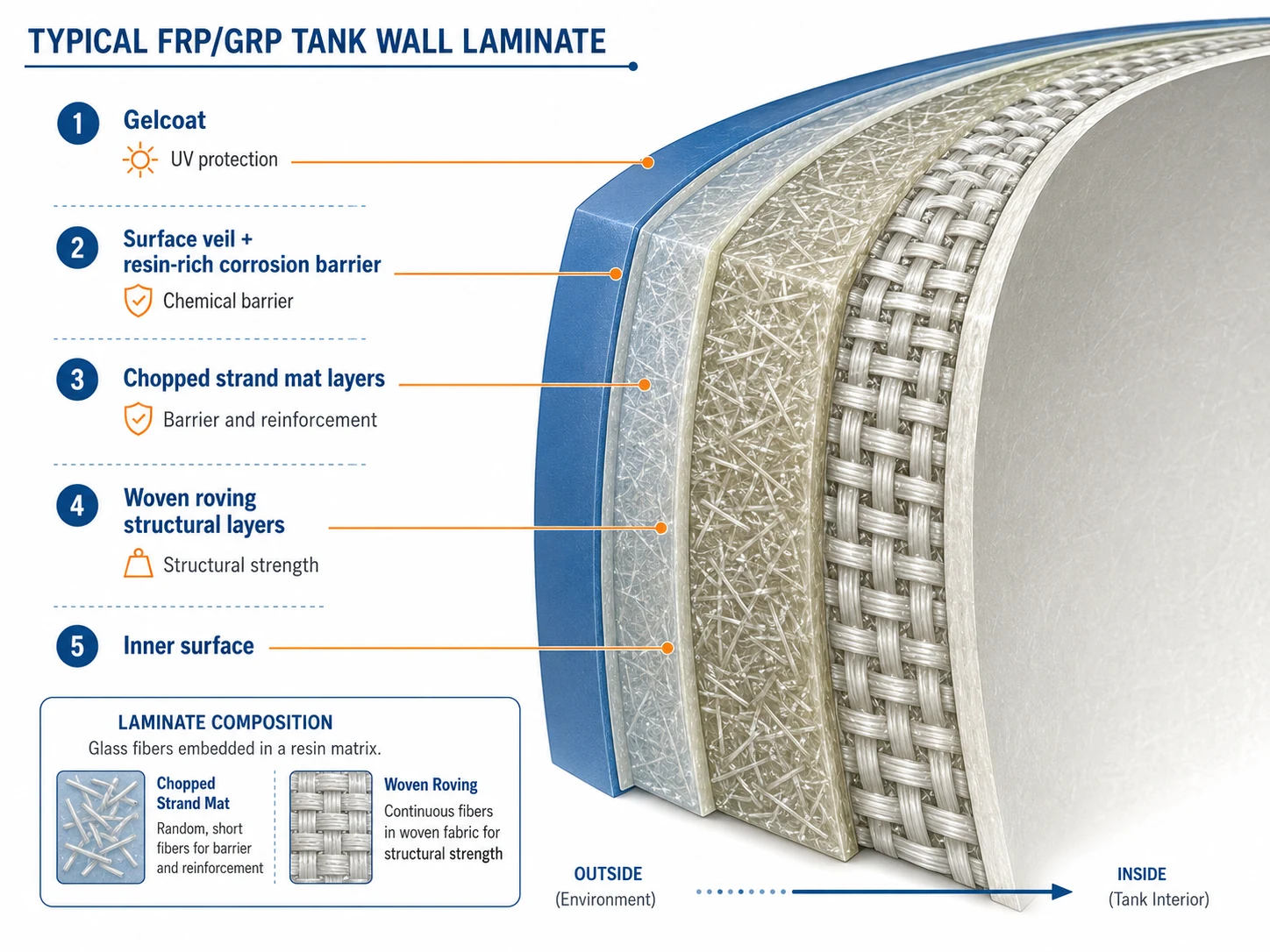
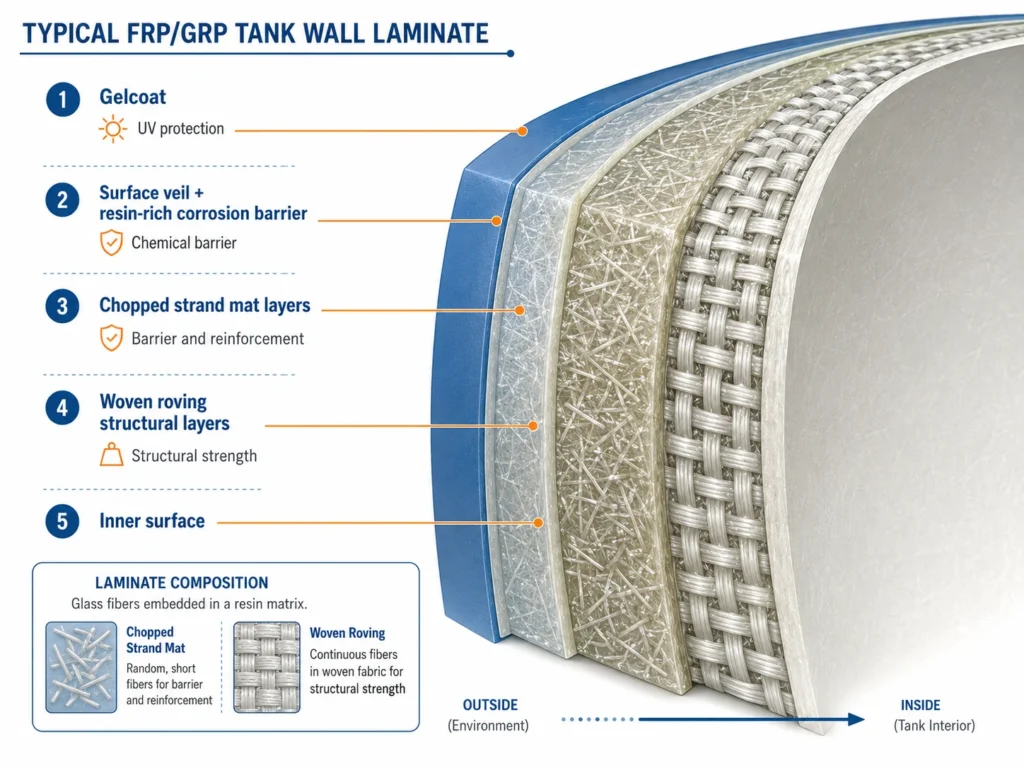
A finished FRP product is not a uniform material — it is a carefully engineered stack of layers, each with a specific function. The way raw materials are combined into a laminate determines the final properties of the product.
A typical FRP tank wall consists of:
| Layer | Materials Used | Function |
|---|---|---|
| Gelcoat | Pigmented resin + UV stabilizers | UV protection, color, smooth surface |
| Corrosion barrier | Surface veil + resin-rich layer (2–3 mm) | Chemical resistance, moisture barrier |
| Transition layer | Chopped strand mat (300 g/m²) | Bonds corrosion barrier to structural laminate |
| Structural laminate | Alternating layers of CSM and woven roving + resin | Mechanical strength, stiffness, load-bearing |
| Inner surface | Surface veil or CSM + resin | Smooth interior, secondary corrosion protection |
The total wall thickness depends on the tank diameter, design pressure, and the contents being stored. A typical water tank may have a wall thickness of 5–10 mm, while a large chemical tank may require 12–20 mm or more.
The ratio of glass fiber to resin (glass content) is a critical quality parameter. For hand lay-up manufacturing, typical glass content is 25–35% by weight. For filament winding, glass content can reach 50–70%. Higher glass content generally means higher strength — but only if the resin fully wets and bonds to every fiber.
Why Raw Material Quality Matters in Saudi Arabia
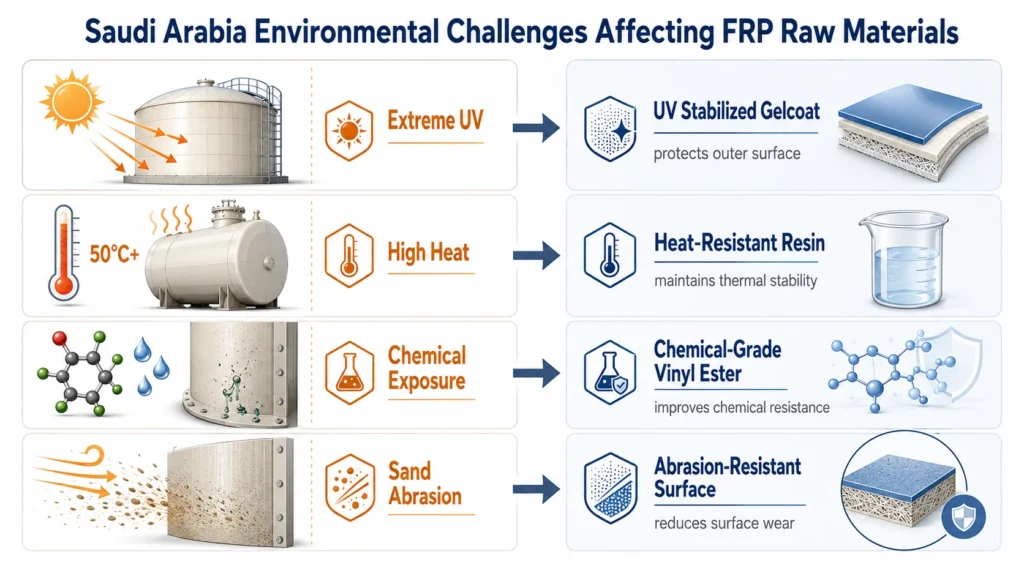
Saudi Arabia presents some of the most demanding conditions for fiberglass products anywhere in the world:
Extreme UV exposure — Riyadh receives over 2,500 hours of direct sunlight annually. Without proper gelcoat and UV stabilizers, FRP surfaces degrade rapidly.
High ambient temperatures — Summer temperatures routinely exceed 45°C, with ground-level surface temperatures reaching 70°C or higher. The resin system must maintain its mechanical properties at sustained elevated temperatures.
Chemical exposure — Water treatment plants, desalination facilities, and petrochemical installations expose FRP to aggressive chemicals including chlorine, sodium hypochlorite, sulfuric acid, and H₂S gas.
Saline and sulfate-rich environments — Coastal areas (Jeddah, Dammam, Jubail, Yanbu) and inland sabkha soils expose FRP to chloride and sulfate attack. While FRP resists these far better than steel or concrete, resin selection and corrosion barrier design must account for these conditions.
Sand and dust abrasion — Windblown sand can abrade unprotected surfaces. Gelcoat hardness and surface quality affect long-term resistance to abrasion.
These conditions mean that cutting costs on raw materials — using lower-grade resin, thinner gelcoat, insufficient glass reinforcement, or omitting UV stabilizers — will always result in shorter service life, earlier maintenance, and higher total lifecycle cost.
How to Verify Raw Material Quality When Buying FRP Products
Not all FRP products are manufactured with the same raw material quality. When procuring FRP tanks, covers, or manholes in Saudi Arabia, the following raw material verification points should be part of your evaluation:
Resin type and grade — Request the resin brand, type (polyester, vinyl ester, or epoxy), and technical data sheet (TDS). Confirm the resin is appropriate for the stored contents and operating conditions. For potable water tanks, confirm FDA or food-contact compliance.
Glass fiber type and content — Request confirmation of E-glass type, glass fiber product forms used (CSM, woven roving), and the nominal glass content by weight. Minimum glass content for structural laminates should be specified.
Gelcoat specification — Confirm gelcoat is applied, its type (polyester or vinyl ester based), minimum thickness, and whether UV stabilizers are included. For outdoor tanks in Saudi Arabia, UV-stabilized gelcoat is essential.
Laminate schedule — Request the laminate schedule (the layer-by-layer build-up specification). This document should list every layer of the laminate, the material used, and the nominal thickness or weight. It is the blueprint for the composite wall and the most important quality reference.
Material traceability — A quality-focused manufacturer will maintain batch traceability for resin, glass fiber, gelcoat, and catalyst. This allows any quality issue to be traced back to specific raw material batches.
Curing verification — Ask whether the manufacturer performs Barcol hardness testing on cured laminates. Barcol hardness confirms that the resin has fully cured and reached its design mechanical properties. Under-cured laminate is one of the most common hidden quality defects in FRP manufacturing.
Practical Reference: Raw Materials by Product Type
| FRP Product | Typical Resin | Typical Glass Reinforcement | Gelcoat | Key Raw Material Focus |
|---|---|---|---|---|
| Potable water tank | Isophthalic polyester (FDA) | E-glass CSM + woven roving | UV-stabilized exterior gelcoat | Food-grade resin, UV protection |
| Chemical storage tank | Vinyl ester | E-glass CSM + C-glass veil (inner) | Chemical-resistant inner barrier | Resin-chemical compatibility |
| Diesel storage tank | Isophthalic polyester | E-glass CSM + woven roving | UV-stabilized exterior gelcoat | Fuel resistance, fire retardant options |
| STP/WWTP cover | Isophthalic or vinyl ester | E-glass CSM + woven roving | UV-stabilized exterior gelcoat | H₂S resistance, UV protection |
| Manhole cover | Isophthalic polyester | E-glass CSM + woven roving + continuous roving | UV-stabilized exterior gelcoat | Load-bearing strength, abrasion resistance |
| GRP sheets/panels | Orthophthalic or isophthalic polyester | E-glass CSM or woven roving | Optional gelcoat | Surface finish, UV resistance |
FAQs
What is fiberglass (FRP/GRP) made of?
Fiberglass is a composite material made from two main components: glass fiber reinforcement and a resin matrix. The glass fiber provides mechanical strength and stiffness, while the resin binds the fibers together and provides chemical and environmental resistance. Additional raw materials include gelcoat for surface protection, catalysts for curing, fillers, and UV stabilizers. The terms FRP, GRP, and fiberglass all refer to this same composite material family.
What is the difference between FRP and GRP?
FRP stands for Fiber Reinforced Plastic — a broad term covering composites reinforced with any fiber type (glass, carbon, aramid). GRP stands for Glass Reinforced Plastic — specifically composites reinforced with glass fibers. In the water tank and industrial equipment industry, FRP and GRP are used interchangeably because glass fiber is the standard reinforcement material. They refer to the same product.
What type of glass fiber is used in FRP tanks?
The standard glass fiber type for FRP tanks is E-glass (electrical glass). E-glass provides an excellent balance of tensile strength, chemical resistance, and cost. For chemical tanks requiring enhanced corrosion resistance in the inner barrier, C-glass (chemical glass) surface veils may be used. S-glass (high strength) is used in aerospace and specialty applications but is rare in standard industrial FRP products.
What is chopped strand mat (CSM) in fiberglass?
Chopped strand mat is a non-woven reinforcement made from short glass fiber strands (typically 25–50 mm long) randomly oriented and held together by a chemical binder. CSM provides equal strength in all directions (isotropic properties) and is the most common reinforcement for hand lay-up FRP manufacturing. It is used in both corrosion barrier layers and structural laminate layers.
Why does resin type matter in FRP tanks?
Resin type determines the chemical resistance, temperature tolerance, and mechanical properties of the finished FRP product. Polyester resin is suitable for water storage and general applications. Vinyl ester resin is required for chemical storage and aggressive environments. Epoxy provides the highest performance but at the highest cost. Using the wrong resin for the application — for example, polyester where vinyl ester is needed — can lead to premature tank failure and chemical attack on the laminate.
What does gelcoat do on a fiberglass tank?
Gelcoat is a specialized resin-based coating applied to the outer surface of FRP products. It provides UV protection, chemical resistance, a smooth non-porous finish, and permanent color. In Saudi Arabia’s high-UV environment, gelcoat with UV stabilizers is essential for any outdoor FRP product. Without gelcoat, the laminate surface will degrade, show fiber blooming, and lose structural integrity within a few years.
How thick should an FRP tank wall be?
Wall thickness depends on tank diameter, height, design pressure, and the contents stored. A typical potable water tank may have a wall thickness of 5–10 mm, while large chemical tanks may require 12–20 mm or more. Wall thickness is determined by engineering design calculations, not arbitrary selection. The laminate schedule specifies exactly how many layers of glass and resin are required to meet the design requirements.
What is the glass content in FRP and why does it matter?
Glass content is the percentage of glass fiber by weight in the composite. For hand lay-up manufacturing, typical glass content is 25–35%. For filament winding, it can reach 50–70%. Higher glass content generally means higher strength, but only if the resin fully wets every fiber. Glass content below minimum thresholds results in resin-rich, weak laminates. Glass content above maximum thresholds can result in dry fibers without adequate resin bonding.
How do Saudi Arabia’s conditions affect FRP raw material selection?
Saudi Arabia’s extreme UV exposure, high temperatures (45–50°C+), chemical environments, saline coastal conditions, and sand abrasion demand premium raw materials. UV-stabilized gelcoat is mandatory for outdoor products. Heat-resistant resin systems must maintain properties at sustained elevated temperatures. Chemical-grade vinyl ester is required for wastewater and chemical applications. Cutting costs on raw materials in Saudi conditions always results in shorter service life.
How can I verify the raw material quality of an FRP product?
Request the resin brand and technical data sheet, glass fiber type and content, gelcoat specification and thickness, the complete laminate schedule, material batch traceability records, and Barcol hardness test results for cured laminates. A quality-focused manufacturer will provide all of these without hesitation. Inability or unwillingness to provide raw material documentation is a red flag.
Key Takeaways
Fiberglass (FRP/GRP) is a composite material made from glass fiber reinforcement and a resin matrix, plus gelcoat, catalysts, fillers, and additives.
Glass fiber — typically E-glass — provides mechanical strength. It comes in several forms: chopped strand mat (CSM), woven roving, continuous roving, and surface veil, each serving a specific structural purpose.
Resin — the matrix that binds fibers, provides chemical resistance, and protects against environmental exposure. Three main types:
- Polyester (general purpose, water storage)
- Vinyl ester (chemical resistance, aggressive environments)
- Epoxy (highest performance, specialty applications)
Gelcoat protects the FRP surface from UV degradation, chemicals, and moisture. In Saudi Arabia’s extreme UV environment, UV-stabilized gelcoat is essential for outdoor products.
The laminate structure — gelcoat, corrosion barrier, structural laminate — is an engineered layer system where each layer serves a specific function.
Raw material quality directly determines service life. In Saudi Arabia’s demanding conditions, cutting costs on resin, glass, or gelcoat always leads to premature failure and higher lifecycle cost.
Always request raw material documentation — resin TDS, glass type, gelcoat spec, laminate schedule, and Barcol hardness results — when procuring FRP products.
Conclusion
Understanding what fiberglass is made of is the first step toward making informed procurement decisions. The raw materials — resin type, glass fiber form, gelcoat quality, and laminate design — are what separate a 25-year tank from a 5-year failure.
Pioneers Fiberglass has been manufacturing FRP/GRP products in Riyadh since 1977, using premium-grade resins, E-glass reinforcement, and UV-stabilized gelcoat engineered for Saudi Arabia’s demanding conditions. Every product is built on a documented laminate schedule with full material traceability.
To discuss your project requirements or request a detailed specification, please share:
- Application type (water storage, chemical containment, wastewater, diesel, structural)
- Required capacity and dimensions
- Contents to be stored and operating temperature
- Installation location (indoor, outdoor, underground, rooftop)
- Any applicable standards or client specifications