

Introduction
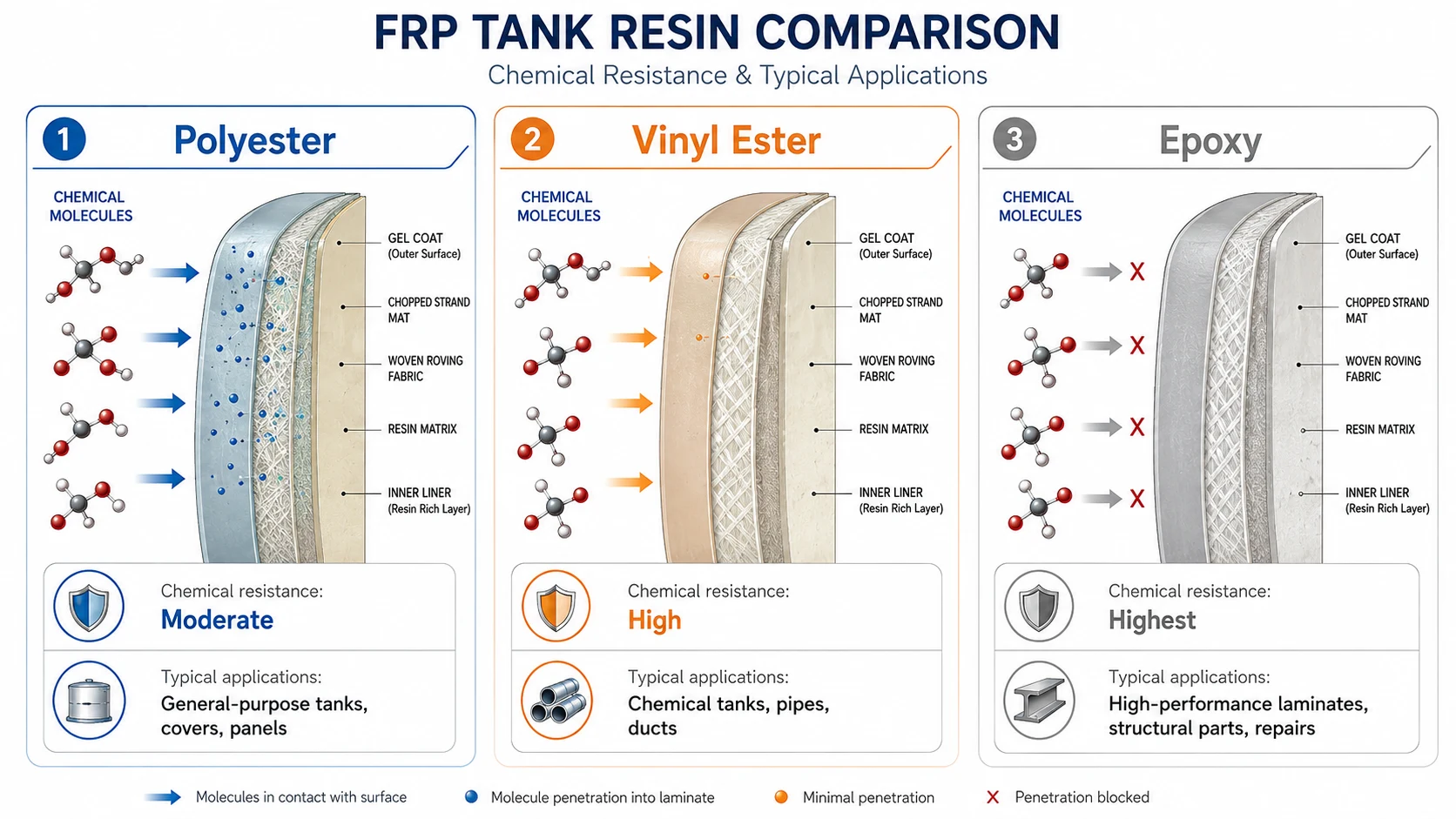
Polyester vs vinyl ester vs epoxy resin for FRP tanks is one of the most important decisions in FRP/GRP tank manufacturing. The resin is the matrix that holds the glass fiber reinforcement together, provides chemical resistance, and determines how long the tank will perform in service.
In FRP/GRP tank manufacturing, three resin families are used: polyester, vinyl ester, and epoxy. All three produce strong, durable composites — but they are not interchangeable. Each resin has a specific chemical resistance profile, mechanical property range, temperature tolerance, and cost position.
Selecting the wrong resin is one of the most expensive mistakes in FRP procurement. A polyester tank in a sodium hypochlorite application will fail within months. A vinyl ester tank for clean potable water storage is overspecified and overpriced. An epoxy tank for general water storage offers no practical advantage over polyester at two to three times the cost.
The correct resin selection depends on three factors:
- What the tank will store — water, diesel, acid, alkali, solvent, or mixed chemicals
- Operating temperature — ambient, elevated, or fluctuating
- Service life expectation — 10 years, 20 years, or 25+ years
This article compares polyester, vinyl ester, and epoxy resin for FRP tank applications, explains when each is the correct choice, and identifies the common resin selection mistakes that lead to premature tank failure in Saudi Arabia.
Polyester Resin: The General-Purpose Standard
Polyester resin is the most widely used resin in the fiberglass industry worldwide. It accounts for the majority of FRP tanks manufactured for water storage, general industrial use, and non-aggressive chemical environments.
Chemistry and Properties
Polyester resins are unsaturated polyester polymers dissolved in a reactive monomer (typically styrene). When a catalyst (MEKP) is added, the resin crosslinks into a rigid thermoset matrix.
Key properties of polyester resin:
| Property | Typical Value |
|---|---|
| Tensile strength | 40–90 MPa |
| Flexural modulus | 2.5–4.0 GPa |
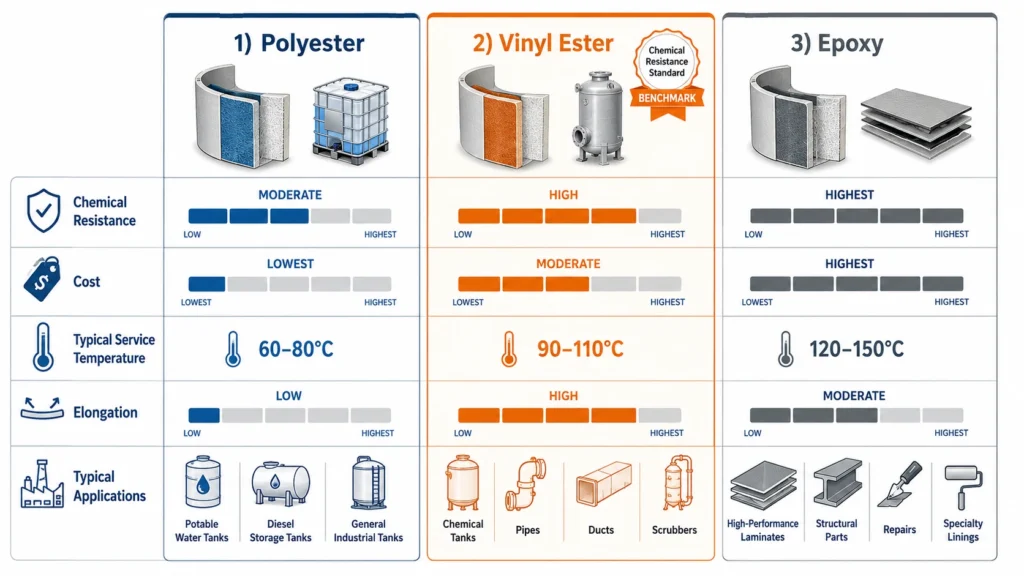
| Heat distortion temperature (HDT) | 60–120°C (varies by grade) |
| Elongation at break | 1–3% |
| Water absorption (24 hr) | 0.15–0.60% |
Two Types of Polyester
Orthophthalic polyester — The most economical grade. Made with phthalic anhydride. Suitable for general-purpose applications with no chemical exposure. Lower water resistance than isophthalic grades. Commonly used for non-critical structural components, GRP sheets, and indoor products.
Isophthalic polyester — Made with isophthalic acid, which provides better water resistance, higher chemical resistance, and improved mechanical properties. This is the standard resin for potable water tanks, diesel tanks, and outdoor FRP products in Saudi Arabia. Food-grade isophthalic polyester resins are available with FDA compliance for potable water contact.
When to Use Polyester
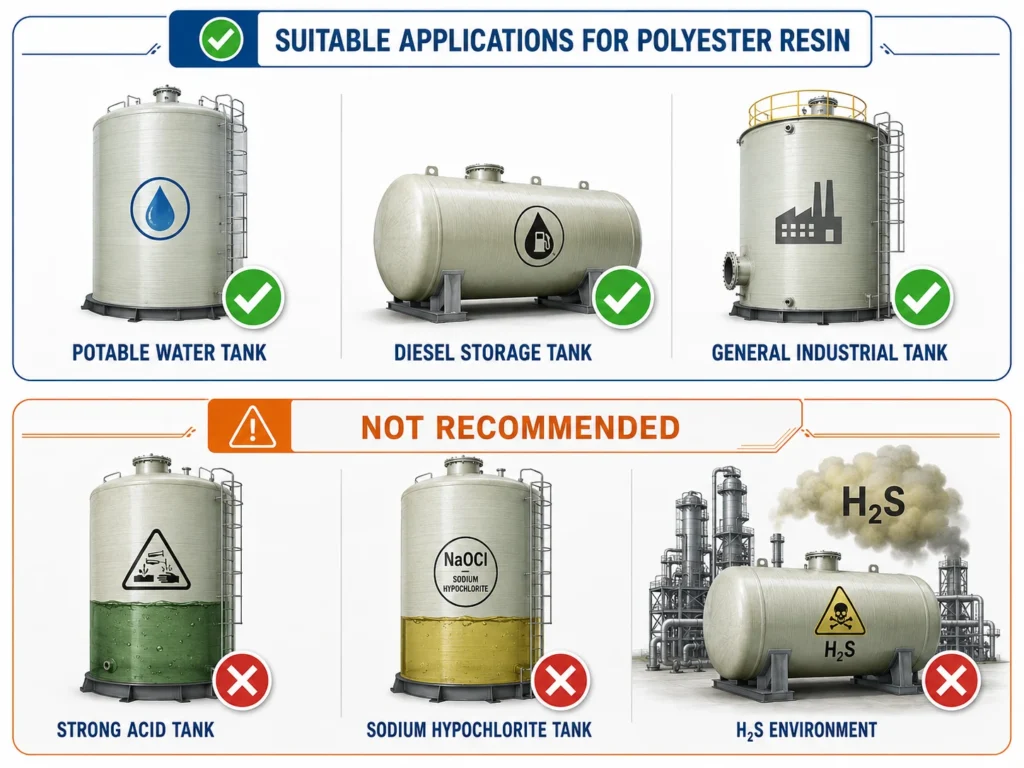
Polyester resin is the correct choice when:
- The tank stores potable water, clean water, or non-aggressive liquids
- The operating temperature stays below 60°C
- The chemical environment is mild (no strong acids, alkalis, or solvents)
- Cost optimization is important and service conditions are not chemically aggressive
- The application is diesel storage (with appropriate fuel-resistant grade)
When NOT to Use Polyester
Polyester should not be used when:
- The tank stores strong acids (sulfuric, hydrochloric, nitric)
- The tank stores strong alkalis (caustic soda, sodium hydroxide)
- The environment involves H₂S gas exposure (wastewater treatment)
- Operating temperatures exceed the resin’s HDT
- Oxidizing chemicals (sodium hypochlorite, bleach, hydrogen peroxide) will contact the tank
Vinyl Ester Resin: The Chemical-Resistant Upgrade
Vinyl ester resin is the standard choice for FRP tanks that will be exposed to aggressive chemicals, corrosive gases, or elevated temperatures. It provides significantly better chemical resistance than polyester while maintaining good processability.
Chemistry and Properties
Vinyl ester resins are produced by reacting an epoxy resin with methacrylic acid, then dissolving the result in styrene monomer. This chemistry gives vinyl ester the backbone structure of an epoxy (providing chemical resistance) with the processing ease of a polyester (styrene-based crosslinking).
Key properties of vinyl ester resin:
| Property | Typical Value |
|---|---|
| Tensile strength | 70–90 MPa |
| Flexural modulus | 3.0–3.5 GPa |
| Heat distortion temperature (HDT) | 100–150°C |
| Elongation at break | 3–6% |
| Water absorption (24 hr) | 0.10–0.30% |
The higher elongation of vinyl ester compared to polyester is significant. It means vinyl ester laminates are more flexible and resistant to microcracking under thermal cycling and mechanical stress. This translates directly to longer service life in demanding applications.
Chemical Resistance Advantage
Vinyl ester provides superior resistance to:
- Strong acids — sulfuric acid (up to 98% concentration depending on grade), hydrochloric acid, phosphoric acid, nitric acid (at lower concentrations)
- Strong alkalis — sodium hydroxide (caustic soda), potassium hydroxide
- Oxidizing chemicals — sodium hypochlorite, hydrogen peroxide, chlorine solutions
- Solvents — many organic solvents at moderate temperatures
- H₂S and sewer gas — critical for wastewater treatment plant applications
- Brine and high-salinity solutions — relevant for desalination plants
When to Use Vinyl Ester
Vinyl ester resin is the correct choice when:
- The tank stores any aggressive chemical (acid, alkali, oxidizer, solvent)
- The application involves H₂S gas or sewer gas exposure (STP covers, sewer manholes)
- The tank is used in a desalination plant for chemical storage or brine
- Operating temperatures exceed 60°C
- The chemical environment is mixed or variable
- Long service life (25+ years) is required in a corrosive environment
Cost Consideration
Vinyl ester resin typically costs 2–3 times more than polyester resin per kilogram. However, for chemical applications, the additional cost is not optional — it is the price of a tank that works. A polyester tank that fails in 2 years costs far more than a vinyl ester tank that lasts 25 years.
The correct approach is to use vinyl ester where the chemistry demands it, and polyester where it does not. Using vinyl ester for potable water storage offers no practical benefit. Using polyester for sulfuric acid storage creates certain failure.
Epoxy Resin: The High-Performance Option
Epoxy resin provides the highest mechanical properties, best adhesion, lowest shrinkage, and excellent chemical resistance among the three resin families. It is the premium choice for specialty and high-performance FRP applications.
Chemistry and Properties
Epoxy resins are formed by reacting epichlorohydrin with bisphenol-A (or other precursors) and cured with amine or anhydride hardeners. Unlike polyester and vinyl ester, epoxy does not use styrene monomer — which eliminates styrene emissions during manufacturing and provides lower VOC.
Key properties of epoxy resin:
| Property | Typical Value |
|---|---|
| Tensile strength | 55–130 MPa |
| Flexural modulus | 2.5–5.0 GPa |
| Heat distortion temperature (HDT) | 120–200°C+ |
| Elongation at break | 2–8% |
| Water absorption (24 hr) | 0.08–0.15% |
When to Use Epoxy
Epoxy resin is used when:
- The application requires maximum mechanical performance (structural FRP, load-bearing components)
- Dimensional stability and low shrinkage are critical
- Operating temperatures are high (above vinyl ester range)
- The application involves aerospace, marine, or defense specifications
- Styrene-free manufacturing is required for environmental or workplace reasons
- Superior fatigue resistance is needed
When Epoxy Is Not Necessary
For standard FRP tanks — water storage, diesel storage, most chemical storage — epoxy resin is overspecified. Vinyl ester provides sufficient chemical resistance for virtually all standard chemical tank applications, at lower cost and with easier processing.
Epoxy is rarely used in standard FRP tank manufacturing in Saudi Arabia. It is more common in structural FRP components, piping systems, and specialty applications.
How to Match Resin to Application: A Practical Guide
The following table provides a practical reference for matching resin type to specific FRP tank applications commonly encountered in Saudi Arabia:
| Application | Stored Contents | Recommended Resin | Reason |
|---|---|---|---|
| Potable water tank | Drinking water | Isophthalic polyester (FDA grade) | Mild environment, food-grade compliance |
| Irrigation water tank | Non-potable water | Isophthalic polyester | No chemical aggression |
| Diesel storage tank | Diesel fuel | Isophthalic polyester (fuel-resistant grade) | Moderate chemical environment |
| Fire water reserve tank | Fire fighting water | Isophthalic polyester | Clean water, no chemical exposure |
| Sodium hypochlorite tank | NaOCl (bleach) | Vinyl ester | Strong oxidizer, attacks polyester rapidly |
| Sulfuric acid tank | H₂SO₄ | Vinyl ester (premium grade) | Strong acid, concentration-dependent |
| Hydrochloric acid tank | HCl | Vinyl ester | Strong acid |
| Caustic soda tank | NaOH | Vinyl ester | Strong alkali |
| Brine tank (desalination) | High-salinity brine | Vinyl ester | Elevated salinity and temperature |
| STP/WWTP tank cover | H₂S gas environment | Vinyl ester | Sewer gas corrosion |
| Sewer manhole | H₂S + wastewater | Vinyl ester | Microbially induced corrosion environment |
| Structural FRP column | No stored contents | Isophthalic polyester or epoxy | Load-bearing, mechanical performance |
Common Resin Selection Mistakes
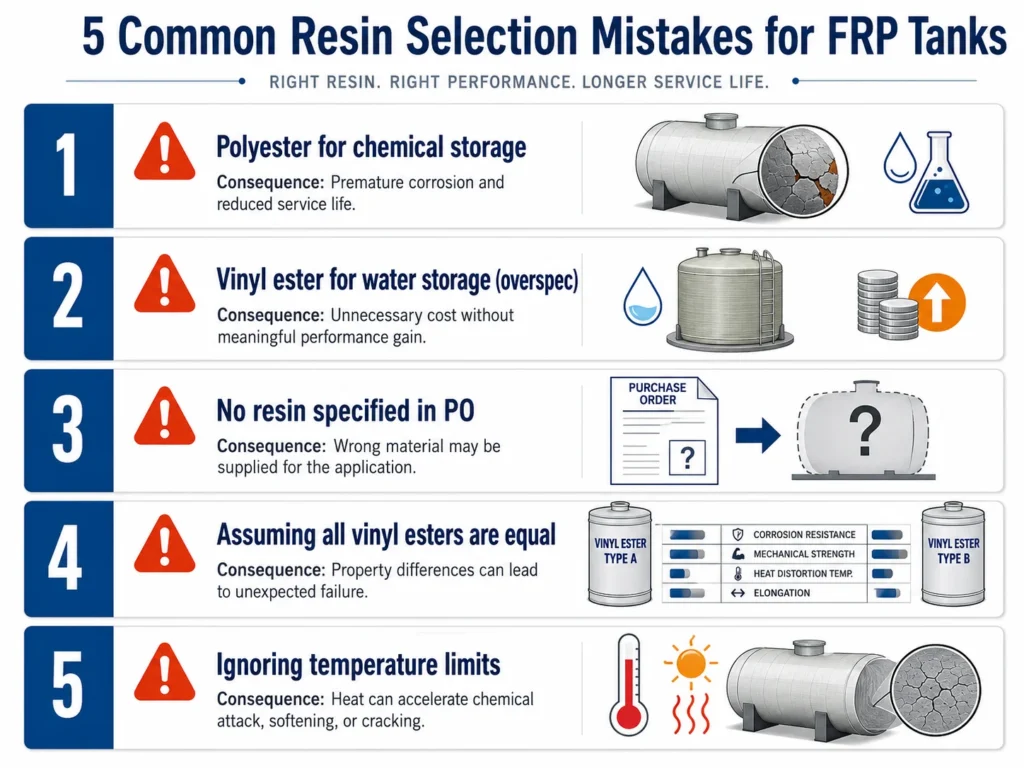
Mistake 1: Using polyester for chemical storage because it is cheaper
Polyester resin cannot resist strong acids, alkalis, or oxidizers. A polyester tank storing sodium hypochlorite will show blistering, softening, and delamination within weeks to months. The entire tank must be replaced. The cost of replacement far exceeds the price difference between polyester and vinyl ester.
Mistake 2: Specifying vinyl ester for potable water storage
Vinyl ester offers no practical advantage over isophthalic polyester for clean water storage. The additional cost is wasted. Isophthalic polyester with FDA compliance is the correct and cost-effective choice for potable water.
Mistake 3: Not specifying the resin type in the purchase order
Many procurement teams issue purchase orders for “FRP tank” without specifying the resin type. The manufacturer may use the cheapest resin available, which may not be appropriate for the application. Always specify the resin type — by name and grade — in the purchase order and technical specification.
Mistake 4: Assuming all vinyl esters are the same
Vinyl ester resins come in different grades optimized for different chemical environments. A standard bisphenol-A vinyl ester may not be suitable for high-concentration oxidizing chemicals, which may require a novolac vinyl ester. The resin must be matched to the specific chemical, concentration, and temperature using the resin manufacturer’s corrosion resistance guide.
Mistake 5: Ignoring temperature in resin selection
Every resin has a heat distortion temperature (HDT). If the operating temperature exceeds the HDT, the resin softens and loses structural integrity. In Saudi Arabia, where ambient temperatures reach 50°C and stored liquids may be warmer, the resin’s HDT must exceed the maximum expected operating temperature with an adequate safety margin.
Resin and the Corrosion Barrier
In chemical storage tanks, the inner surface in contact with the stored chemical is protected by a corrosion barrier — a resin-rich inner layer typically 2–3 mm thick, reinforced with surface veil and chopped strand mat.
The corrosion barrier is the most critical part of a chemical FRP tank. It is the first line of defense against chemical attack. The resin used in the corrosion barrier determines the tank’s chemical resistance.
In many chemical tanks, a dual resin approach is used:
- Corrosion barrier — vinyl ester resin (for chemical resistance)
- Structural laminate — isophthalic polyester resin (for cost-effective structural strength)
This approach provides the chemical resistance where it is needed (the inner surface) while keeping the overall cost lower than a full vinyl ester construction. However, the corrosion barrier must be continuous, properly cured, and of sufficient thickness to protect the structural laminate behind it.
For highly aggressive chemicals or applications where the consequence of failure is severe, full vinyl ester construction (corrosion barrier + structural laminate) is recommended.
How Pioneers Fiberglass Selects Resin
At Pioneers Fiberglass, resin selection is an engineering decision, not a cost decision. For every tank project, the resin is selected based on:
- The specific chemical(s) to be stored and their concentrations
- The operating temperature range
- The resin manufacturer’s corrosion resistance data
- Applicable standards and client specifications
- The required design life
For potable water tanks, we use FDA-compliant isophthalic polyester resin with UV-stabilized gelcoat. For chemical tanks, we use vinyl ester resin — matched to the specific chemical environment using verified corrosion resistance data. For every tank, the resin type, grade, and brand are documented in the manufacturing record.
FAQs
Which resin is best for FRP water tanks?
Isophthalic polyester resin is the best choice for potable and clean water storage tanks. It provides good water resistance, meets FDA food-contact requirements, and is cost-effective for non-aggressive environments. Vinyl ester and epoxy are not necessary for clean water storage and would increase cost without practical benefit.
Can polyester resin be used for chemical tanks?
Polyester resin has limited chemical resistance and should not be used for tanks storing strong acids, alkalis, oxidizers, or solvents. For chemical storage, vinyl ester resin is the correct choice. Using polyester in a chemical application will result in premature tank failure — often within weeks or months.
What is the cost difference between polyester and vinyl ester resin?
Vinyl ester resin typically costs 2–3 times more than polyester resin per kilogram. However, the cost difference must be evaluated against the application. For chemical storage, the additional cost of vinyl ester is not optional — it is the cost of a tank that performs. The total lifecycle cost of a vinyl ester tank in a chemical application is far lower than replacing a failed polyester tank.
When is epoxy resin needed for FRP tanks?
Epoxy resin is needed when maximum mechanical performance, very high temperature resistance (above 150°C), or styrene-free manufacturing is required. For standard FRP tanks — water, diesel, and most chemicals — epoxy is not necessary. Vinyl ester provides sufficient chemical resistance for virtually all standard chemical tank applications at a lower cost.
How do I know which resin to specify for my application?
Start with the stored chemical, its concentration, and the operating temperature. Use the resin manufacturer’s corrosion resistance guide to verify compatibility. For water and diesel, isophthalic polyester is standard. For acids, alkalis, oxidizers, and H₂S environments, vinyl ester is required. If uncertain, consult the tank manufacturer’s engineering team — resin selection is their core expertise.
What happens if the wrong resin is used?
The tank’s inner surface will be attacked by the stored chemical. Symptoms include blistering, softening, delamination, discoloration, fiber exposure, and eventually leakage or structural failure. Resin failure can happen within days (strong oxidizers on polyester) or over months (mild chemicals on marginal resin). The tank must be replaced — there is no repair that restores chemical resistance once the corrosion barrier has failed.
What is a corrosion barrier in an FRP tank?
A corrosion barrier is the resin-rich inner layer of a chemical FRP tank, typically 2–3 mm thick, reinforced with surface veil and chopped strand mat. It is the first line of defense against chemical attack. The resin used in the corrosion barrier must be compatible with the stored chemical. In many tanks, vinyl ester is used for the corrosion barrier while polyester is used for the structural laminate behind it.
Does temperature affect resin selection in Saudi Arabia?
Yes. Every resin has a heat distortion temperature (HDT) — the temperature at which it begins to soften and lose structural integrity. In Saudi Arabia, ambient temperatures routinely exceed 45°C, and stored liquids may be even warmer. The resin’s HDT must exceed the maximum expected operating temperature with a safety margin. Selecting a resin with an HDT close to the operating temperature risks softening and failure.
Should the resin type be specified in the purchase order?
Absolutely. Never order an “FRP tank” without specifying the resin type, grade, and (ideally) brand. Without this specification, the manufacturer may use the cheapest available resin, which may not be appropriate for the application. The resin specification should be part of the technical specification attached to the purchase order.
What is a novolac vinyl ester and when is it needed?
Novolac vinyl ester is a premium grade of vinyl ester with higher crosslink density, providing superior chemical and temperature resistance compared to standard bisphenol-A vinyl ester. It is used for the most aggressive chemical environments — high-concentration oxidizers, mixed acid/solvent services, and elevated temperature applications. It costs more than standard vinyl ester but is required when standard grades are insufficient for the chemical service.
Key Takeaways
Three resin families are used in FRP tank manufacturing: polyester, vinyl ester, and epoxy. They are not interchangeable — each has a specific chemical resistance profile and application range.
Polyester (isophthalic grade) is the correct choice for potable water, clean water, and diesel storage. It is cost-effective and provides adequate resistance for non-aggressive environments.
Vinyl ester is the correct choice for chemical storage, H₂S environments, desalination plant applications, and any aggressive chemical service. It provides superior chemical resistance, higher elongation, and longer service life in corrosive conditions.
Epoxy is reserved for high-performance applications requiring maximum mechanical properties, very high temperature resistance, or styrene-free construction. It is rarely needed for standard FRP tanks.
Resin selection is an engineering decision based on stored chemical, concentration, temperature, and service life. Specifying the wrong resin leads to premature failure — often the most expensive mistake in FRP procurement.
Always specify resin type, grade, and brand in the purchase order. Never order an “FRP tank” without a resin specification.
Conclusion
The resin inside your FRP tank is what stands between your stored contents and the glass fiber structure. The right resin means 25+ years of reliable service. The wrong resin means premature failure and replacement cost that far exceeds the initial price difference.
Pioneers Fiberglass selects resin based on engineering analysis, not cost minimization. We match the resin type to your specific chemical environment, operating temperature, and service life requirements — and we document the resin specification in every manufacturing record.
To get an accurate resin recommendation for your project, please share:
- Chemical(s) to be stored and concentration(s)
- Operating temperature range
- Tank capacity and dimensions
- Installation location (indoor, outdoor, underground)
- Required design life
- Any applicable standards or client specifications
Contact Pioneers Fiberglass for a resin selection consultation →