

Introduction
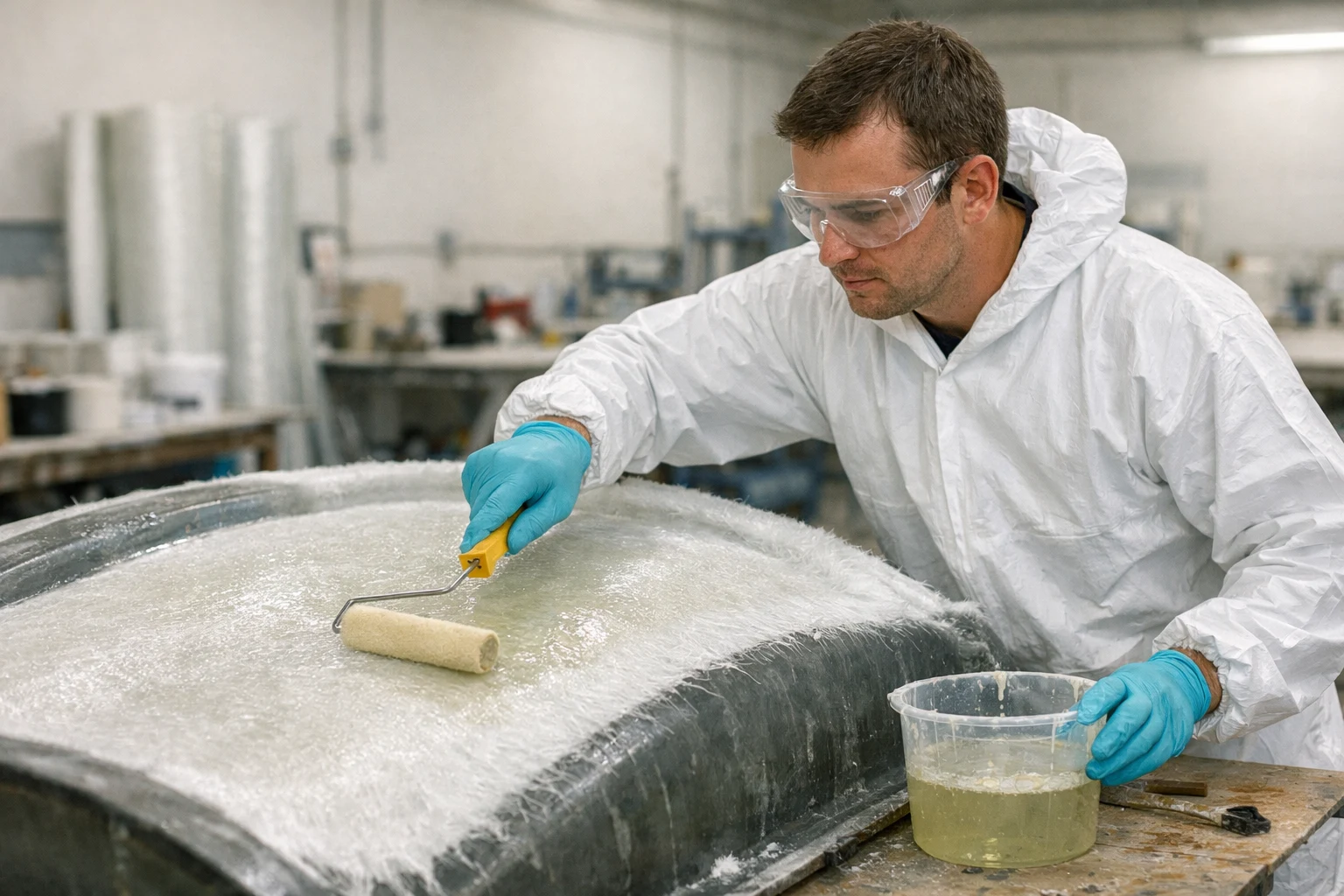
How FRP tanks are manufactured affects tank strength, corrosion resistance, service life, and installation performance. For buyers in Saudi Arabia and the GCC, understanding hand lay-up and filament winding helps in choosing the right FRP/GRP tank for each application.
Quick Answer
- Both methods can produce strong tanks when the design, resin selection, and FRP tank quality control are done correctly (strength always varies by design and manufacturer).
- Hand lay-up FRP tank production is very flexible for custom shapes, rectangular tanks, and integrating special nozzles, manholes, and covers.
- A filament winding FRP tank offers high consistency for cylindrical shells, especially where hoop strength and repeatable thickness are important.
- In both methods, the corrosion barrier FRP liner on the inside is critical for chemical resistance and long service in KSA/GCC conditions.
- Overall quality depends on resin type, curing control, FRP tank laminate thickness control, and inspection at each stage.
- You should choose based on tank shape, operating pressure (or vacuum), chemical duty, temperature, and project specifications.
- Always ask for QA/QC documents and traceability: resin batch records, laminate schedule, inspection reports, and test results.
- For a correct quotation, share duty (fluid, temperature, pressure), dimensions, location, installation constraints, and any standard or specification to be followed.
What Is an FRP/GRP Tank Made Of?
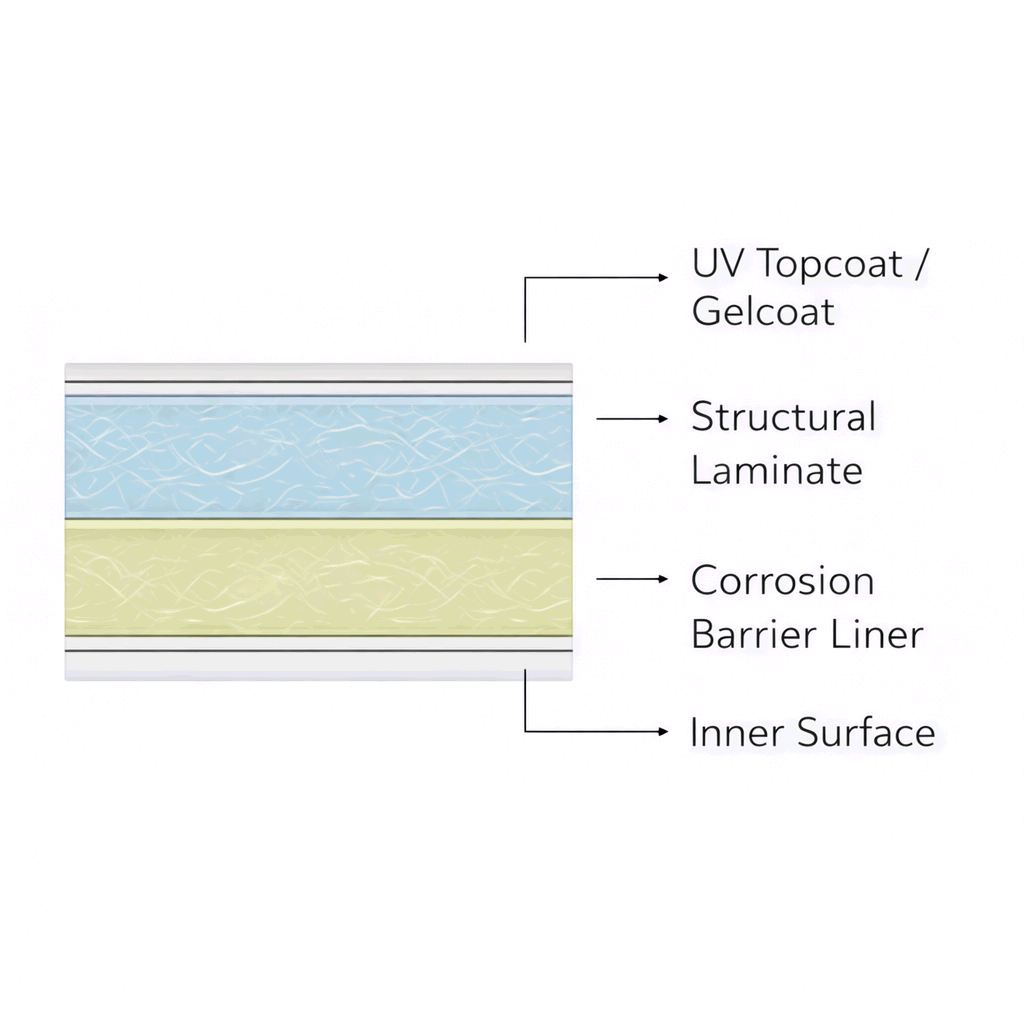
An FRP (fiberglass reinforced plastic) or GRP tank is a composite: glass fibers provide strength, and a resin matrix holds everything together and protects the fibers. Layers of fiberglass and resin are built up to form a laminate, which behaves like a single thick wall. Inside the tank there is usually a corrosion barrier (also called a liner), which is a resin-rich inner layer designed to resist the stored liquid. Outside this barrier, structural layers carry the main loads from liquid, wind, and sometimes pressure or vacuum. For outdoor tanks in KSA/GCC, a gelcoat or UV-resistant topcoat is normally applied on the outside to help resist sun and weather.
Mini glossary (simple)
- Resin: Liquid polymer (for example polyester, vinyl ester, or epoxy) that hardens during curing and binds the glass fibers.
- Roving: Bundles of continuous glass filaments, usually used in filament winding FRP tank production.
- Mat: Fiberglass in sheet form (chopped strand mat or woven fabric) used in hand lay-up layers.
- Laminate: The final layered composite wall made from fibers and resin together.
- Corrosion barrier: Inner resin-rich layer designed to protect the structural laminate from chemicals.
- Curing: The chemical reaction where the resin hardens, usually using catalyst and sometimes heat.
Hand Lay-Up Manufacturing
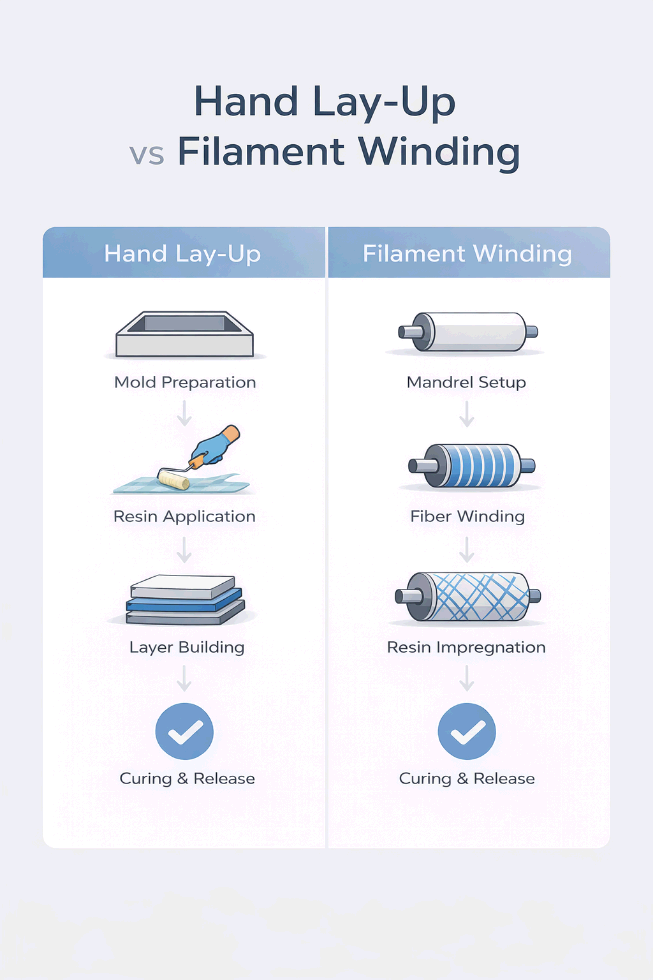
Hand lay-up is a straightforward and flexible FRP tank manufacturing method. It is widely used for GRP tank fabrication where custom shapes or many fittings are required. The steps, simplified:
- Mold preparation
A mold is prepared in the desired tank shape (for example cylindrical, rectangular, or special). The surface is cleaned and coated with release agent so the finished tank can come off cleanly later.yongchangfrp+1 - Apply gelcoat/liner
A gelcoat is sprayed or brushed onto the mold surface to create a smooth outer surface for the tank, often with UV-resistant pigments for outdoor use. On the inner side (future product side), a corrosion barrier FRP layer is built using a resin-rich mix and fine glass materials.jiubofrp+1 - Place fiberglass layers by hand (mat/cloth)
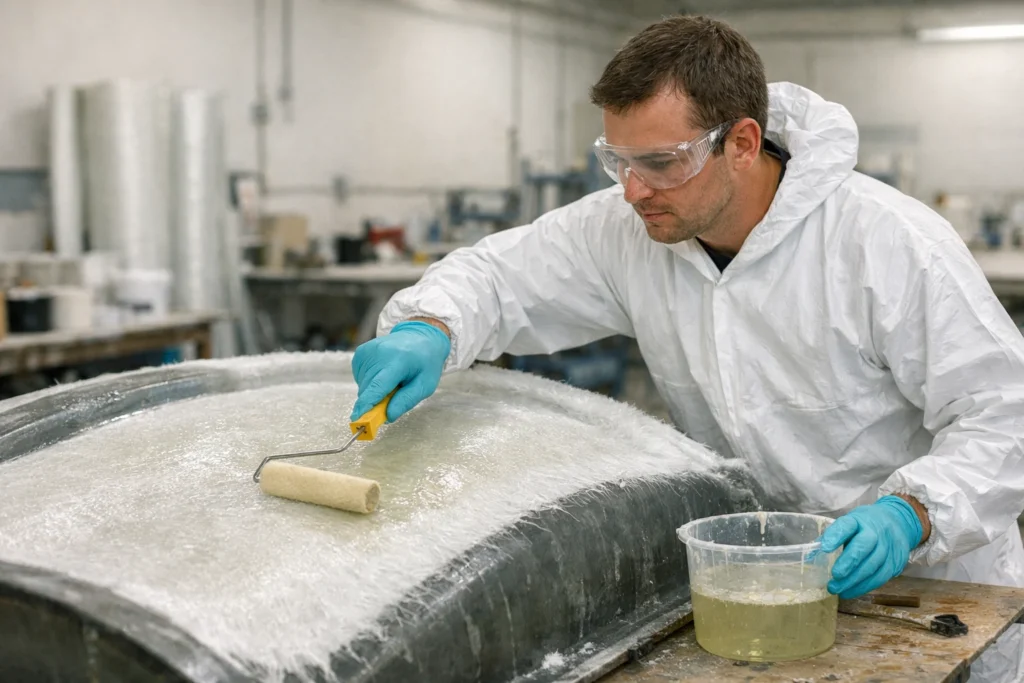
Fiberglass mats or fabrics are cut to size and placed onto the mold by hand. The type and sequence of these layers form the “laminate schedule,” which defines strength and stiffness (this varies by design and manufacturer). - Wet-out with resin and remove air bubbles
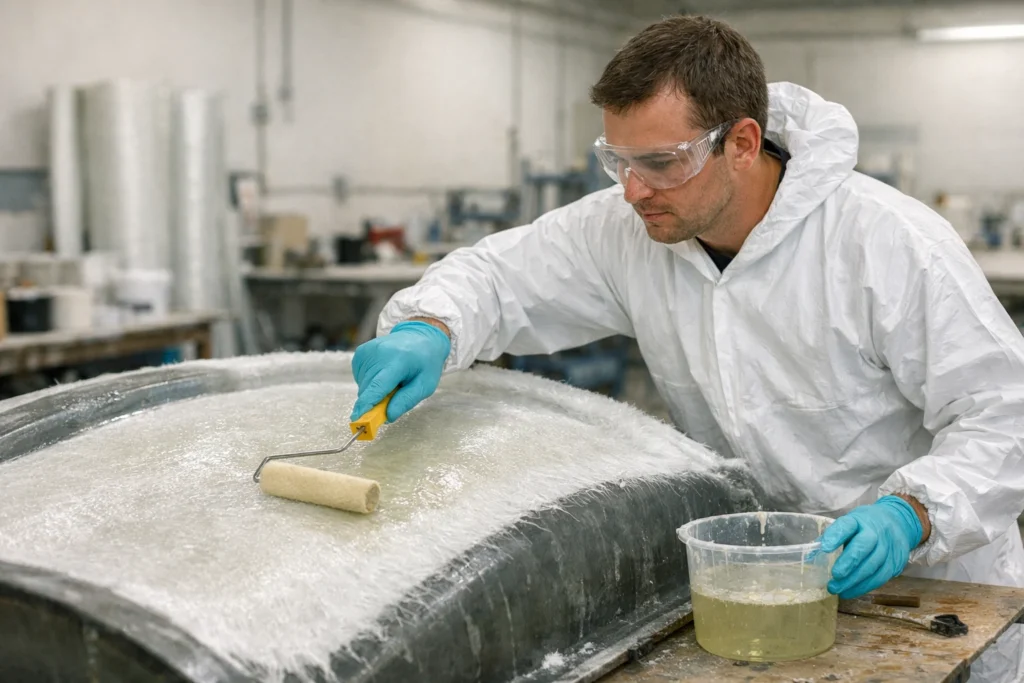
Resin is applied by brush or roller to fully wet-out the fibers. Air bubbles are removed using rollers to avoid weak spots or voids. - Build thickness layer by layer
Additional layers of mat or fabric and resin are added until the specified wall thickness and laminate design are reached. - Cure and demold
The laminate is left to cure (harden) at controlled temperature and time. After curing, the tank is carefully removed from the mold.yongchangfrp+1 - Trim, drill, add nozzles/manholes
Edges are trimmed, holes are cut for nozzles or manholes, and fittings are laminated or bonded in place. - Inspection
Visual inspection, dimensional checks, and, when required, hardness/curing verification and leak testing are done as part of FRP tank quality control.
Best uses: hand lay-up FRP tank manufacturing is strong for custom shapes, rectangular tanks, covers, manholes, and tanks with many integrated fittings or complex details.
Filament Winding Manufacturing
Filament winding is a more automated FRP tank manufacturing method mainly used for cylindrical tanks and pipes. It gives very consistent wall thickness and fiber alignment.
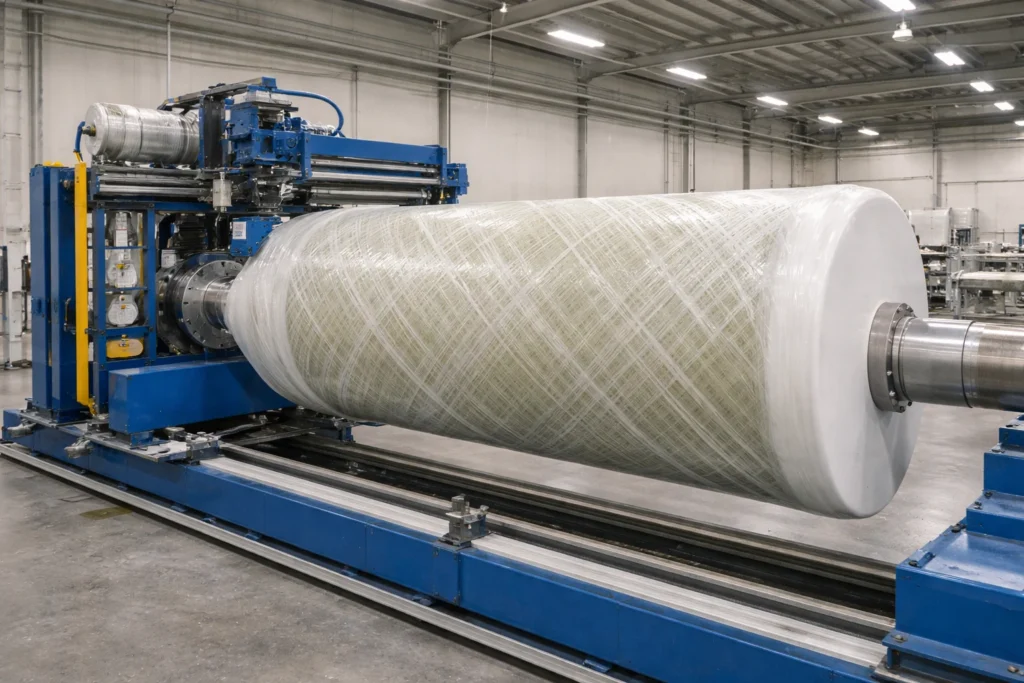
- Mandrel setup (rotating form)
A mandrel (rigid form) is set up to the required diameter and length. It rotates like a large roller. - Resin bath or resin delivery
Continuous glass roving passes through a resin bath or a controlled resin delivery system so the fibers are impregnated with resin. - Continuous fibers wound at controlled angles
The fibers are wound onto the rotating mandrel in programmed patterns, at certain angles (for example near hoop or helical), to build strength in specific directions. The exact angles and patterns depend on the design and vary by manufacturer.iopscience.iop+3 - Build structural thickness precisely
The machine repeats the winding until the designed laminate thickness and fiber pattern are reached, giving high repeatability of shell thickness. - Cure
The wound tank shell is cured, sometimes at ambient temperature, sometimes with heat, to ensure the resin fully hardens. - Remove mandrel
After curing, the mandrel is removed (or collapsed) and the hollow cylindrical shell remains. - Add ends, nozzles, accessories
Flat or domed ends, nozzles, manways, and other accessories are added, often using hand lay-up around these areas. - Inspection
Visual inspection, dimensional measurement, hardness/curing verification methods, and, when specified, pressure or leak tests are carried out.
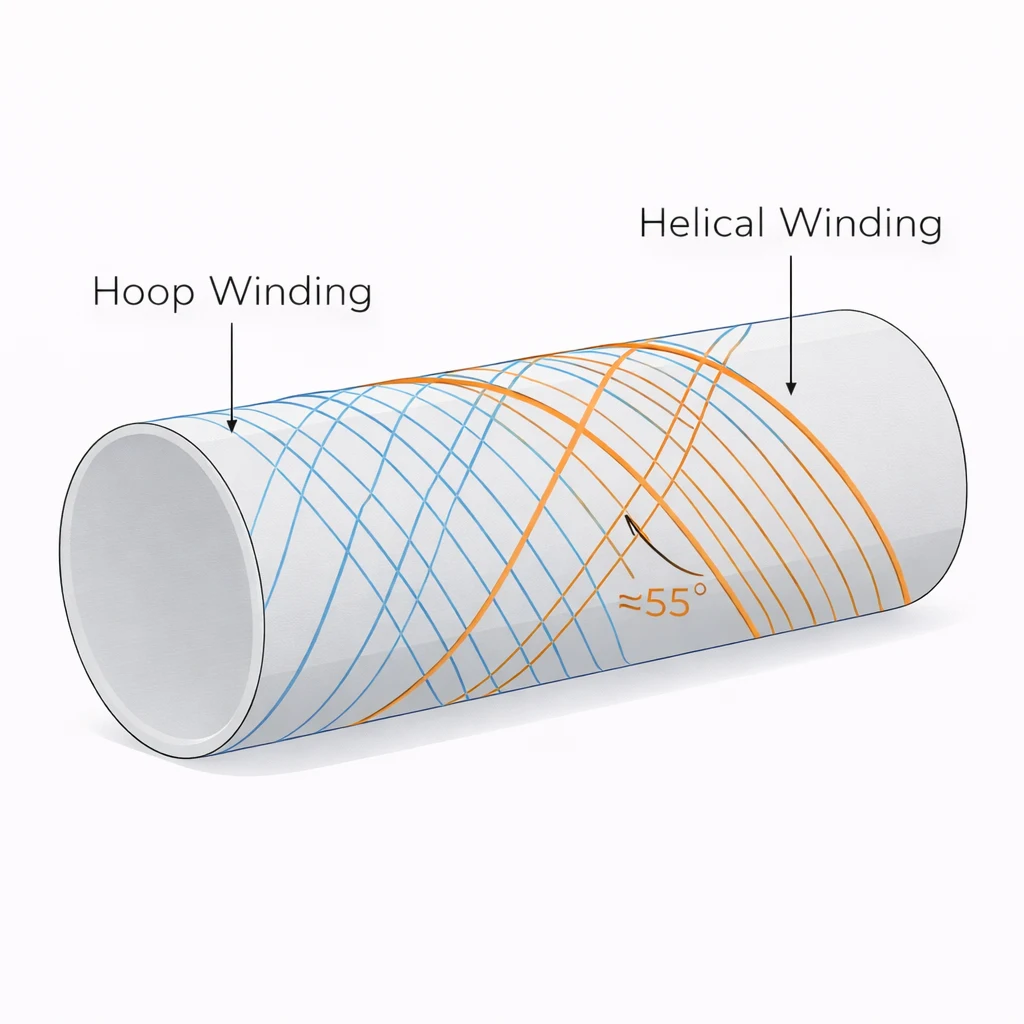
Best uses: filament winding FRP tank manufacturing is ideal for cylindrical tanks, vertical or horizontal, for consistent shells, pipes, and pressure-rated designs.
Head-to-Head Comparison (What Buyers Should Care About)
(Full table is provided in the Tables section.)
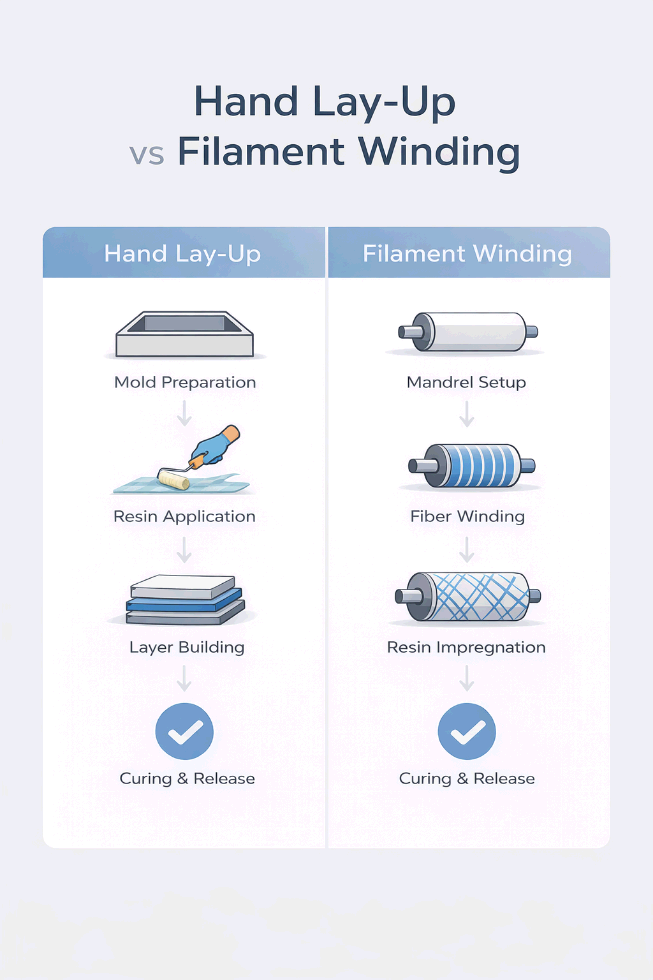
In simple terms, hand lay-up gives maximum flexibility in shape and details, while filament winding gives excellent repeatability for cylindrical shells. For KSA/GCC buyers, key issues are: how consistent is the thickness, how well is the corrosion barrier FRP layer controlled, and how good is the documentation of resin batches and curing. Both hand lay-up FRP tank and filament winding FRP tank methods can work well when the laminate schedule, resin, and QA/QC are appropriate for the chemical duty and temperature, and when installation conditions (transport, lifting, site space) are understood.
Quality Control: What to Ask For (Simple Checklist)
For FRP tank manufacturing, most problems come from missing or weak quality control, not from the method itself. A simple buyer checklist:
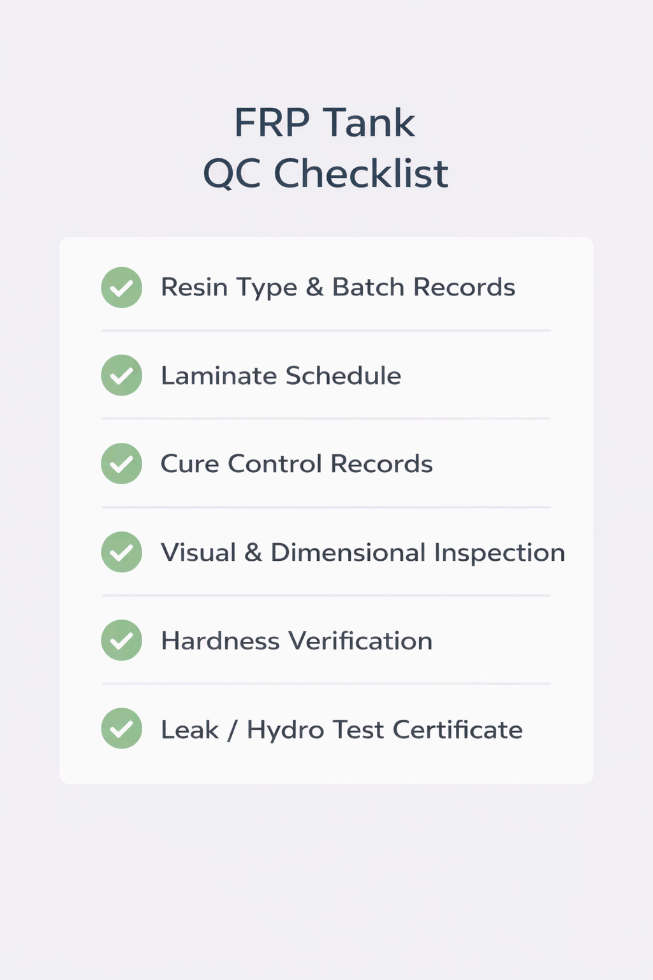
- Resin type and batch traceability
Ask for the exact resin type (e.g. polyester, vinyl ester) and batch records so you know the material used matches the design and chemical resistance table. - Laminate schedule / thickness spec
Request a laminate schedule showing the sequence of layers and the nominal thicknesses. Confirm that these are suitable for your duty and that they “vary by design and manufacturer.” - Cure control and records
Ask how curing is controlled (time, temperature, catalyst ratio) and if records are kept to show that the resin reached the intended cure level. - Visual inspection + dimensional checks
Ensure there is a formal inspection for surface defects, dry areas, cracks, and that tank dimensions and tolerances are measured and recorded. - Hardness/curing verification methods
Many manufacturers use surface hardness tests (such as Barcol hardness) as a practical check that curing has reached an acceptable level; practices and acceptance criteria vary by standard and manufacturer, so confirm details with the datasheet and QA procedures.mdpi+1 - Leak testing / hydrotest where applicable
For water and many liquid tanks, hydrostatic or leak testing may be performed according to the project specification; always confirm the requirement in the spec or standard you follow. - Documentation: drawings, ITP, NCR handling, warranty terms
Ask for drawings, an Inspection & Test Plan (ITP), procedures for handling non-conformances (NCRs), and clear warranty terms linked to the specified duty.
Common Myths (And the Truth)
- “Filament winding is always better.”
Truth: Filament winding is excellent for cylindrical shells and consistent thickness, but hand lay-up can be better for custom shapes, rectangular tanks, and complex fittings. The “better” method depends on your design and duty. - “Hand lay-up is weak.”
Truth: A hand lay-up FRP tank can be very strong if the laminate is properly designed and controlled. Weakness usually comes from poor design or poor QC, not from the process itself. - “Thickness alone equals strength.”
Truth: Strength depends on fiber type, orientation, resin, and laminate design, not only on thickness. A thinner, well-engineered filament winding FRP tank may outperform a thicker but poorly designed laminate. - “Any resin works for any chemical.”
Truth: Resin must match the stored chemical, temperature, and concentration. Always confirm chemical resistance with the manufacturer’s datasheet and standards, as it varies by design and manufacturer. - “Outdoor tanks don’t need UV protection.”
Truth: Sun and heat in KSA/GCC are harsh. Tanks should have appropriate gelcoat or UV-resistant topcoat to help protect the laminate over time. - “FRP is maintenance-free.”
Truth: FRP tanks need inspection for coatings, supports, fittings, and any mechanical damage. They generally need less maintenance than steel, but not zero.
Which One Should You Choose?
Villa water tanks (space, transport)
For villa or small building water storage, tanks must be easy to transport, pass through gates, and fit tight spaces. Hand lay-up GRP tank fabrication allows custom shapes and dimensions, including rectangular or slim designs. Filament wound cylindrical tanks can still work where access and space permit.
Industrial water/chemical storage
For industrial duty, the key is chemical resistance and structural design. Both hand lay-up FRP tank and filament winding FRP tank options can be used for chemicals if the corrosion barrier FRP liner and laminate are engineered for the specific fluid and temperature and if standards are followed (always “varies by design and manufacturer”). Confirm with the supplier’s chemical resistance tables and design calculations.
Pressure/transfer duty
For pressure or vacuum duty (for example pressure-rated vessels or certain transfer tanks), filament winding is often preferred for the shell because it can control fiber angles and thickness for hoop and axial strength. Hand lay-up is still used for ends, nozzles, and special features, and final performance must be confirmed by design to applicable pressure vessel or tank standards.
Large diameter tanks and pipelines
For large cylindrical tanks and GRP pipelines, filament winding FRP tank manufacturing provides efficient production and repeatable strength along the length. Hand lay-up is still useful for local features like sumps, manways, and special connections.
Custom shapes and covers
Where you need non-cylindrical shapes, complex covers, baffled tanks, or integrated structural features, hand lay-up GRP tank fabrication gives maximum freedom. Filament winding is less flexible for non-cylindrical geometry.
Always end with this thought: whichever you choose, confirm with design duty (fluid, pressure, temperature) and project specifications.
Common Mistakes to Avoid
- Choosing the manufacturing method without considering duty (pressure, chemical, and temperature).
- No laminate schedule documentation and no clear wall thickness or fiber content defined.
- Ignoring the corrosion barrier/liner and focusing only on structural layers.
- No cure verification or records, so you cannot confirm that the resin achieved proper hardness.
- Poor finishing at nozzles and manholes, leading to stress concentrations and leaks.
- Weak saddles, supports, or base foundations that do not match the tank’s weight and operating conditions.
- No UV topcoat or gelcoat protection for outdoor tanks in KSA/GCC.
- No QA/QC handover pack (drawings, inspection reports, test certificates) at delivery.
- Overpromising “lifetime” performance with no reference specification, design standard, or duty definition.
- Not planning transport and handling, especially for large diameter tanks on tight roads or remote sites.
FAQs
What is filament winding in FRP tanks?
Filament winding is an FRP tank manufacturing method where continuous glass fibers (rovings) are passed through resin and wound around a rotating mandrel in controlled patterns to build the tank wall. The process creates a cylindrical shell with precise thickness and fiber orientation, which is then cured, removed from the mandrel, and fitted with ends and nozzles.mdpi+3
What is hand lay-up in fiberglass tanks?
Hand lay-up is a process where technicians place fiberglass mats or fabrics by hand onto a mold, wet them with resin, remove air, and build the laminate layer by layer. After curing, the tank is demolded, trimmed, and fitted with nozzles and manways.jiubofrp+1
Which is stronger: hand lay-up or filament winding?
Neither method is automatically stronger; strength depends on laminate design, fiber orientation, resin, and quality control. Filament winding usually gives better control of strength direction in cylindrical shells, while hand lay-up can be designed to be very strong where loads and details are more complex.
Which is better for water tanks?
For water tanks, both hand lay-up FRP tank and filament winding FRP tank options can perform well. Choice depends on shape (cylindrical vs rectangular), site access, required volume, standards, and budget. For many cylindrical water tanks, filament winding is efficient; for space-limited or custom shapes, hand lay-up is often preferred.
Can both methods be used for chemical tanks?
Yes, both methods can be used for chemical tanks if the corrosion barrier FRP liner and structural laminate are designed for the specific chemical, temperature, and any pressure. Chemical resistance and thickness requirements always vary by design and manufacturer, so they should be confirmed using the supplier’s datasheets and standards.
How can I check FRP tank quality?
Ask for resin and reinforcement traceability, laminate schedule, curing records, dimensional reports, and any hardness or curing verification results, plus leak or hydro tests if specified. Visually check for cracks, dry areas, poor finish at nozzles, and verify supports and lifting points are suitable for your handling and installation plan.
Does manufacturing method affect lifespan?
The method influences how easy it is to control thickness and fiber orientation, which can affect performance. However, lifespan mostly depends on whether the tank is correctly designed for the duty, the corrosion barrier is suitable, and QA/QC is properly applied, not just whether it is hand lay-up or filament wound.
What information do you need for a quote?
For an accurate FRP tank manufacturing quotation, suppliers typically need: fluid type, concentration, temperature, operating pressure/vacuum, tank dimensions and orientation, installation location (indoor/outdoor, KSA region), required standards or specifications, nozzle details, and any special transport or lifting constraints.
Conclusion
Hand lay-up and filament winding are two reliable FRP tank manufacturing methods, each with strengths for different shapes and duties. What matters most for KSA and GCC projects is a suitable design for the fluid and temperature, a well-built corrosion barrier, and clear QA/QC documentation so you know what you are getting.
If you are planning a new FRP or GRP tank, you can Request a Quote or Talk to our engineers and share your duty, dimensions, and installation location. Together, you can confirm the suitable method and specification for your project.
Tables (all tables together)
Head-to-head comparison: hand lay-up vs filament winding (buyer view)
| Feature | Hand lay-up | Filament winding | What it means for KSA buyers |
|---|---|---|---|
| Shape flexibility | Very high; works for rectangular and complex shapes. | Mainly cylindrical; less flexible for complex shapes. | Choose hand lay-up for custom layouts, limited spaces, and special covers. |
| Thickness consistency | Depends on operator skill and QC. | Generally very consistent along cylindrical shells. | For critical shells, filament winding can give more uniform thickness. |
| Strength direction control | Moderate; can orient fabrics but less precise. | High; fiber angles are programmed. | For pressure/vacuum or high hoop stress, winding gives controlled strength. |
| Surface finish options | Easy to adjust gelcoat and finish zones. | Mainly smooth cylindrical shells; details added later. | For visible or complex surfaces, hand lay-up can tailor finish more easily. |
| Lead time for custom designs | Good for one-offs and small batches. | Best for repeat designs; more setup for new sizes. | Use filament winding for repeat standard tanks; hand lay-up for prototypes. |
| Repairability | Repairs can be done on site with hand lay-up. | Repairs also possible, usually with hand lay-up. | Both can be repaired; access and workmanship are more important than method. |
| Typical best-fit applications | Rectangular tanks, covers, manholes, special tanks. | Cylindrical tanks, vertical/horizontal, pipes, pressure shells. | Match method to geometry and duty for efficient GRP tank fabrication. |
| Cost drivers (qualitative) | Labor time and complexity of shape and fittings. | Machine time, fiber usage, and mandrel setup. | Discuss total cost including tooling, volume, and lifetime, not only unit price. |
| QA/QC focus points | Layer sequence, thickness, air removal, curing. | Fiber angle, winding pattern, resin content, curing. | In both, ask for FRP tank quality control documents and traceability. |