
Introduction
This GRP vs HDPE vs concrete manhole comparison is written for Saudi Arabia conditions—heat, saline groundwater, sulfate soils, and H₂S. Manhole material choice in Saudi Arabia and the wider GCC directly affects leakage risk, corrosion, and long-term maintenance budgets, especially with aggressive soils, high groundwater, and H₂S in sewers. In coastal and industrial areas, sulfate and chloride attack, salinity, and biogenic sulfuric acid can rapidly damage unprotected concrete structures. At the same time, municipalities and EPCs are under pressure to accelerate sewer manhole installation and reduce road closures. This article provides a practical manhole material comparison Saudi Arabia decision-makers can use, focusing on GRP, HDPE, and concrete manholes from a lifecycle and installation perspective. You will see where each material fits best, how local conditions change service life, and what information is needed for a robust specification and quote.
Quick Answer
- Concrete is common and structurally strong but can suffer sulfate, chloride, and H₂S chemical attack and joint leaks in aggressive sewer and groundwater conditions (service life highly site-dependent).
- An HDPE manhole is lightweight and highly corrosion resistant but requires correct stiffness selection and backfill design to avoid long-term deformation and joint stresses.
- A GRP manhole Saudi Arabia solution offers corrosion resistance with high stiffness and relatively fast installation, but performance depends on resin system, design, and construction quality.
- Total cost in a manhole material comparison Saudi Arabia must include transport, lifting equipment, installation time, and the probability of future rehabilitation or replacement.
- Good joint watertightness in any material reduces infiltration/exfiltration, protecting roads, foundations, and wastewater treatment performance.
- Heat, UV, and blowing sand mainly affect covers, frames, seals, and workmanship quality during sewer manhole installation in KSA/GCC.
- Coastal and high-groundwater sites usually require higher corrosion resistance and better external waterproofing or inherently corrosion resistant manhole materials.
- High-traffic roads and intersections need the correct cover and frame load class regardless of whether the shaft is concrete, HDPE, or GRP.
- For a proper specification and quote, engineers must define location, depth, soil and groundwater conditions, sewer type, connection details, traffic loading, and QA/QC expectations.
What’s Driving Failures in Saudi Manholes?
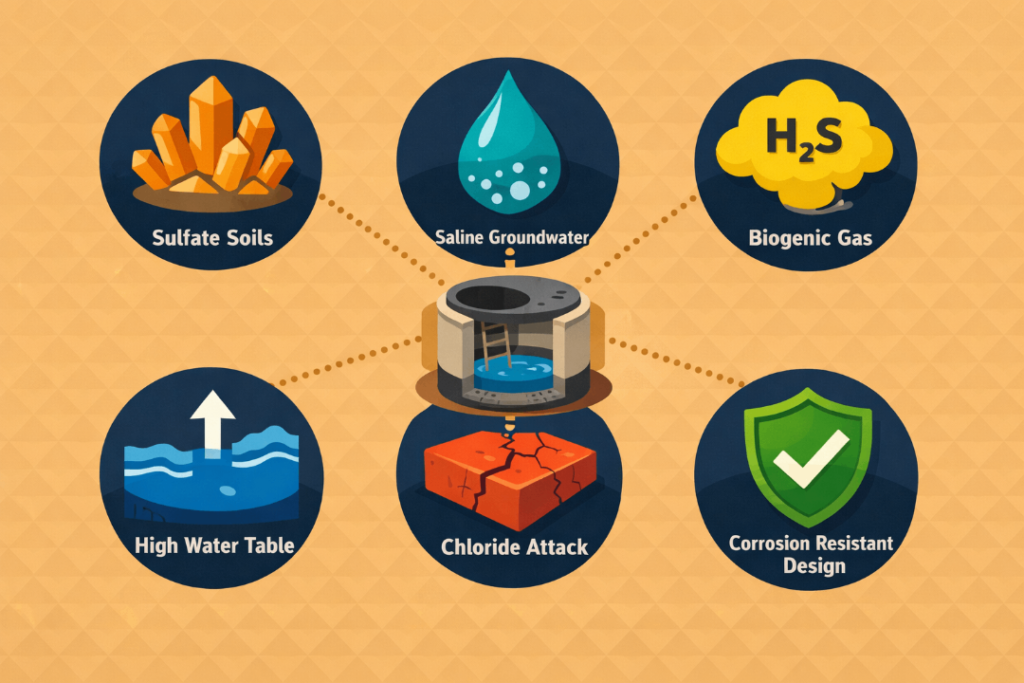
In Saudi Arabia and the GCC, many manhole problems link back to geotechnical and chemical exposure: sulfate- and chloride-rich soils, saline groundwater, and variable compaction quality. In sanitary sewers, microbiologically influenced corrosion converts H₂S gas into sulfuric acid on moist concrete surfaces, causing rapid loss of concrete cover and early structural deterioration. Infiltration through cracked joints or poor seals increases groundwater pumping at treatment plants, while exfiltration can contaminate surrounding soils and utilities. Settlement from weak bedding or poor backfill compaction leads to frame rocking, cracked connections, and leak paths. Heavy traffic and poor frame seating can accelerate deterioration at the cover-seat interface, regardless of shaft material.
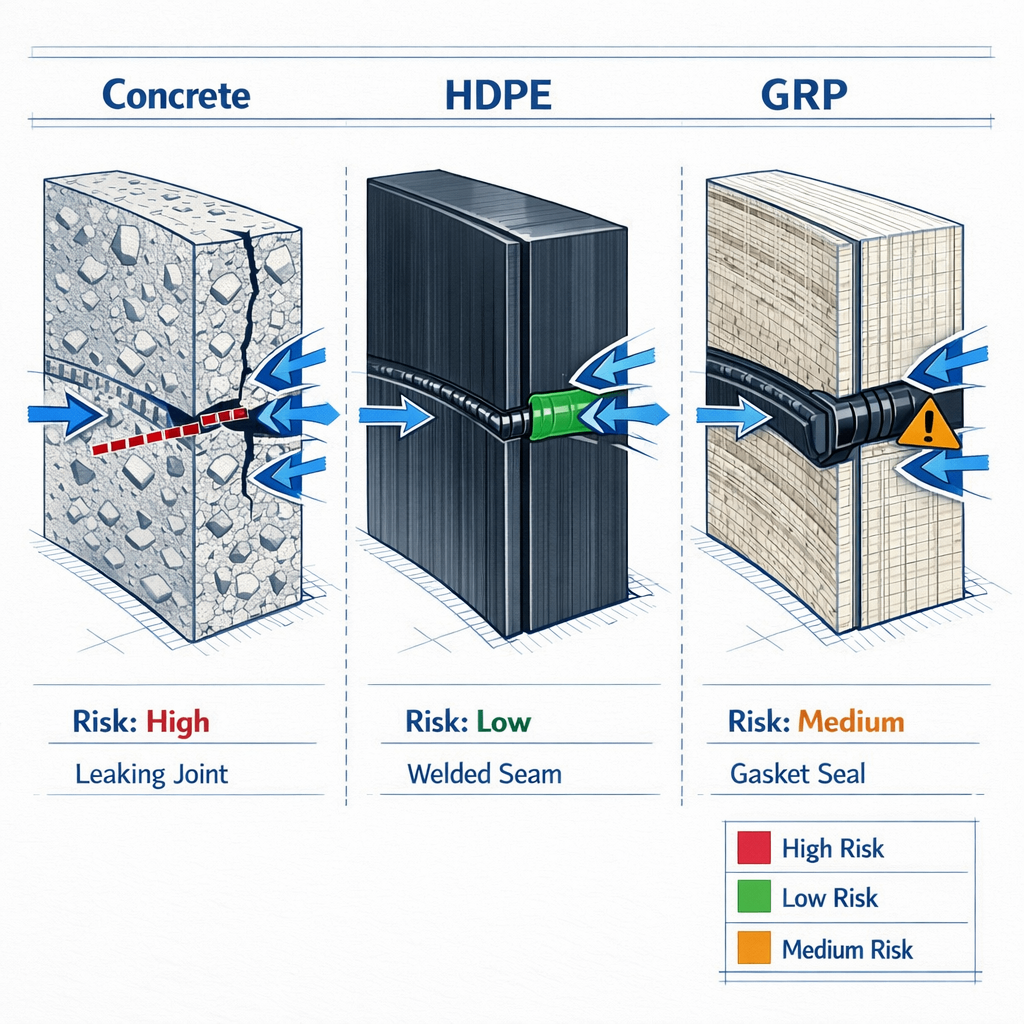
Mini table is provided in the Tables section.
Material Overview (GRP vs HDPE vs Concrete)
Concrete manholes (precast or cast-in-place)
Concrete manholes remain the default for many authorities because they are familiar, locally available, and provide high structural capacity when properly designed and detailed. However, without appropriate cement type, mix design, cover, waterproofing, or internal lining, concrete is vulnerable to sulfate soils, chloride ingress, and H₂S-related sulfuric acid attack in sanitary sewers. Standards and manufacturer data show that service life can vary widely depending on chemistry and protective measures, from relatively short in severe H₂S attack to long where exposure is mild and covers are correctly designed. Concrete manholes also rely on good construction joints, gaskets, and external waterproofing to limit leakage.
HDPE manholes (thermoplastic, welded joints)
HDPE manholes are fabricated from high-density polyethylene pipe or plates, with welded seams and thermoplastic connections that provide a monolithic, corrosion resistant shell. HDPE is resistant to biogenic sulfuric acid and many industrial effluents, making it attractive where concrete corrosion is a concern. Published data for HDPE components and rings suggest potential long service periods (often several decades) when correctly designed for stiffness and installed with proper backfill to control deformation and creep, though exact figures depend on load, temperature, and standards used. Because HDPE is flexible and lightweight, installation is faster but more sensitive to backfill type, compaction, and uniform support.
GRP manholes (composite with resin/glass, gasketed joints)
GRP (glass-reinforced plastic) manholes use a composite shell made from glass fibers and thermosetting resin, often filament-wound, with integrated bases, shafts, and benching options. Properly designed GRP products combine high ring stiffness with low weight and excellent corrosion resistance to many sewer gases and saline or sulfate environments, provided the resin system is suited to the exposure. Manufacturers in the region design GRP pipes and manhole components for long-term pressure or deformation performance (for example, testing at multiples of operating pressure over 50 years), highlighting the importance of qualified design for service life. GRP manholes typically use gasketed or laminated joints to achieve watertight performance, with installation guidance emphasizing careful handling and bedding to achieve the intended long life.
Cost Comparison (Upfront vs Lifecycle)
When doing a manhole material comparison Saudi Arabia teams should separate upfront capital cost from lifecycle cost and risk. Material procurement cost per manhole is only one part of the equation; transport, lifting, installation speed, and potential rehabilitation strongly influence the real “life cycle cost manhole” outcome. Concrete units may have lower local material cost but higher installation time and future lining or rehabilitation needs in aggressive sewers. HDPE and GRP can reduce corrosion-related repair but may have higher supply cost per unit and require more precise installation QA/QC.
Key cost buckets include:
- Material procurement (shell, base, cover, internal ladder, accessories).
- Transport/logistics (weight vs distance to remote sites, number of truckloads).
- Installation time and equipment (crane size, crew time, dewatering, traffic management).
- Jointing and QA/QC (gaskets, welds, vacuum testing, documentation).
- Rehabilitation/repair frequency risk (coatings, linings, replacement risk in corrosive soils or H₂S).
- Downtime and social cost (road closures, odor complaints, sinkholes, service disruptions).
The KSA/GCC context adds heat, sand, and often deep excavations with high groundwater, which can make faster installation and fewer returns to site particularly valuable.
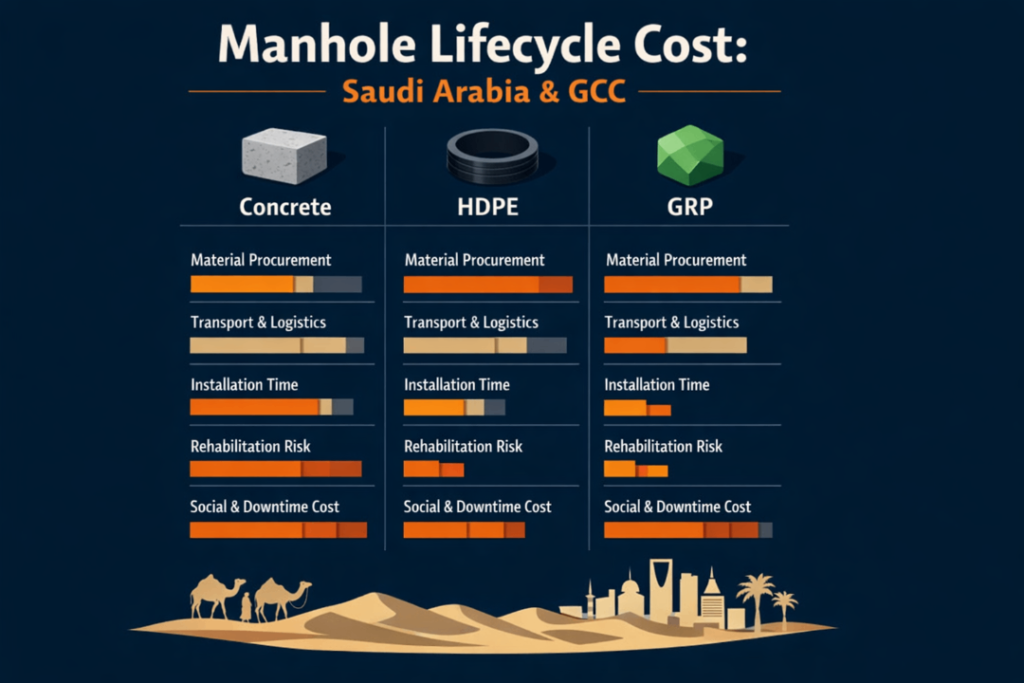
The comparative table appears in the Tables section.
Lifespan & Durability (What Really Changes Service Life)
Service life for any manhole material in Saudi Arabia varies widely with soil chemistry, groundwater, sewer contents, depth, and whether protective systems are specified. Published studies on concrete sewer structures show that under strong H₂S attack, loss of concrete cover can exceed several millimeters per year, leading to some manholes needing replacement in about a decade, while enhanced mixes or linings can extend life significantly where conditions are less aggressive. Conversely, concrete structures designed with adequate cover, suitable cement and aggregates, and compatible exposure conditions can achieve 50–100 years or more in non-aggressive service, according to pipe and precast manufacturers and standards, but this always “varies by site chemistry, depth, and project specs.
HDPE and GRP are inherently corrosion resistant to typical sewer environments and many saline or sulfate conditions, and manufacturers often design these systems for design lives on the order of several decades under appropriate load and temperature assumptions, again with “lifespan varying by site chemistry, depth, and project specs.” For thermoplastics, long-term durability is controlled by ring stiffness, creep, and temperature, while for GRP it is controlled by resin type, glass content, and strain limits. In all materials, joints, seals, installation quality, and bedding/backfill practices strongly influence real-world performance in KSA/GCC.advancedpiping.
The durability comparison table is provided in the Tables section.
Installation Comparison (Speed, Equipment, Risk)
Concrete manholes are heavy and usually require larger cranes, more time for lifting and alignment, and extended curing periods if cast in place, which can slow sewer manhole installation and backfilling. However, their mass provides inherent stability against flotation where groundwater is high, assuming proper design and anti-buoyancy measures. HDPE and GRP systems are lightweight manhole system options that reduce crane size, ease handling in tight sites, and may allow faster installation, particularly on remote or sandy sites in the GCC, but they are more sensitive to flotation and to backfill uniformity.
Jointing method also changes risk. Concrete relies on gasketed or mortared joints and external waterproofing to control infiltration and exfiltration. HDPE typically uses welded joints to create monolithic structures with very high watertight integrity if workmanship is good. GRP manholes use gasketed or laminated joints that can be factory-tested or field-tested for leakage, provided correct procedures are followed. Alignment errors, poor bedding, and inadequate compaction are recurring causes of settlement and leaks across all materials in Saudi Arabia’s mixed soil conditions.
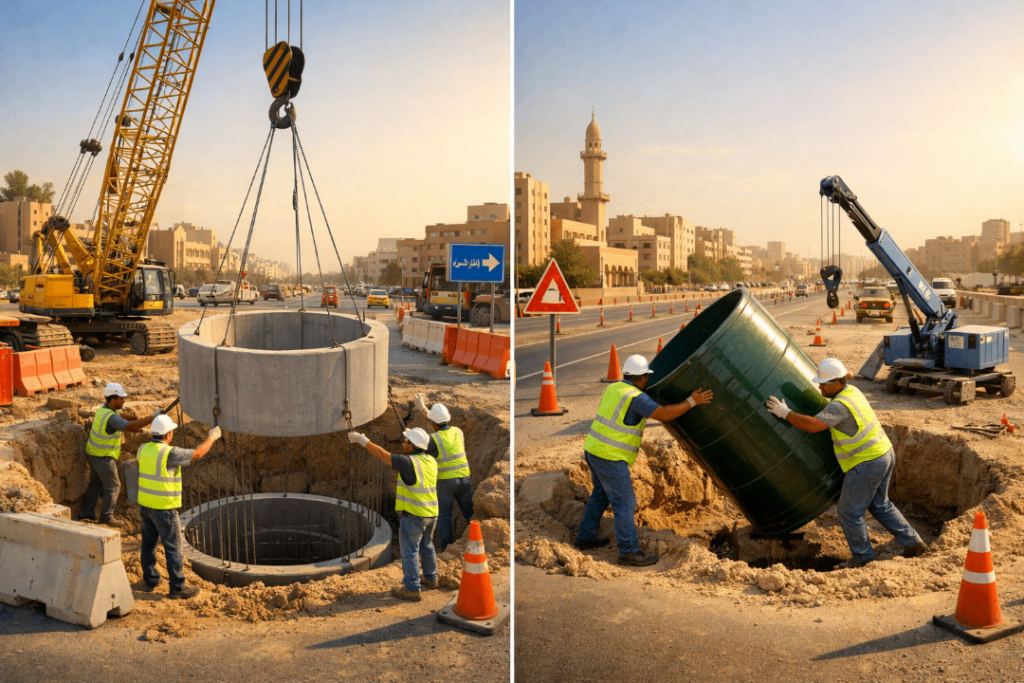
The installation comparison table is in the Tables section.
Where Each Material Works Best in KSA
Coastal cities and high groundwater
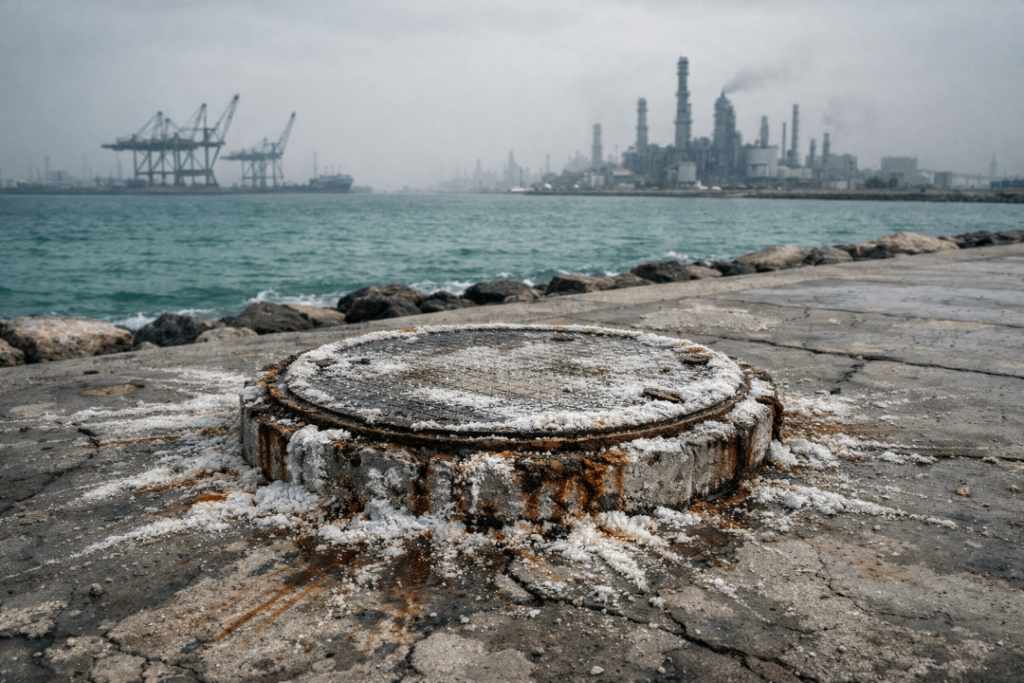
In coastal cities like Dammam, Jubail, or Jeddah, manholes often face saline groundwater, chloride-rich soils, and high water tables. Here, corrosion resistant manhole materials and high watertightness are crucial to avoid concrete deterioration and groundwater intrusion. Concrete can still be used with careful waterproofing and, where needed, linings and anti-floatation design, but HDPE and GRP shafts offer inherent resistance to salinity and H₂S with lower risk of chemical attack, provided uplift and backfill are handled correctly. For a manhole material comparison Saudi Arabia in these locations, GRP or HDPE shafts with robust covers and frames are often strong options.
Industrial zones with aggressive effluent
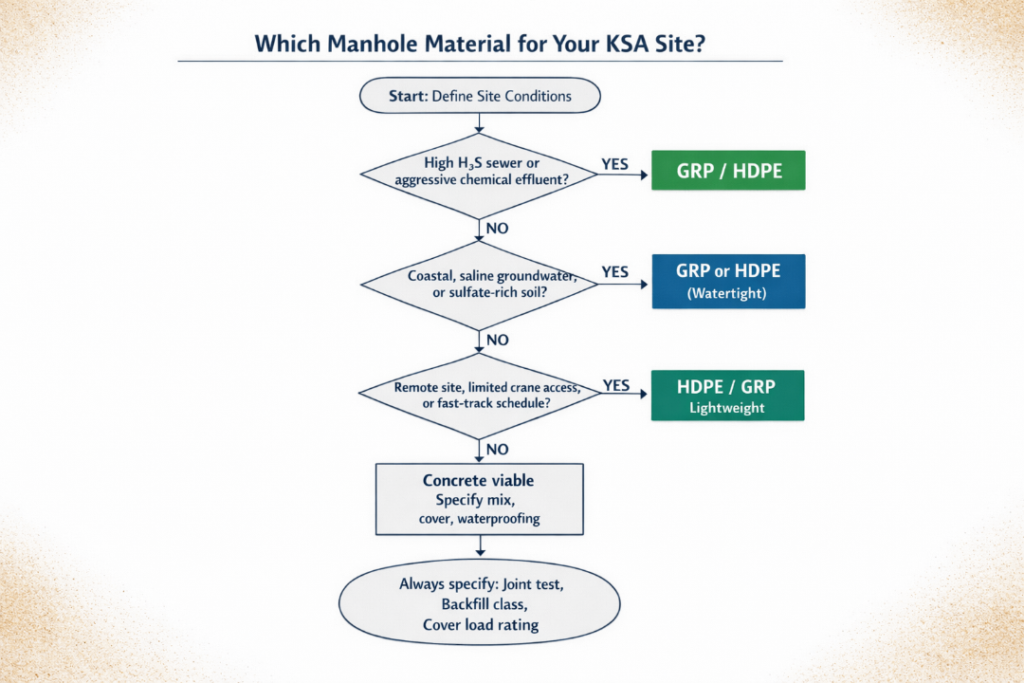
Industrial wastewater may contain acids, solvents, or high sulfate/chloride loads that exceed normal municipal sewer exposure. Unprotected concrete can deteriorate quickly under such conditions, even when general concrete manhole lifespan is acceptable elsewhere. In many industrial zones, specifying a corrosion resistant manhole — either HDPE, GRP, or concrete with a proven lining system — is essential, and material tests or chemical resistance charts should be included in the spec. The best fit will depend on the specific effluent, temperature, and pipe connections.
Residential/villa developments
For shallow to medium-depth residential sewers in non-aggressive soils, precast concrete manholes remain technically viable and widely accepted by authorities when designed and installed correctly. Where groundwater is moderate and sewer gas levels are typical, concrete durability can be adequate if mix design, cover, and waterproofing are appropriate. However, using GRP or HDPE may reduce future corrosion risk and speed installation, especially on fast-track housing projects that value a lightweight manhole system and fewer heavy lifts.
High-traffic roads and intersections
In high-traffic areas, frame and cover design and load class are often more critical than the shaft material itself. Any of the three materials can be structurally adequate if the cover, frame, and neck section are detailed correctly and settlement is controlled. Concrete can provide a very stiff support for frames, while GRP and HDPE require proper transition details or backfill to transfer loads safely to the surrounding soil. For these locations, specify the correct cover load class and construction tolerance first, then select the shaft material based on corrosion and installation considerations.
Remote sites with limited maintenance
Remote pumping stations, pipelines, and industrial sites in Saudi Arabia and the GCC often have limited maintenance access and higher logistics costs. Here, materials with low likelihood of corrosion or early rehabilitation needs (HDPE or GRP) can reduce lifetime visits, but only if installed correctly. Lightweight systems also make sense where heavy cranes are difficult to mobilize. For desert locations with sandy soils and low groundwater, structural stability and UV-resistant covers become key design inputs.
Selection Checklist (What to Specify)
Copy-paste this checklist into your RFQ or design brief for manhole material comparison Saudi Arabia projects:
- Location (city/region, coastal or inland, typical groundwater level and seasonal variations).
- Sewer type (storm, sanitary, combined, or industrial; note any aggressive chemicals or high temperatures).
- Depth and diameter of each manhole, including groundwater level relative to invert and cover.
- Soil and groundwater chemistry if available (sulfate content, chloride, salinity, pH, contamination).
- Traffic load area and required cover/frame load class (e.g., pedestrian, light vehicle, heavy truck, industrial yard).
- Joint watertightness requirement (test pressure, allowable leakage, vacuum or hydrostatic tests).
- Connection types and diameters (pipe materials, angles, drop connections, future provisions).
- Bedding/backfill specification reference (material type, compaction requirements, stiffness class assumptions).
- Installation constraints (site access, allowable crane size, dewatering needs, work window duration, night work).
Common Mistakes to Avoid (12 bullets)
- Choosing based on upfront price only, without evaluating life cycle cost manhole performance and potential rehabilitation frequency.
- Ignoring groundwater level, salinity, and soil chemistry when selecting concrete, HDPE, or GRP.
- Using weak or inappropriate bedding/backfill materials that do not match the stiffness needs of HDPE or GRP shafts.
- Poor compaction causing settlement, frame rocking, cracked pipe connections, and leaks.
- Selecting the wrong cover and frame load class for traffic areas, regardless of manhole shaft material.
- Allowing misaligned frames or poor mortar bedding, leading to rocking covers, noise, and faster deterioration.
- Skipping watertightness checks such as vacuum or hydrostatic tests on completed manholes.
- Not planning corrosion protection for concrete manholes in H₂S-rich sewers or sulfate/chloride soils.
- Not considering HDPE deformation and long-term creep risks under fill and traffic if stiffness and backfill are not correctly specified.
- Overlooking access and lifting safety, especially for heavy concrete units or deep GRP/HDPE shafts.
- Providing no documentation or traceability (mix designs, resin data, weld logs, test reports) for assets with long design lives.advancedpiping.
- Operating without a maintenance and inspection plan that includes periodic inspections of covers, frames, and internal corrosion or deformation.
FAQs
Which manhole lasts longest in Saudi Arabia?
There is no single “longest lasting” material, because manhole service life varies by site chemistry, groundwater, sewer type, depth, and project specs. Well-designed concrete, with appropriate materials and protective systems, can achieve long service in mild conditions, while in aggressive H₂S or sulfate environments, GRP or HDPE often provide more reliable corrosion resistance.
Is HDPE or GRP better for corrosion?
Both HDPE and GRP are widely used as corrosion resistant manhole options in sewer and saline environments, but performance depends on the specific chemical exposure, temperature, and product design. HDPE performs very well against many acids and wastewater constituents, while GRP’s resistance depends strongly on resin type and manufacturing quality, so chemical resistance data from the supplier should be checked against your actual effluent.
Why do concrete manholes fail in sewers?
Concrete manholes in sanitary sewers often fail because microbiologically influenced corrosion converts H₂S gas into sulfuric acid on moist concrete surfaces, dissolving cement paste and exposing reinforcement. Sulfate-rich soils, chloride ingress, inadequate cover, poor joints, and lack of protective linings or coatings further accelerate this process in some Saudi and GCC environments.
Which manhole is easiest to install?
In many KSA/GCC projects, HDPE and GRP manholes are easier to install because they are lightweight manhole system solutions that require smaller cranes and can be handled more quickly. However, they demand tight control of bedding, backfill, and flotation in high groundwater; precast concrete is heavier and slower to place but more tolerant to some installation deviations and buoyancy.
What affects manhole lifespan the most?
Major factors include soil and groundwater chemistry, H₂S levels in sewers, material selection, protective systems, joint watertightness, and installation quality. Depth, traffic loading, temperature, and maintenance practices also strongly influence whether a manhole reaches its intended design life in Saudi Arabia.
How do I reduce infiltration in manholes?
To reduce infiltration, specify high-quality gaskets or welded joints, external waterproofing where needed, proper bedding and compaction, and site leak testing (vacuum or hydrostatic) after installation. For concrete, pay attention to joint detailing and crack control, while for HDPE and GRP, focus on correct welding or gasket installation and avoiding damage during backfill.
Do I need special covers for traffic areas?
Yes, traffic areas in KSA/GCC should use covers and frames with load classes appropriate to expected vehicles and local standards, independent of the manhole shaft material. Heavy truck routes, port and industrial yards, and arterial roads usually require higher class covers and robust frame seating details to avoid rocking and premature damage.
What information do you need for a quote?
For an accurate quote on GRP, HDPE, or concrete alternatives, suppliers typically need location, sewer type, depth, diameter, soil/groundwater data, traffic category, connection details, required test standards, and any authority or project-specific specifications. Providing drawings or typical sections, plus any special installation constraints, helps refine the technical proposal and pricing.
Conclusion
Choosing between GRP, HDPE, and concrete manholes in Saudi Arabia is not about a single “best” material, but about matching corrosion resistance, stiffness, installation speed, and authority requirements to each site. A structured manhole material comparison Saudi Arabia approach, using the checklists and scenarios above, helps reduce leakage risk, unplanned rehabilitation, and traffic disruption over the asset life.
If you are evaluating GRP or composite options for upcoming projects in KSA or the GCC, you can Request a Quote with your site conditions and layouts, or Talk to our engineers to review material choices against your authority standards and project specifications. Final selection should always align with the relevant codes, authority requirements, and detailed project design.
Tables (all tables together)
Table 1 – Key failure drivers in KSA/GCC manholes
| Driver | Concrete impact | HDPE impact | GRP impact | What to control |
|---|---|---|---|---|
| Sulfate/chloride soils, saline groundwater | Risk of sulfate attack, chloride ingress, cracking, and reinforcement corrosion if not protected. | Generally resistant, but external loads and flotation must be controlled. | Generally resistant with suitable resin; joints and backfill still critical. | Determine soil/groundwater chemistry, specify protective systems or corrosion resistant manhole materials. |
| H₂S biogenic corrosion in sewers | Sulfuric acid attack can rapidly consume cover and shorten concrete manhole lifespan. | Shell is resistant; joints and connections must be watertight | Shell is resistant with correct resin; joints and benching must be properly detailed. | Assess sewer H₂S potential, specify linings for concrete or use HDPE/GRP where appropriate. |
| Infiltration/exfiltration through joints | Cracked or poorly sealed joints allow groundwater in and sewage out. | Welded or gasketed joints can be very tight but are sensitive to workmanship. | Gasketed/laminated joints can achieve low leakage with correct installation. | Use tested joint systems and leakage criteria; perform site leak tests. |
| Settlement from poor bedding/backfill | Can crack bases, joints, and pipe connections. | Flexible shell may deform, stressing joints and connections. | Stiff shell, but local voids can cause point loads and damage. | Follow bedding/backfill specs suited to each material; ensure proper compaction. |
| Traffic loading and frame seating | Poor frame seating causes rocking, spalling, and water ingress. | Needs proper transition from flexible shaft to rigid frame zone. | Needs compatible frame-seat design and adequate bearing ring or collar. | Specify correct cover load class and construction details; ensure quality frame installation. |
Table 2 – Cost elements for manhole material comparison Saudi Arabia
| Cost element | Concrete | HDPE | GRP | Notes for KSA |
|---|---|---|---|---|
| Material procurement | Often lowest local material cost; linings/coatings add cost in aggressive environments. | Material cost per unit can be higher; includes welded components and fittings. | Typically higher unit cost than basic concrete but includes corrosion resistance by design. | Evaluate cost vs expected lifespan and corrosion risk; “varies by site chemistry, depth, and project specs.” |
| Transport/logistics | Heavy units may limit number per truck and require more fuel and handling. | Light weight reduces transport cost and allows more units per load. | Also lightweight, helping logistics to remote sites. | Long distances and remote desert projects in KSA/GCC can favor lighter systems for logistics and crane mobilization. |
| Installation time and equipment | Larger cranes and longer installation durations; curing time for cast in place. | Faster handling, smaller cranes, but needs careful dewatering and backfill. | Fast installation with small cranes; factory-finished internals possible. | Faster installation can reduce dewatering, traffic management, and night work costs, especially in high-traffic Saudi cities. |
| Jointing and QA/QC | Gasketed or mortared joints; waterproofing membranes; testing adds labor. | Welded joints give high integrity but require skilled welders and inspection. | Gasketed or laminated joints; factory testing possible; site QA/QC still required. | Authorities may require specific leakage tests and records; factor QA/QC into life cycle cost manhole assessments. |
| Rehabilitation/repair frequency risk | In aggressive sewer/soil, may require coatings, relining, or partial replacement earlier. | Lower corrosion risk; occasional repairs may focus on joints or frames. | Low corrosion risk if correctly specified; damage risk mainly from mechanical or installation issues. | Rehabilitation frequency “varies by site chemistry, depth, and project specs”; consider this in NPV or lifecycle evaluations. |
| Downtime/social cost | Failures can cause collapses, odors, and traffic disruption requiring major works. | Fewer corrosion failures can reduce major road openings; damage still possible from settlement. | Similar benefit; good performance reduces emergency interventions. | In dense Saudi urban areas, social and traffic costs can exceed material savings; factor into material selection and detailing. |
Table 3 – Lifespan and durability factors
| Durability factor | Concrete | HDPE | GRP | Best practice |
|---|---|---|---|---|
| Exposure to H₂S and sewer gases | Unprotected surfaces can lose concrete cover quickly under strong MIC, shortening concrete manhole lifespan. | Generally resistant to H₂S and common sewer chemicals. | Resistant with suitable resin; benching and joints must match exposure. | Quantify sewer H₂S risk and choose material or lining accordingly; “lifespan varies by site chemistry, depth, and project specs.” |
| Soil/groundwater chemistry | Sulfates, chlorides, and low pH can attack concrete unless mix and cover are designed for exposure. | Shell not attacked by sulfates/chlorides, but structure still affected by loads and flotation. | Shell highly resistant with proper resin; joints and accessories must also be compatible. | Obtain basic geotechnical and groundwater data; align material choice and protective systems with exposure class and standards. |
| Structural loads and deformation | High compressive strength; cracks from settlement or inadequate design can allow ingress. | Flexible; creep and deformation governed by stiffness, backfill, and temperature. | Stiff composite; strength depends on wall thickness and glass/resin ratio. | Match ring stiffness and wall design to depth and traffic; follow bedding/backfill specifications for the chosen material. |
| Temperature and UV | Heat mainly affects covers, coatings, and joint materials. | Thermoplastic properties influenced by temperature; covers must be UV-resistant if exposed. | Resin matrix must be suitable for local temperatures and UV; often protected by backfill and covers. | Specify temperature and UV-resistant covers and frames; consider ventilation and shading where appropriate. |
| Installation quality | Honeycombing, poor joints, and inadequate curing reduce durability. | Poor welding or backfill can cause leaks or deformation. | Mishandling or poor jointing can introduce stress points or leaks. | Enforce QA/QC on fabrication and installation; include inspections, tests, and documentation in project specs. |
Table 4 – Installation comparison
| Installation step | Concrete | HDPE | GRP | Common mistakes |
|---|---|---|---|---|
| Delivery and handling | Heavy units; need larger cranes and careful lifting points. | Easy manual or small-crane handling; risk of damage from improper slinging. | Lightweight; must avoid impact and point loads during handling. | Underestimating crane size for concrete; lifting HDPE/GRP without correct slings or spreader bars. |
| Excavation and bedding | Often larger excavation; stable base needed to prevent cracking. | Requires uniform bedding and carefully graded support. | Needs flat, compacted bedding to distribute loads. | Using uneven or soft bedding for flexible systems; inadequate compaction under bases. |
| Shaft placement and alignment | Heavier lifts make fine adjustments slower; joints must be cleaned and gasketed. | Lightweight shafts align quickly; weld joints may be done on site. | Factory-assembled shafts can be set quickly; joint gaskets need correct compression. | Rushing joint assembly, leaving debris on gasket surfaces, or misaligning connections. |
| Backfill and compaction | Sensitive to voids that can cause settlement and cracking. | Critical for controlling deformation and long-term stiffness. | Important for stability; localized voids can create point loads. | Poorly compacted backfill, especially near connections, leading to settlement and leaks. |
| Frame, cover, and finishing | Mortar bedding and curing needed; heavy covers common. | Transition from flexible shaft to rigid frame must be designed. | Collar or adapter rings required to seat frames properly. | Misaligned frames, rocking covers, inadequate mortar or grout thickness, poor finishing around frames. |