

Introduction
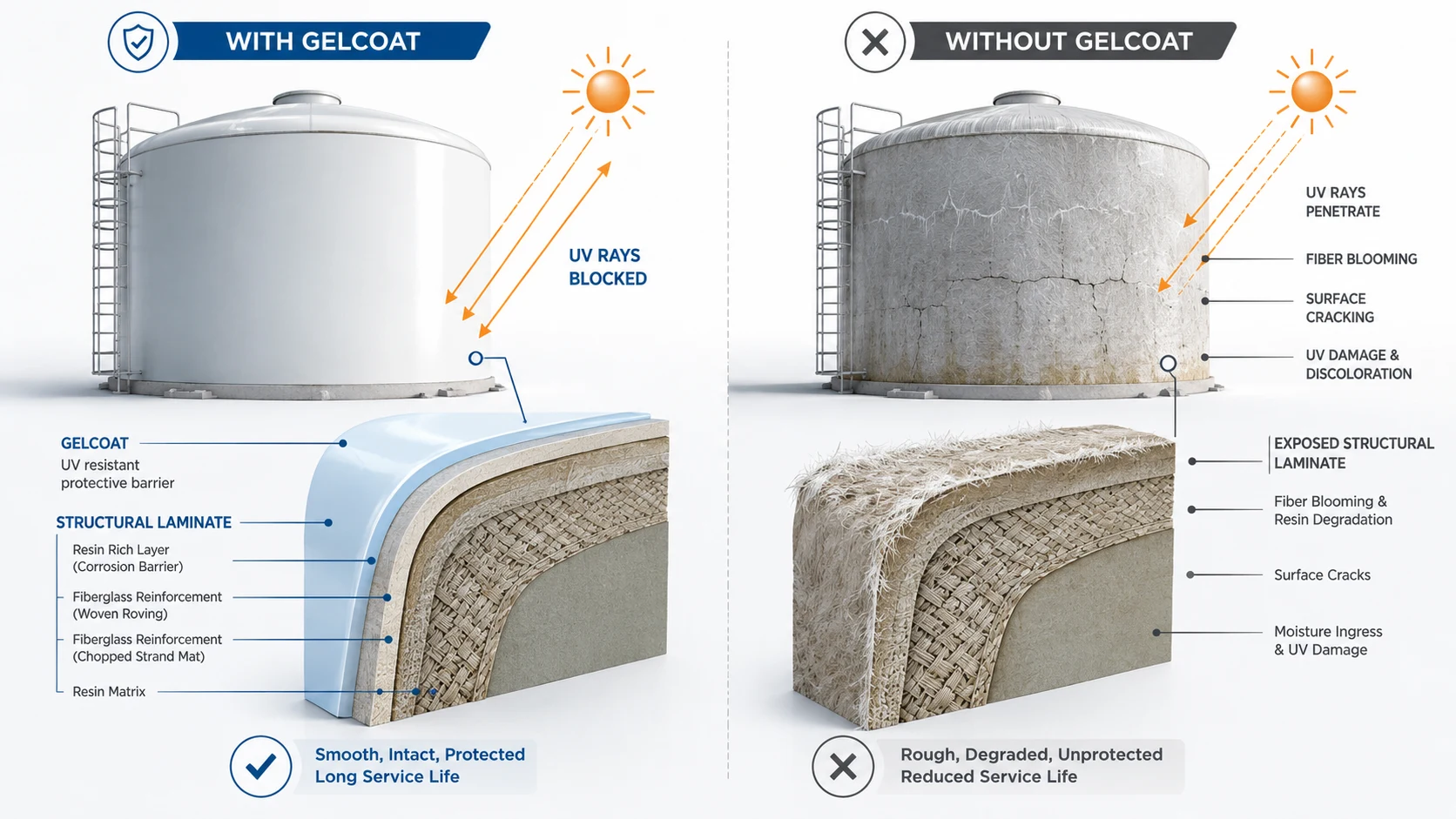
Gelcoat fiberglass tanks UV protection is essential for long-term FRP/GRP tank performance in Saudi Arabia. Gelcoat is a thin, resin-based coating applied to the outer surface of fiberglass products. It is typically 0.4–0.6 mm thick — a fraction of the total wall thickness — yet it is the single most important layer for long-term surface protection.
In Saudi Arabia, where FRP tanks are exposed to some of the highest UV radiation levels in the world, ambient temperatures exceeding 50°C, windblown sand, and aggressive chemical environments, gelcoat is not a cosmetic option. It is a functional engineering requirement.
A fiberglass tank without gelcoat — or with improperly applied gelcoat — will show visible surface degradation within 1–3 years in Saudi outdoor conditions. The glass fibers at the surface become exposed (a defect called fiber blooming), moisture wicks into the laminate, and the structural integrity of the outer layers begins to decline.
Despite this, gelcoat is sometimes omitted or reduced to cut manufacturing cost. Buyers who do not understand what gelcoat does may accept tanks without it — and then face premature maintenance, surface repair, or full tank replacement years earlier than expected.
This article explains what gelcoat is, what it does, how it protects FRP tanks, and why it is essential for every outdoor fiberglass product in Saudi Arabia.
What Is Gelcoat?
Gelcoat is a specialized, pigmented, resin-based coating designed specifically for composite (FRP/GRP) surfaces. It is not ordinary paint. It is not a primer. It is a purpose-engineered surface layer with properties that standard coatings cannot match.
Gelcoat is typically based on:
– Isophthalic polyester resin — for general-purpose and water tank applications
– Vinyl ester resin — for chemical-resistant applications
– Neopentyl glycol (NPG) polyester — for enhanced weathering resistance and UV stability
The gelcoat is mixed with pigments for color, UV stabilizers to resist solar degradation, and thixotropic agents to control application thickness.
Gelcoat is applied to the mold surface before the glass fiber and structural resin are laid up. This means the gelcoat becomes the outermost layer of the finished product — the first line of defense against the environment.
Key Properties of Gelcoat
| Property | Function |
|---|---|
| UV resistance | Blocks ultraviolet radiation from reaching the laminate |
| Chemical resistance | Resists attack from water, mild chemicals, and atmospheric pollutants |
| Low porosity | Creates a dense, non-porous surface that blocks moisture ingress |
| Hardness | Provides a durable, abrasion-resistant surface |
| Smooth finish | Creates an aesthetically pleasing, easy-to-clean surface |
| Color stability | Maintains color without fading for years |
| Algae resistance | Smooth, non-porous surface discourages biological growth |
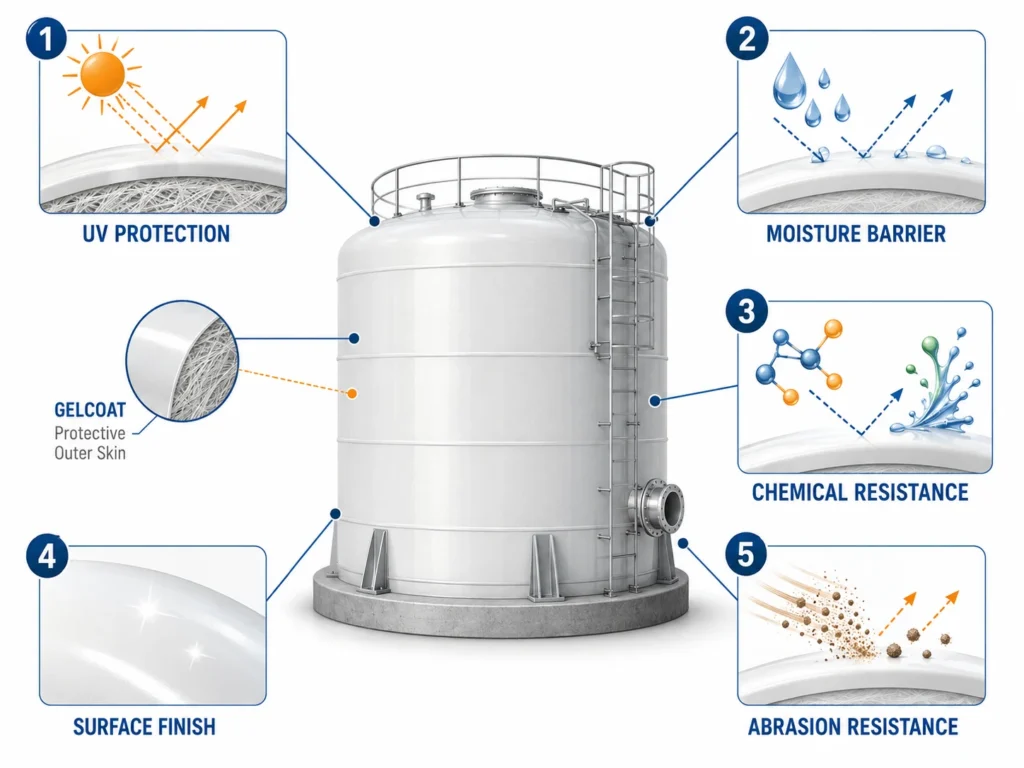
The Five Functions of Gelcoat
Function 1: UV Protection
Ultraviolet radiation is the primary enemy of exposed FRP surfaces. UV energy breaks the chemical bonds in the resin matrix, causing chain scission — the progressive degradation of the polymer structure.
Without UV protection, the resin at the surface of an FRP product degrades first. The glass fibers — which are unaffected by UV — become exposed as the resin around them erodes. This is called fiber blooming — white, chalky patches of exposed glass fiber visible on the tank surface.
Gelcoat with UV stabilizers absorbs and blocks UV radiation before it reaches the structural laminate. A properly applied gelcoat can protect the underlying laminate for 15–25 years in outdoor exposure, even in high-UV environments like Saudi Arabia.
Riyadh receives over 2,500 hours of direct sunlight annually, with UV index routinely reaching 10–11+ during summer months. Coastal cities like Jeddah and Dammam add humidity and salt spray to the UV load. In these conditions, gelcoat is not optional — it is the difference between a 25-year tank and a 5-year failure.
Function 2: Moisture Barrier
Fiberglass is not waterproof by nature. The resin matrix resists water, but the glass fibers can absorb moisture through exposed fiber ends and micro-porosity in the laminate surface.
Moisture absorption leads to:
– Blistering — osmotic pressure builds under the surface, creating bubbles
– Hydrolysis — water chemically attacks the resin, weakening the matrix
– Reduced mechanical properties — wet laminate has lower strength than dry laminate
– Freeze-thaw damage — less relevant in Saudi Arabia but critical in cooler climates
Gelcoat creates a dense, low-porosity surface that minimizes moisture ingress. It is the first barrier that water must penetrate before reaching the structural laminate.
Function 3: Chemical Resistance
For tanks exposed to atmospheric chemicals, cleaning agents, or mild chemical splash, gelcoat provides a resistant outer surface. Isophthalic gelcoat resists most atmospheric pollutants, mild acids, and cleaning chemicals. Vinyl ester gelcoat provides enhanced resistance for more aggressive environments.
For the interior of chemical storage tanks, a resin-rich corrosion barrier (not gelcoat) is used — but the principle is the same: a dense, resin-rich surface layer that protects the structural glass fiber laminate from chemical attack.
Function 4: Surface Finish and Aesthetics
Gelcoat provides a smooth, glossy, professional surface finish. For visible installations — rooftop water tanks, architectural GRP panels, building-integrated FRP products — the cosmetic quality of gelcoat is important for project acceptance.
Beyond aesthetics, the smooth surface has practical benefits:
– Easier to clean and inspect
– Resists dirt and dust adhesion
– Discourages algae and biological growth on water tanks
– Provides a professional appearance for client-facing installations
Function 5: Abrasion Resistance
Gelcoat is harder than the structural laminate beneath it. It provides a durable surface that resists scratching, scuffing, and abrasion from handling, installation, and environmental exposure (including windblown sand in Saudi Arabia).
Without gelcoat, the softer resin/glass surface is more susceptible to mechanical damage, which can expose glass fibers and initiate degradation.
What Happens Without Gelcoat
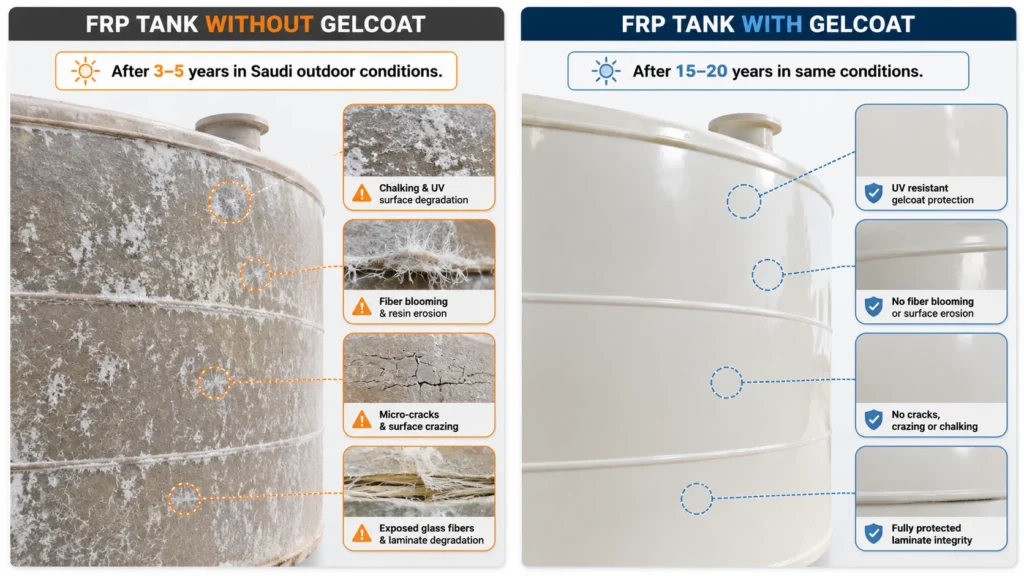
When gelcoat is omitted or improperly applied, the structural laminate surface is directly exposed to the environment. The degradation sequence in Saudi outdoor conditions follows a predictable pattern:
Year 1–2: Surface chalking and slight color change. The resin at the surface begins to break down under UV exposure. Fine white powder appears on the surface when wiped.
Year 2–4: Fiber blooming begins. White patches of exposed glass fiber appear on the surface. The glass fibers are visible because the resin around them has eroded away. The surface becomes rough and porous.
Year 3–5: Moisture absorption increases. Water wicks along exposed fibers into the laminate. Blistering may appear. Surface hardness decreases.
Year 5–8: Structural degradation of outer laminate layers. Mechanical properties decline. The tank’s ability to withstand design loads is compromised. Surface cracking and delamination may begin.
Year 8+: The tank may still function, but its structural margin is reduced, its appearance is severely degraded, and its remaining service life is uncertain. Repair or replacement becomes necessary.
This degradation timeline assumes standard outdoor exposure in Riyadh. In coastal environments (higher humidity + salt spray + UV), the timeline is accelerated.
With properly applied UV-stabilized gelcoat, the same tank would show minimal surface change after 15–20 years in the same conditions.
| Condition | Without Gelcoat | With Gelcoat |
|---|---|---|
| Surface appearance after 5 years | Chalked, fiber bloom, rough | Smooth, color stable |
| Moisture absorption | Increasing from Year 2 | Minimal through Year 15+ |
| Structural integrity of outer layers | Declining from Year 3 | Maintained through Year 20+ |
| Expected service life (outdoor, Riyadh) | 5–10 years (surface limited) | 20–30 years |
| Maintenance required | Surface repair, recoating | Periodic cleaning only |
Gelcoat Application and Thickness
Gelcoat is applied to the mold surface before the structural lay-up begins. The standard application methods are:
Brush application — Gelcoat is brushed onto the mold in even coats. Requires skill to achieve uniform thickness. Used for small and complex shapes.
Spray application — Gelcoat is sprayed onto the mold using a gelcoat spray gun. Provides more uniform thickness and faster application. Used for larger products and production manufacturing.
Recommended Thickness
The recommended gelcoat thickness for FRP tanks is 0.4–0.6 mm(400–600 microns, or approximately 16–24 mils).
Too thin(below 0.3 mm) — Insufficient UV protection and moisture barrier. The gelcoat may not fully cover the surface, leaving thin spots that allow UV penetration.
Too thick (above 0.8 mm) — Excessive thickness causes the gelcoat to become brittle and prone to cracking, crazing (network of fine surface cracks), and delamination from the laminate beneath. More is not better.
Gelcoat thickness is measured during manufacturing using a wet film thickness gauge. Quality-focused manufacturers verify gelcoat thickness at multiple points across the product surface.
Gelcoat Quality Problems and How to Spot Them
Even when gelcoat is applied, quality problems can occur. The most common gelcoat defects are:
Undercure — The gelcoat has not fully cured, remaining soft and tacky. Caused by insufficient catalyst, low ambient temperature, or high humidity during application. Results in poor chemical resistance and early degradation.
Pinholes — Small holes or pits in the gelcoat surface caused by trapped air bubbles. Pinholes allow moisture and chemicals to reach the laminate. A few isolated pinholes are common; clusters indicate a process problem.
Crazing — Fine network of surface cracks in the gelcoat. Caused by excessive thickness, thermal stress, or impact. Crazing allows moisture ingress and worsens with continued UV exposure.
Wrinkling — Distorted surface texture caused by uneven application or cure. Indicates process control issues.
Color variation — Uneven color across the surface caused by inconsistent pigment mixing or application thickness variation.
When inspecting FRP products, these defects should be identified before acceptance. A quality manufacturer will have process controls in place to prevent them and inspection protocols to catch them before delivery.
What is gelcoat made of?
Gelcoat is a specialized resin-based coating, typically made from isophthalic polyester, vinyl ester, or NPG (neopentyl glycol) polyester resin. It includes pigments for color, UV stabilizers to block ultraviolet radiation, and thixotropic agents to control application thickness. It is not paint — it is a purpose-engineered composite surface layer.
Why is gelcoat important for FRP tanks in Saudi Arabia?
Saudi Arabia has among the highest UV radiation levels in the world, with ambient temperatures exceeding 50°C. Without UV-stabilized gelcoat, FRP tank surfaces degrade rapidly — showing fiber blooming within 2–4 years and losing structural integrity in outer layers within 5–8 years. Gelcoat extends the surface life to 20+ years.
How thick should gelcoat be on a fiberglass tank?
The recommended gelcoat thickness is 0.4–0.6 mm (400–600 microns). Too thin provides insufficient protection. Too thick causes brittleness, crazing, and cracking. Thickness should be verified during manufacturing using a wet film thickness gauge.
What is fiber blooming?
Fiber blooming is a surface defect where glass fibers become visible on the FRP surface because the resin around them has eroded away — typically from UV degradation. It appears as white, chalky patches on the tank surface. Fiber blooming indicates that the surface resin layer has failed, and moisture absorption and further degradation will follow.
Can gelcoat be applied after the tank is manufactured?
Gelcoat is designed to be applied to the mold surface before lay-up, so it bonds to the laminate during manufacturing. A post-manufacturing topcoat can be applied, but it is not true gelcoat and does not achieve the same bond strength or performance. Post-applied coatings are a maintenance measure, not a substitute for factory-applied gelcoat.
Does gelcoat come in different colors?
Yes. Gelcoat can be pigmented to virtually any color. Common FRP tank colors include white, grey, cream, green, and blue. The pigment is mixed into the gelcoat before application, providing permanent color that does not require painting. UV stabilizers help maintain color stability over time.
Is gelcoat needed on indoor FRP tanks?
For indoor tanks not exposed to UV, the UV protection function of gelcoat is less critical. However, gelcoat still provides moisture barrier, chemical resistance, smooth surface finish, and abrasion resistance. For indoor chemical tanks, a resin-rich inner corrosion barrier is more critical than exterior gelcoat. The decision depends on the specific application and environment.
How can I tell if an FRP tank has gelcoat?
A gelcoated surface is smooth, glossy, and uniformly colored. An uncoated FRP surface typically shows a visible glass fiber pattern (the weave of woven roving or the random pattern of chopped strand mat) and has a rougher, less uniform appearance. Touching the surface, gelcoat feels smooth and hard, while an uncoated surface may feel slightly rough or textured.
Can damaged gelcoat be repaired?
Minor gelcoat damage (scratches, small chips) can be repaired with gelcoat repair kits that include matching gelcoat paste and hardener. The damaged area is cleaned, filled with fresh gelcoat, and allowed to cure. For extensive damage or fiber blooming, professional surface repair is recommended. However, repair is always less effective than original factory-applied gelcoat.
Does gelcoat affect tank cost?
Gelcoat typically adds 5–10% to the manufacturing cost of an FRP tank. Given that it extends surface life by 10–15+ years and eliminates or reduces maintenance requirements, gelcoat is one of the highest-value investments in the entire FRP product. Omitting gelcoat to save 5% on purchase price and losing 50% of the tank’s service life is poor economics.
Key Takeaways
Gelcoat is a specialized resin-based coating, 0.4–0.6 mm thick, applied to the outer surface of FRP products during manufacturing.
Gelcoat performs five critical functions: UV protection, moisture barrier, chemical resistance, smooth surface finish, and abrasion resistance.
In Saudi Arabia’s extreme UV environment, gelcoat is not optional — it is essential. Without it, FRP tank surfaces degrade within 2–5 years. With it, surfaces last 20+ years.
Fiber blooming — the exposure of glass fibers from UV-degraded resin — is the visible sign of missing or failed gelcoat protection.
Gelcoat thickness must be controlled: 0.4–0.6 mm is optimal. Too thin provides insufficient protection; too thick causes cracking and crazing.
Gelcoat typically adds only 5–10% to tank cost but extends service life by decades — making it one of the highest-value components in any FRP product.
Always confirm gelcoat specification, type, thickness, and UV stabilizer content when procuring FRP products for outdoor installation in Saudi Arabia.
Conclusion
If your FRP tanks are showing surface chalking, fiber blooming, or color fading, the cause is likely missing or inadequate gelcoat protection. These problems are preventable at the manufacturing stage.
Pioneers Fiberglass applies UV-stabilized gelcoat to every outdoor FRP product, with controlled thickness and verified cure. Our gelcoat specification is part of every manufacturing record, and we can provide technical data sheets for the gelcoat systems we use.
To discuss gelcoat specifications or request a quote for gelcoated FRP products, please share:
– Product type (tank, cover, panel, manhole)
– Installation environment (outdoor, indoor, rooftop, ground level)
– Exposure conditions (direct sun, coastal, chemical environment)
– Color preference
– Required design life