

Introduction
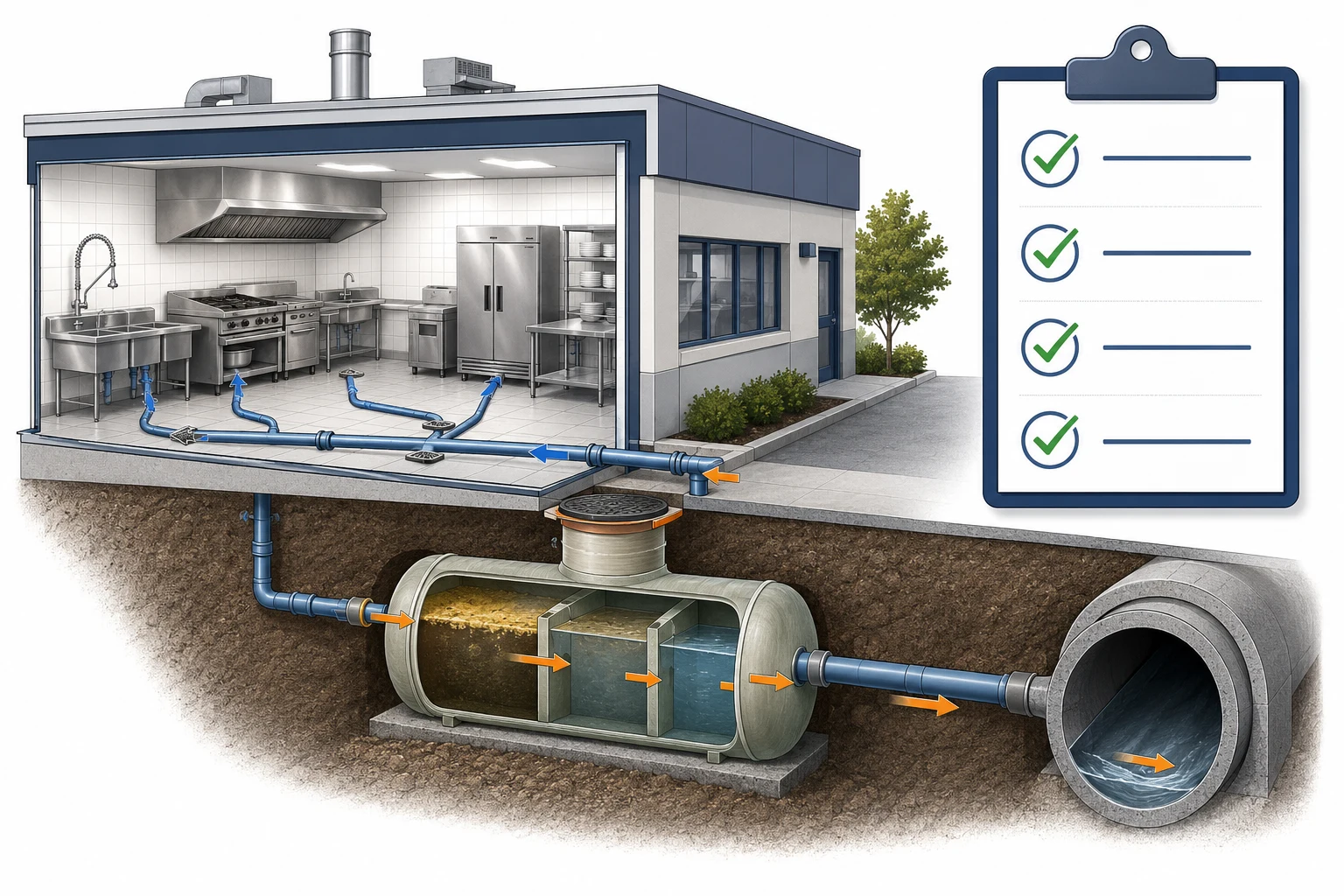
Grease trap requirements in Saudi Arabia apply during design, licensing, operation and waste disposal. Food establishments must demonstrate that their interceptor is correctly sized, properly connected, regularly maintained and supported by complete service and disposal records.
Grease pre-treatment in Saudi Arabia is no longer a recommendation — it is an enforced condition of operating a food establishment. Municipalities have moved from reactive blockage response to proactive inspection, and the question asked at inspection has shifted from “is there a grease trap?” to “show the sizing basis, the service records, and the disposal manifests.”
Responsibility sits with the establishment, not the contractor who installed the tank. A restaurant whose FOG discharge blocks a shared sewer line, generates odour complaints, or appears in a drainage authority’s CCTV survey will answer for it — regardless of who designed the drainage a decade earlier.
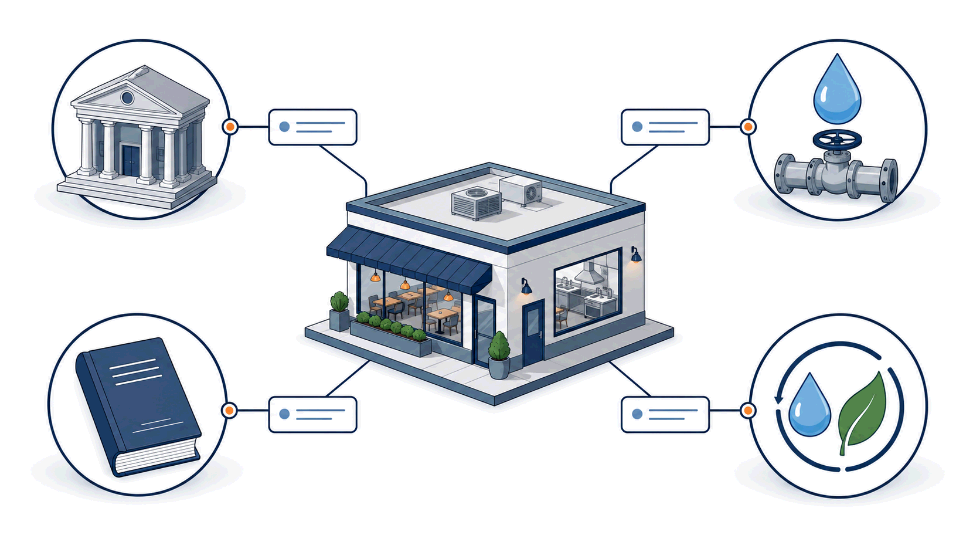
The regulatory landscape involves several actors: the municipal Amanah/Baladiya (food establishment licensing and inspection), the sewer service provider (connection consent and discharge quality), the Saudi Building Code (design provisions), and national environmental regulation (waste transport and disposal). Requirements are applied locally and evolve — this article maps the framework and the practical obligations that recur across the Kingdom, so specifiers know what to verify with their own city’s authorities.
This is an engineering compliance guide, not legal advice; always confirm current requirements with your local Amanah and sewer service provider before design freeze.
Grease Trap Requirements in Saudi Arabia: Who Regulates What
| Authority / Instrument | Role in Grease Compliance |
|---|---|
| Amanah / Baladiya (municipality) | Food establishment licensing and inspection; presence and condition of grease pre-treatment is an inspectable item; violations affect the establishment’s license standing |
| Balady platform | Licensing workflow through which food establishment requirements — including sanitary drainage provisions — are administered |
| Sewer service provider (e.g., National Water Company in its service areas) | Connection consent and discharge quality conditions; prohibits discharges that obstruct or damage the network |
| Saudi Building Code (SBC 701 — plumbing) | Design-stage requirement for grease interceptors on fixtures discharging FOG in food-service occupancies; venting, access, and separation of sanitary flows |
| National environmental regulation (MEWA / NCEC framework) | Governs waste transport and disposal — FOG waste must move by licensed carriers to approved facilities |
The practical consequence of this structure: compliance must be demonstrated at three moments — at design/licensing (adequate unit, correctly connected), during operation (maintenance and records), and at waste disposal (licensed chain of custody).
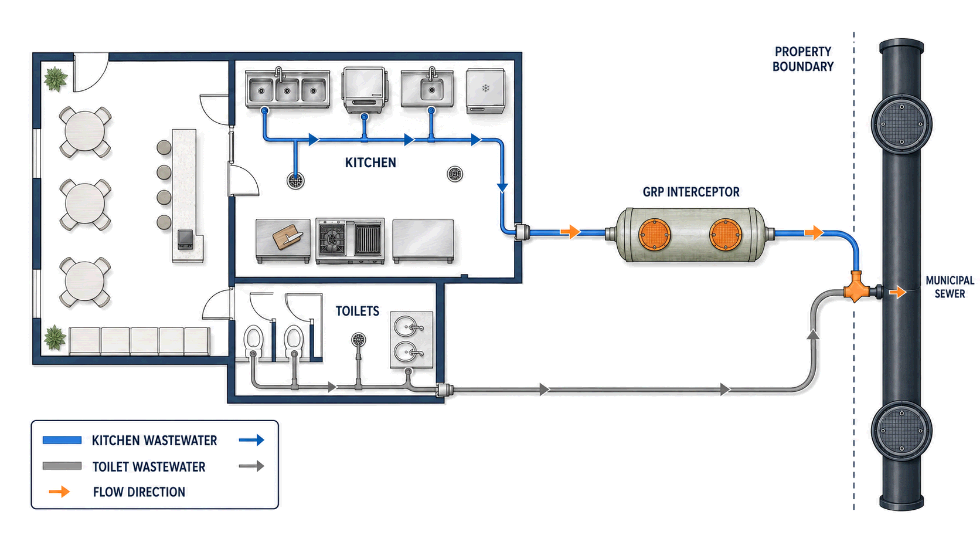
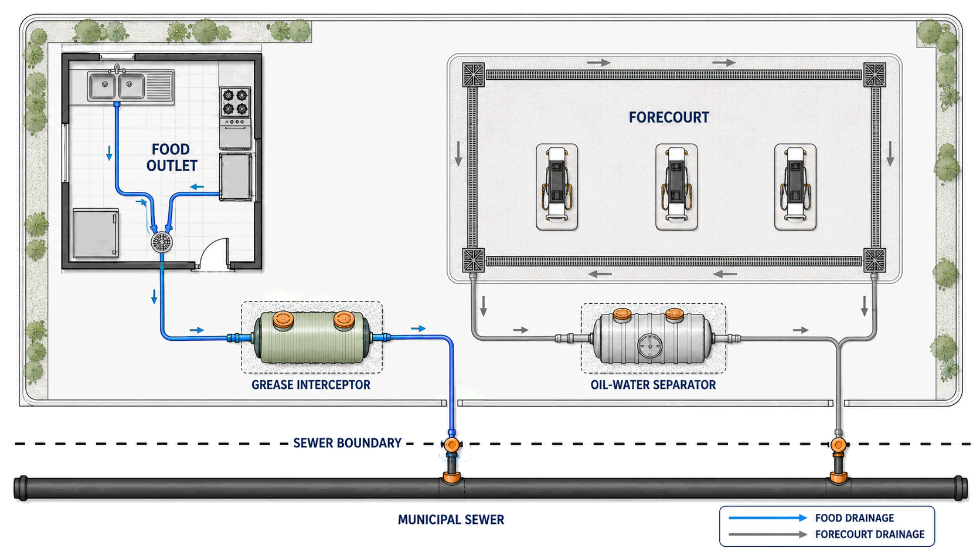
Key principle applied across Saudi cities: kitchen drainage carrying FOG must pass through an interceptor before the sewer connection; sanitary (toilet) drainage must never pass through it. Combined connections are among the most common defects found in older buildings and are treated as violations, not legacy conditions.
Grease Trap Installation Requirements
Compliance is cheapest at the drawing stage. The recurring design-stage expectations across Saudi municipalities:
- A grease interceptor on all FOG-bearing kitchen drainage — pot sinks, pre-rinse stations, wok lines, kitchen floor drains, and (where the authority requires) dishwashers.
- A documented sizing basis. Submissions increasingly ask for the calculation, not just a tank capacity. Use the fixture flow method or EN 1825 approach set out in the GRP grease trap sizing guide and keep the calculation sheet in the project file.
- Strict separation of sanitary flows. WCs and ablution drainage bypass the interceptor entirely.
- Accessible location. The unit must be reachable by a vacuum tanker and openable without entering the building’s food-handling areas — external buried installation is the standard solution.
- Venting. A dedicated vent terminating away from openings and occupied areas, controlling H₂S in the headspace.
- Watertight construction. Buried units serving food establishments are expected to be verifiably watertight — one-piece GRP shells with a pre-backfill hydrostatic test provide the cleanest evidence (procedure in the FRP hydrotest guide).
- Traffic and burial design. Cover ratings, burial depth, and anti-flotation anchoring resolved for the actual location — parking areas and service yards mean trafficked covers and load slabs.
Discharge Quality: What the Sewer Provider Expects
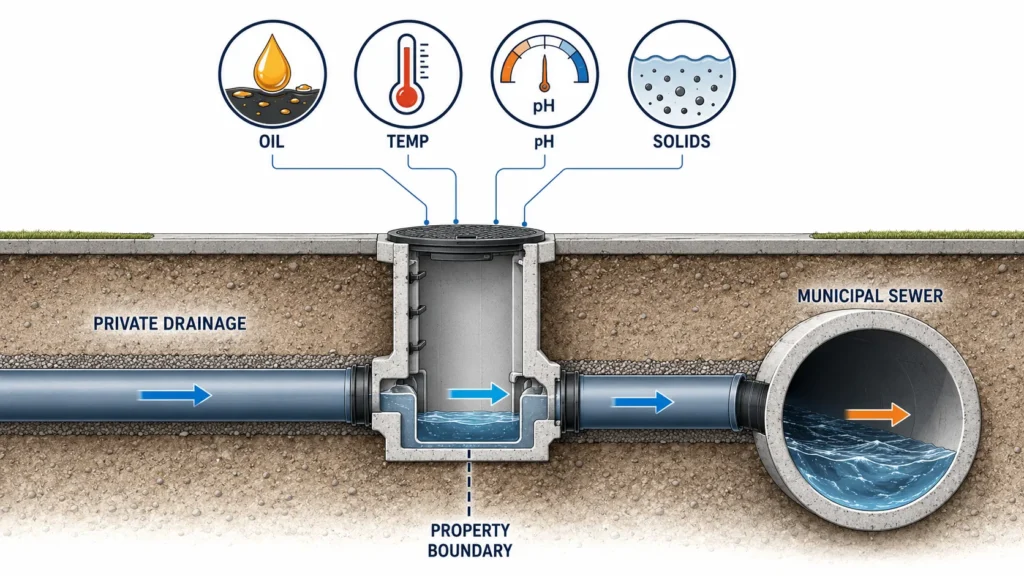
Sewer connection consents in Saudi Arabia condition the quality of what leaves the property. For food establishments, the operative parameter is oil and grease concentration in the discharged effluent, alongside general prohibitions on discharges that block, corrode, or overload the network.
| Parameter (typical sewer discharge conditions) | Commonly Applied Expectation |
|---|---|
| Oil and grease | Limits in the tens of mg/L are typical of GCC sewer discharge standards — confirm the figure in your city’s connection conditions |
| Temperature | Upper limits apply; very hot discharges (commercial dishwashers, boiling processes) may require cooling or declaration |
| pH | Neutral range required; aggressive cleaning chemical dumps are prohibited |
| Solids | No discharges liable to settle and obstruct — the argument against food grinders discharging to drain |
| Prohibited substances | Flammables, solvents, and hazardous chemicals excluded entirely |
The engineering implication is direct: a correctly sized, properly maintained gravity interceptor is what keeps a food establishment inside its oil and grease limit. An overdue or undersized unit is, functionally, a consent violation in progress — the failure modes and their fixes are covered in the maintenance and pump-out scheduling guide.
Verification note: Discharge limit values are set by the sewer service provider for each city and are updated over time. Do not design to a number from a blog — including this one. Obtain the current connection conditions for the specific municipality and design with margin.
Grease Trap Inspection and Operational Compliance
Municipal food-establishment inspections treat the grease trap as a hygiene and infrastructure item. The recurring inspection points:
- Presence and accessibility of the interceptor; covers not obstructed, buried under stock, or paved over.
- Condition — sealed covers, no surface leakage, no persistent odour at the unit.
- Service records — dated log of pump-outs with volumes and layer measurements.
- Disposal evidence — licensed hauler details and disposal manifests matching the log.
- No prohibited practices — no evidence of chemical emulsifier dosing regimes used in place of pump-outs, no bypass pipework around the unit.
- Kitchen-side controls — sink strainers present, used cooking oil collected separately rather than poured to drain.
Enforcement escalates predictably: observation → corrective notice with deadline → fines → impact on the establishment’s license standing. In blockage incidents traced to a specific establishment, clean-up cost recovery is an additional exposure.
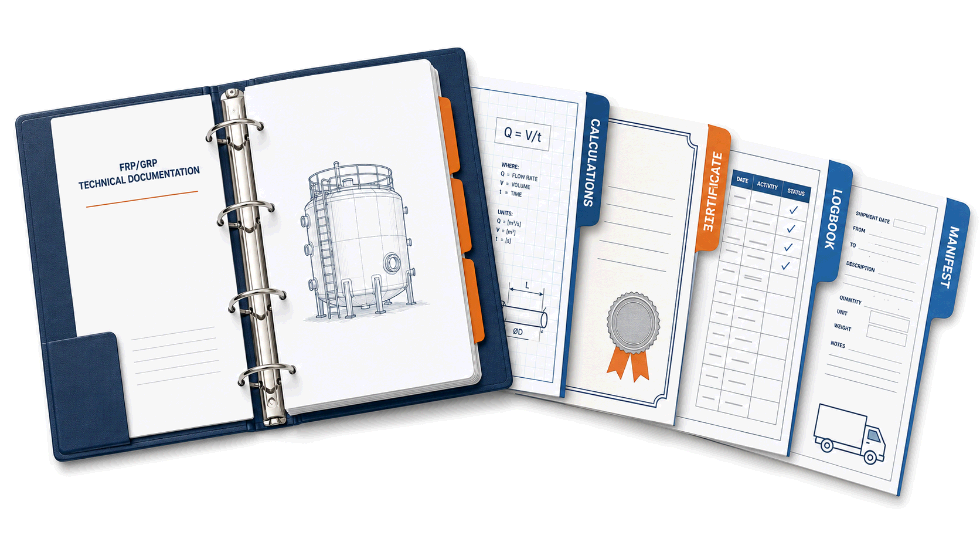
The Compliance File: Documentation That Closes Every Question
Assemble one file per establishment and keep it current. Its contents:
| Document | Origin | Answers |
|---|---|---|
| Sizing calculation sheet | Designer / supplier | “Is the unit adequate for this kitchen?” |
| Tank data sheet and drawings | Manufacturer | “What is installed, and to what specification?” |
| Hydrostatic test certificate | Installation stage | “Is it watertight?” |
| Installation records (bedding, anchoring, cover rating) | Contractor | “Was it installed for this location’s loading and water table?” |
| Service log (dates, layers, volumes) | Operator | “Is it maintained on condition?” |
| Hauler licenses and disposal manifests | Service provider | “Where does the waste go?” |
| Corrective action notes | Operator | “Were defects closed out?” |
For multi-outlet operators — food courts, franchise groups, hotel portfolios — standardise this file across sites. Shared interceptors serving multiple tenants additionally need a written maintenance agreement naming the responsible party; “everyone’s tank” is, at inspection, no one’s tank.
Compliance for New Projects vs. Existing Establishments
New Projects
- Confirm the local Amanah’s and sewer provider’s current requirements before drainage design freeze.
- Test before backfill; file the certificate.
- Hand the compliance file to operations at opening — compliance fails most often at this handover.
Existing Establishments
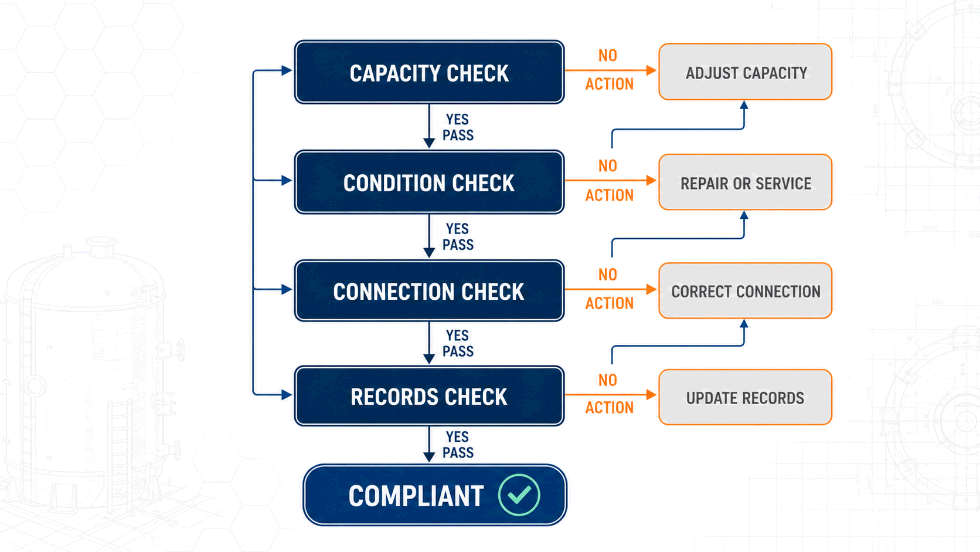
- Audit what exists: capacity vs. current kitchen load (menus and equipment grow; tanks do not), condition, connections (check for sanitary cross-connections and bypasses).
- Reconstruct the paperwork: if no sizing basis exists, produce one now against the current fixture schedule.
- Regularise the schedule: apply the 25% rule, log every service, retain manifests.
- Replace failing units proactively. A corroded concrete chamber or leaking steel tank found by an inspector is a violation with a deadline; the same unit replaced on the operator’s schedule is a routine project. One-piece GRP replacements install in days.
Special Cases
- Food courts and shared interceptors. Sized on combined peak flow; governed by a maintenance agreement; individual tenants remain answerable for their kitchen-side practices.
- Cloud/central kitchens. High FOG loads in light-industrial zonings — expect the sewer provider, not only the Amanah, to take interest; monitoring access may be required.
- Temporary and seasonal operations. Event catering and seasonal sites still require pre-treatment; above-ground GRP units suit relocatable duties.
- Fuel stations with food outlets. Two separate systems: a grease interceptor for the kitchen and an oil-water separator for the forecourt — never combined. The separator side is covered in how GRP oil-water separators work.
FAQs
1. Are grease traps mandatory for restaurants in Saudi Arabia? Yes — grease pre-treatment on FOG-bearing kitchen drainage is a standing expectation in food establishment licensing and inspection across Saudi municipalities, and a plumbing-code design requirement for food-service occupancies. The exact administrative details vary by Amanah, so confirm locally.
2. What documents do inspectors ask for regarding the grease trap? The recurring set is the service log (dates, volumes, measured layers), licensed hauler details with disposal manifests, and — for newer installations — the sizing basis and test certificate. Keeping a single compliance file per site answers all of these.
3. What oil and grease limit applies to my sewer discharge? Limits are set in the sewer connection conditions for each city and are typically in the tens of mg/L for oil and grease. Obtain the current figure from your sewer service provider rather than relying on published summaries, and maintain the interceptor so you operate well inside it.
4. Can toilets connect to the grease trap? No. Sanitary drainage must bypass the interceptor entirely; combined connections are a code violation, destroy the trap’s function, and are among the first defects flagged in older buildings.
5. Who is responsible for a shared grease trap in a food court? The interceptor requires one named responsible party under a written maintenance agreement — usually the mall or food court management — while each tenant remains accountable for kitchen-side practices such as oil disposal and strainer use.
6. What happens if my establishment causes a sewer blockage? Expect a corrective notice, potential fines, and possible recovery of clean-up costs where the blockage is traced to your discharge. A maintained interceptor with complete records is both the prevention and the defence.
7. Do I need approval before installing or replacing a grease trap? Drainage works affecting the sewer connection generally require coordination with the municipality and/or sewer provider, particularly for new connections. Replacements within an existing approved configuration are simpler but should still be documented in the compliance file.
8. Does the Saudi Building Code specify grease interceptor sizing? SBC 701 (the plumbing code) establishes the requirement for interceptors in food-service occupancies and their design provisions; detailed capacity is derived from recognised sizing methods based on fixture flows. Keep the calculation with the project documents as the sizing basis.
Key Takeaways
- Compliance is demonstrated at three moments: design (adequate, correctly connected unit), operation (condition-based servicing with records), disposal (licensed chain of custody).
- Sanitary flows never pass through the interceptor — cross-connections are violations, not legacy conditions.
- Design to the sewer provider’s current discharge conditions, obtained directly — not to figures from articles.
- Maintain one compliance file per site: sizing basis, data sheet, test certificate, service log, manifests.
- Shared interceptors need a named responsible party under a written agreement.
- Proactive replacement of failing concrete/steel units is a routine project; inspector-discovered failure is a violation with a deadline.
- Fuel stations with food outlets run two separate systems — grease interceptor and oil-water separator.
Conclusion
Grease trap compliance in Saudi Arabia rewards the establishments that treat it as an engineering routine: a documented sizing basis, a verifiably watertight unit, condition-based servicing, and a closed paper trail to licensed disposal. Everything an inspector can ask sits in one file — and everything in that file is straightforward to produce if it is built from day one.
For a compliant unit, a replacement, or help regularising an existing installation, share the following with Pioneers Fiberglass:
- Project location in Saudi Arabia (city/Amanah)
- Facility type and kitchen scale (fixtures or meals per day)
- New installation, replacement, or compliance upgrade of an existing unit
- Site conditions if relevant (soil type, water table, traffic over the unit)
- Required timeline, including any inspection or licensing deadlines
Contact Pioneers Fiberglass for a project-specific consultation →