

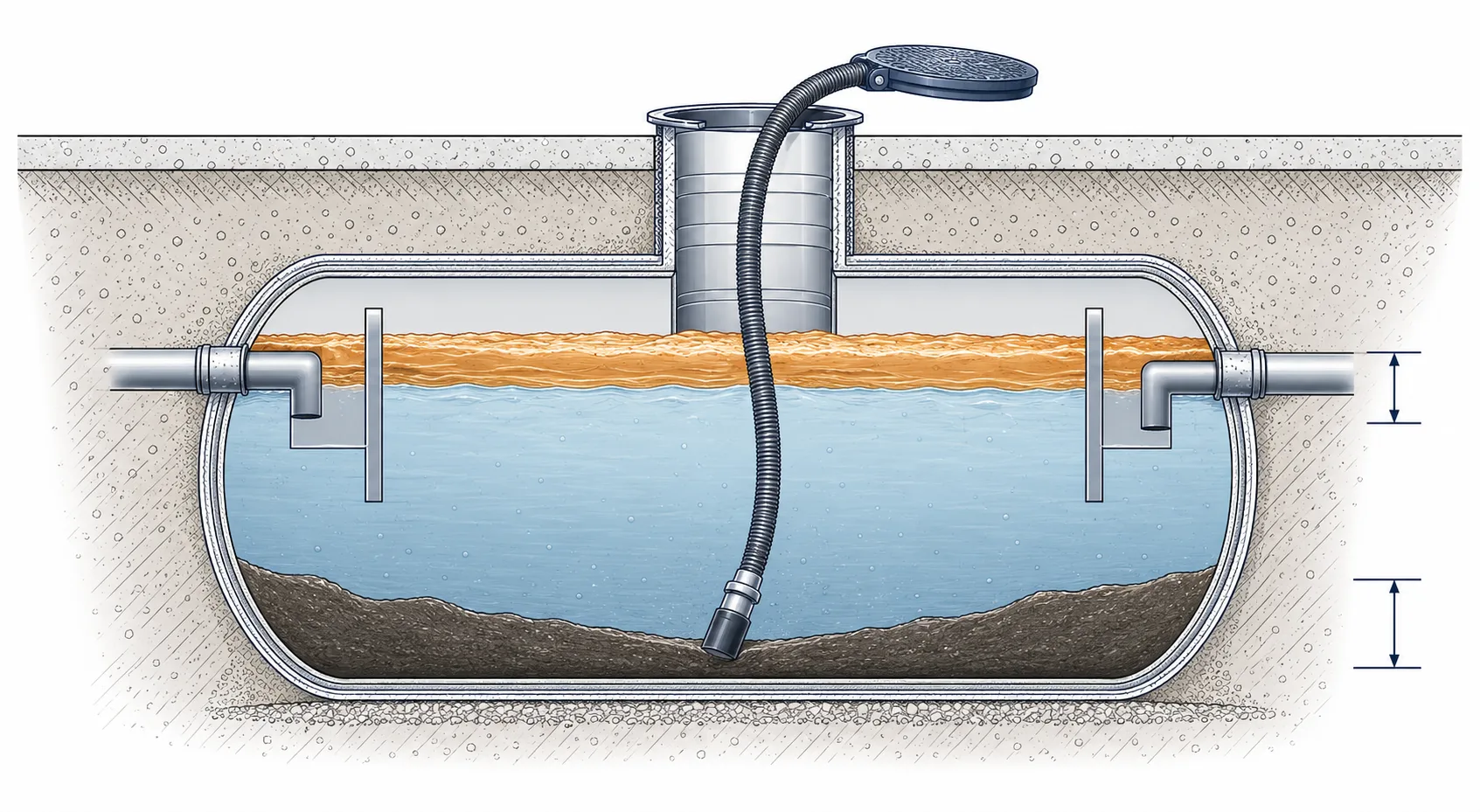
Introduction
Effective grease trap maintenance protects restaurant drainage systems, prevents sewer blockages and keeps grease interceptors operating correctly. This guide explains grease trap cleaning frequency, the 25% rule, complete pump-out procedures, inspections, record-keeping and proper waste disposal for restaurants and food facilities in Saudi Arabia.
A correctly sized grease interceptor with a wrong maintenance schedule performs like an undersized one. As grease and solids accumulate, they occupy retention volume; effective retention time falls, separation efficiency collapses, and FOG passes downstream — long before the tank is visibly “full.”
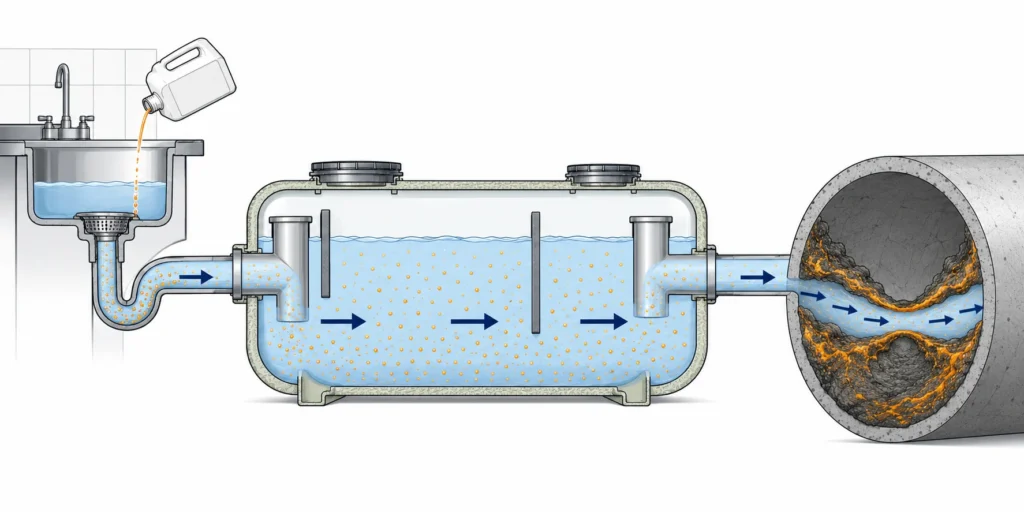
Grease Trap Maintenance is where most grease trap programmes fail in practice. The tank is buried, out of sight, and generates no alarm as its condition degrades. The consequences surface elsewhere: drain-line blockages, odour complaints, municipal violation notices, and — in the worst cases — sewer surcharges traced back to a specific establishment.
In Saudi Arabia, the operational context adds discipline requirements: pump-outs must go to licensed tanker operators and approved disposal points, food-establishment inspections increasingly ask for service records, and high ambient temperatures accelerate FOG decomposition, odour generation, and H₂S production between services.
This guide sets out how to determine the correct pump-out frequency, the full servicing procedure, the inspection points that catch problems early, and the practices that must be prohibited.
Grease Trap Maintenance: The 25% Rule and Pump-Out Frequency
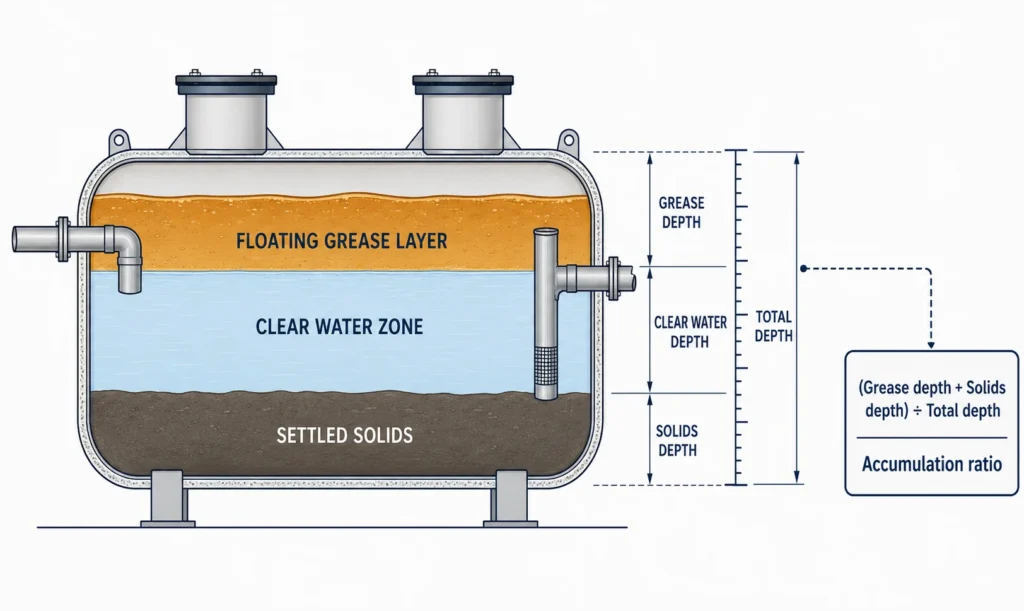
The governing standard is condition-based, not calendar-based. An interceptor requires pumping when the combined thickness of the floating grease layer plus the settled solids layer reaches 25% of the total liquid depth.
Measuring Accumulation
- Open the access cover and allow the headspace to vent before working over the opening.
- Measure the grease layer with a core sampler or a graduated dip rod fitted with a bottom plate (a “sludge judge” type sampler retrieves a full column showing all layers).
- Measure the settled solids layer from the same core.
- Calculate: (grease thickness + solids thickness) ÷ total liquid depth × 100.
- Log the result with the date. Two or three measurements establish the accumulation rate — from which a reliable service interval follows.
Grease Trap Cleaning Frequency by Facility Type
Use these as starting points; adjust from measured accumulation:
| Facility Type | Starting Interval | Adjust Toward |
|---|---|---|
| Café / light kitchen | Monthly | 6–8 weeks if measurements allow |
| Standard restaurant | Monthly | 2–4 weeks for fried-food-heavy menus |
| Broasted / grill / fried chicken outlet | 2–3 weeks | Weekly in peak seasons |
| Hotel kitchen | 2–4 weeks | Per measured rate |
| Food court shared interceptor | 2 weeks | Weekly during Ramadan and peak periods |
| Central production kitchen | Weekly–biweekly | Per measured rate |
Ramadan note: Evening-concentrated service compresses a full day’s discharge into a few hours and typically doubles FOG accumulation rates at Saudi food outlets. Schedule an additional service before and during Ramadan rather than discovering the need mid-month.
Grease Trap Pump Out: Complete Service Procedure
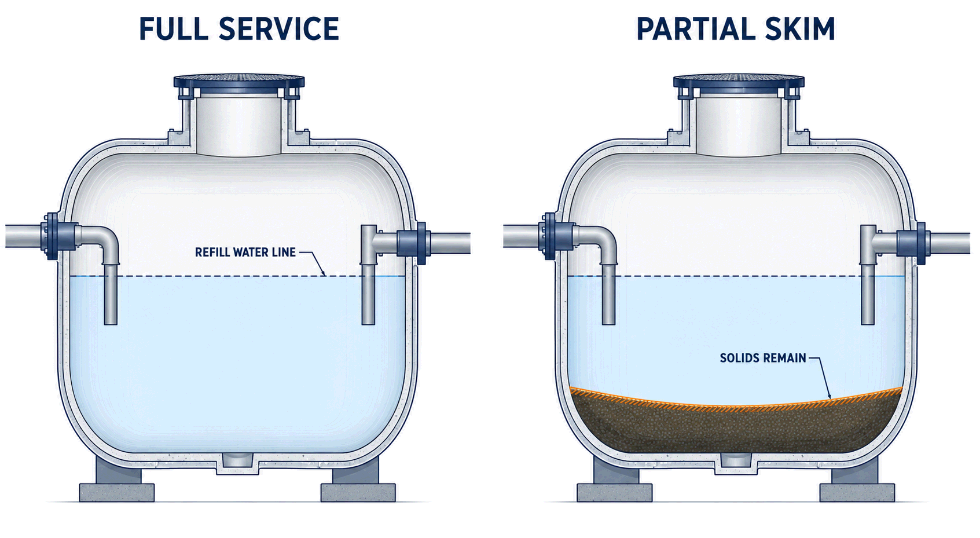
A proper service is a full evacuation and inspection — not skimming the grease cap. Partial pump-outs that remove only the floating layer leave the solids blanket in place and misrepresent the tank’s condition.
- Isolate and ventilate. Stop kitchen discharge where practical; open access covers and allow the headspace to air. H₂S in the headspace is a genuine hazard — no entry into the tank, and no leaning into shafts.
- Measure and record layers before pumping (this validates the service interval).
- Evacuate completely. Remove the grease cap, the full liquid contents, and the settled solids. Break up hardened grease with the vacuum wand or washdown as needed.
- Wash down internals. Rinse walls, baffles, and dip pipes; GRP’s smooth gelcoat releases residue readily. Remove wash water with the tanker.
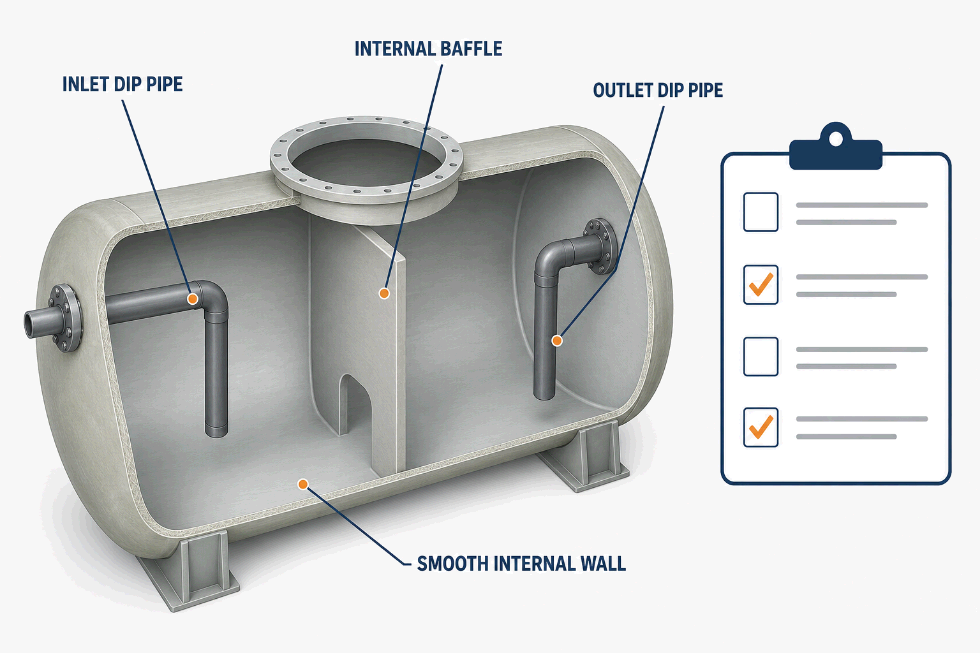
- Inspect the empty tank (from outside the access): baffle condition and fixing, inlet/outlet dip pipes intact and clear, internal surfaces, visible standing-water ingress at fittings.
- Refill with clean water to the outlet invert. An interceptor returned to service empty provides no separation until it fills and allows a slug of untreated flow to pass; refilling is part of the procedure, not an option.
- Close and seal covers; confirm gas-tight seating.
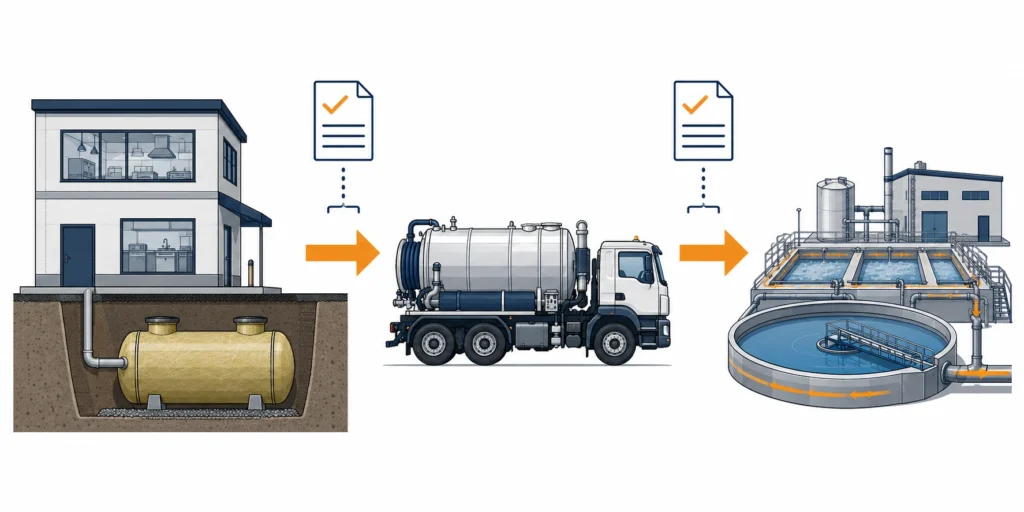
- Complete the service record: date, volumes removed, measured layers, condition notes, tanker registration, and disposal destination.
Safety warning: Grease interceptor headspaces accumulate hydrogen sulphide and are oxygen-deficient. Tank entry is confined-space work requiring gas testing, ventilation, and trained personnel — it is never part of routine servicing. All routine tasks are performed from outside the access opening.
Record-Keeping and Compliance in Saudi Arabia
The service record is the compliance instrument. Municipal (Amanah/Baladiya) food-establishment inspections and drainage authority audits increasingly expect documented evidence that pre-treatment is maintained.
A complete grease trap log contains:
| Field | Why It Matters |
|---|---|
| Service date and interval | Demonstrates schedule adherence |
| Measured grease/solids layers before service | Justifies the interval; evidence of the 25% rule |
| Volume removed | Cross-checks against tank capacity and hauler manifest |
| Hauler company and vehicle registration | Confirms licensed transport |
| Disposal destination / manifest reference | Closes the chain of custody for FOG waste |
| Condition notes and defects | Triggers repairs before failures |
- Use licensed tanker operators only. FOG waste must travel to approved treatment/disposal facilities; illegal dumping traced to an establishment carries penalties and, more practically, reputational consequences with the municipality.
- Retain manifests with the log for at least the period your municipality specifies — where unspecified, two years is a defensible minimum.
- Assign ownership. A named individual (facility or kitchen manager) owns the schedule; unowned schedules drift.
Routine Inspection Checklist (Between Pump-Outs)
A five-minute monthly walk-through catches most developing problems:
- Covers — seated, gas-tight, undamaged, not buried under stored goods or vehicles.
- Odour — persistent H₂S odour at covers indicates seal failure or an overdue service.
- Flow behaviour — slow kitchen drains or gurgling suggest downstream FOG buildup or a blinding trap.
- Surface check (cover lifted, no entry) — grease layer thickness by dip rod; floating debris that indicates missing sink strainers upstream.
- Around the tank — ground settlement, wet patches, or vegetation change over a buried unit can signal leakage; document and investigate.
- Downstream manhole — a grease film in the first downstream manhole is direct evidence of carry-over; bring the service forward and review sizing against the GRP grease trap sizing guide.
What Never to Do
These practices appear to help and reliably make things worse:
- Enzyme, bacteria, or solvent “grease dissolvers” dosed to avoid pump-outs. These agents emulsify or liquefy FOG so it passes the trap and re-solidifies in the sewer — displacing the problem downstream, where it becomes a municipal violation. Biological dosing is acceptable only as an odour-management supplement, never as a pump-out substitute.
- Hot water or steam flushing to “melt grease through.” Same mechanism: liquefied FOG re-congeals in cooler downstream pipework.
- Partial skimming as the standard service. The solids blanket drives H₂S generation and consumes retention volume.
- Returning the tank to service empty. No water, no separation — refill to the outlet invert every time.
- Connecting new equipment without review. An added fryer bank or dishwasher changes the design flow; re-check capacity before connection.
- Ignoring the trap because “it was sized generously.” Oversizing extends intervals; it does not eliminate them.
Reducing FOG at Source: Kitchen Practices That Extend Intervals
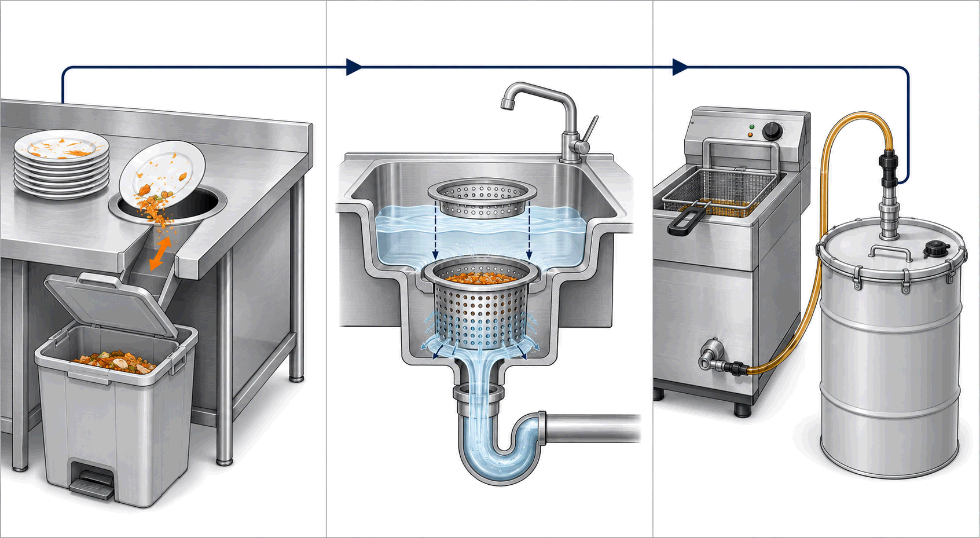
Every kilogram of FOG kept out of the drain extends the service interval and improves effluent quality:
| Practice | Effect |
|---|---|
| Dry-wipe pans and plates before washing | Largest single FOG reduction available |
| Collect used cooking oil separately for licensed recycling | Removes the highest-volume FOG stream entirely |
| Sink strainers on all wash sinks, emptied to solid waste | Cuts the solids blanket accumulation rate |
| No food grinding to drain | Grinders load the trap with fast-decomposing solids |
| Staff training with posted procedures | Sustains all of the above beyond the first month |
Used cooking oil collection deserves emphasis: in Saudi Arabia, licensed UCO collectors take fryer oil for recycling at no cost to the establishment — routing it to the drain instead converts a free service into a pump-out expense.
Maintenance and Tank Longevity
Grease Trap Maintenance discipline also protects the asset itself. Long-overdue services maximise H₂S generation — the mechanism that destroys concrete interceptors from the crown down, as detailed in the material comparison of GRP, concrete, and steel interceptors. GRP tanks are immune to the acid attack, but their internals, seals, and downstream pipework still benefit from controlled H₂S levels — and every tank, whatever the material, should have had its integrity verified at commissioning by hydrostatic test (see the FRP hydrotest guide).
During any service, treat the empty-tank inspection as a free condition survey: baffle fixings, dip pipe condition, and internal surface state, photographed and filed with the service record. Five photographs per service build a condition history that turns end-of-life decisions from surprises into plans.
FAQs
1. How often should a grease trap be cleaned in Saudi Arabia? Service is due when combined grease and solids reach 25% of liquid depth — typically every 2–4 weeks for standard restaurants and weekly to biweekly for fried-food outlets and central kitchens. Measure accumulation for the first two or three cycles, then fix the interval from the measured rate.
2. What is the 25% rule for grease traps? It is the condition-based service trigger: when the floating grease layer plus the settled solids layer together occupy one quarter of the tank’s liquid depth, the unit must be pumped. Beyond this point, retention time and separation efficiency degrade rapidly.
3. Should the grease trap be completely emptied or just skimmed? Completely emptied — grease cap, liquid, and settled solids — then washed down, inspected, and refilled with clean water to the outlet level. Skimming alone leaves the solids blanket that drives odour, H₂S, and capacity loss.
4. Why must the trap be refilled with water after cleaning? An empty interceptor provides no separation until it fills, so the first hours of kitchen discharge pass through untreated. Refilling to the outlet invert restores the water seal and separation function immediately.
5. Can I use enzymes or chemicals instead of pumping the grease trap? No. Emulsifying agents move FOG past the trap into the sewer, where it re-solidifies as blockages attributable to your establishment. Biological products may assist with odour but never replace physical removal.
6. Who can legally remove grease trap waste in Saudi Arabia? Licensed vacuum tanker operators delivering to municipally approved disposal or treatment facilities. Keep the hauler’s details and disposal manifest with every service record — inspections may ask for them.
7. Why does my grease trap smell even after cleaning? Common causes are unsealed or damaged access covers, a missing or blocked vent, an interval that is genuinely too long, or a partial service that left the solids blanket. Check cover gaskets and venting first; if odour persists, shorten the interval.
8. Does a bigger grease trap mean less maintenance? A larger unit extends the interval between services because the 25% threshold takes longer to reach, but it never eliminates servicing. Accumulated FOG must be physically removed regardless of tank size.
Conclusion
Grease trap maintenance is a measurement discipline: dip the tank, log the layers, service on condition, document the disposal. Facilities that run this loop have no blockages, no odour complaints, and nothing to fear from an inspection; facilities that guess have all three.
For maintenance planning, replacement of a failing unit, or a new correctly sized interceptor, share the following with Pioneers Fiberglass:
- Project location in Saudi Arabia
- Facility type and current tank capacity (if known)
- Application and menu profile (fried-food-heavy, general, central kitchen)
- Current service interval and any recurring problems (odour, blockages, carry-over)
- Site conditions if relevant, and timeline
Contact Pioneers Fiberglass for a project-specific consultation →