

Introduction
An undersized grease trap fails silently before it fails visibly. Fats, oils, and grease (FOG) pass through the unit at velocities too high for separation, coat the downstream drainage network, and eventually surface as blockages, odour complaints, and municipal violation notices. By the time symptoms appear, the problem has usually existed for months.
Sizing is the single most consequential decision in grease trap specification. Material selection, baffle design, and access arrangements all matter — but none of them can compensate for a unit that is too small for the kitchen it serves. Conversely, a significantly oversized trap wastes budget and floor or ground space without proportional benefit.
In Saudi Arabia, sizing carries additional weight. High ambient temperatures keep FOG in liquid or semi-liquid form longer, which changes separation behaviour. Municipal (Baladiya) enforcement of pre-treatment requirements for restaurants and food facilities has tightened, and many commercial developments now require documented sizing calculations before drainage approval.
This guide walks through the two accepted sizing methods — the fixture flow rate method and the EN 1825 nominal size method — and provides selection tables to convert calculated values into practical GRP grease trap capacities.
Grease Trap vs. Grease Interceptor: Define the Unit Before Sizing It
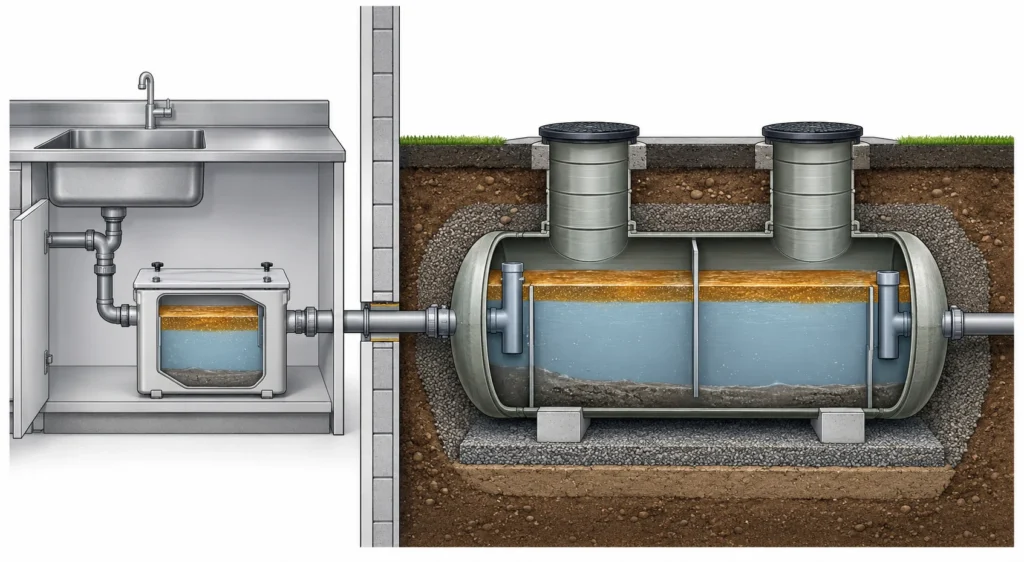
The terminology determines the sizing approach. Although the terms are used interchangeably in the field, they describe two different classes of equipment:
| Parameter | Hydromechanical Grease Trap | Gravity Grease Interceptor |
|---|---|---|
| Typical location | Inside kitchen, under or near sinks | Outside building, buried or in plant room |
| Typical capacity | 40–400 litres | 1,000–20,000+ litres |
| Flow rating basis | GPM / L/s with air entrainment | Retention time (typically ≥ 30 minutes) |
| Separation mechanism | Baffles + flow control + air relief | Gravity separation over long retention |
| Servicing frequency | Weekly to monthly | Monthly to quarterly |
| Common material | GRP, stainless steel, HDPE | GRP, concrete |
For most Saudi commercial kitchens — restaurants, hotel kitchens, catering facilities, food courts — the correct solution is an external gravity interceptor in GRP, sized on retention time and peak flow. Small under-sink traps are supplementary devices, not substitutes.
Key specification: A gravity grease interceptor should provide a minimum hydraulic retention time of 30 minutes at peak design flow. Units sized below this threshold allow emulsified FOG to escape regardless of baffle configuration.
Method 1: Fixture Flow Rate Method
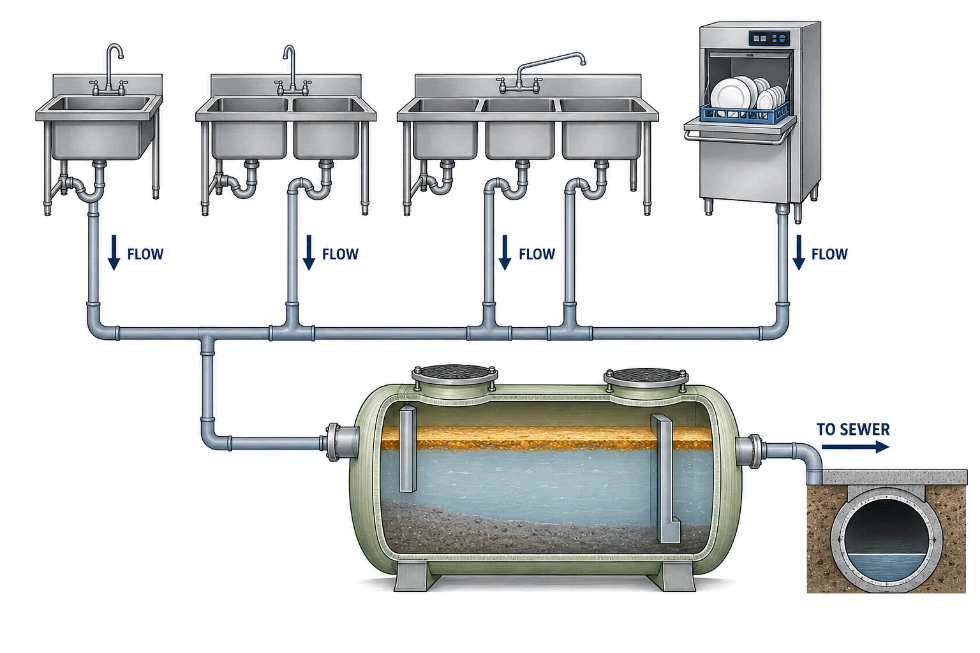
This method sizes the trap from the drainage fixtures actually connected to it. It is the most defensible approach for kitchens where the fixture schedule is known.
Step-by-Step Calculation
- List all fixtures discharging to the grease trap. Include pot sinks, pre-rinse stations, wok stations, floor drains in cooking zones, combi-oven drains, and dishwashers where the authority requires connection. Exclude WCs and hand-wash basins — these must never route through a grease trap.
- Calculate the volume of each sink fixture. Volume (litres) = length × width × depth (in metres) × 1,000, using actual water depth (typically 75% of sink depth).
- Apply a drainage factor. A standard drainage period of 1–2 minutes is assumed; a 75% fill factor accounts for displacement by utensils.
- Convert to peak flow. Peak flow (L/min) = total effective fixture volume ÷ drainage period.
- Add appliance flows. Dishwashers and combi ovens are added at their rated discharge (from manufacturer data — commonly 30–80 L/min for commercial dishwashers).
- Select trap capacity. Required liquid capacity (litres) = peak flow (L/min) × 30 minutes retention.
Worked Example
A restaurant kitchen with two pot sinks (600 × 600 × 350 mm each), one pre-rinse sink (500 × 500 × 300 mm), and one dishwasher rated 40 L/min:
| Fixture | Effective Volume (75% fill) | Drainage Period | Flow Contribution |
|---|---|---|---|
| Pot sink × 2 | 2 × 94.5 L = 189 L | 2 min | 94.5 L/min |
| Pre-rinse sink | 56 L | 2 min | 28 L/min |
| Dishwasher | — | rated flow | 40 L/min |
| Total peak flow | ≈ 162 L/min |
Required capacity = 162 L/min × 30 min = 4,860 litres → select a 5,000 L GRP interceptor.
Method 2: EN 1825 Nominal Size (NS) Method
EN 1825-2 sizes grease separators by nominal size (NS), corrected for wastewater characteristics. This method is preferred by consultants working to European specifications and is widely referenced in GCC project documentation.
The governing formula:
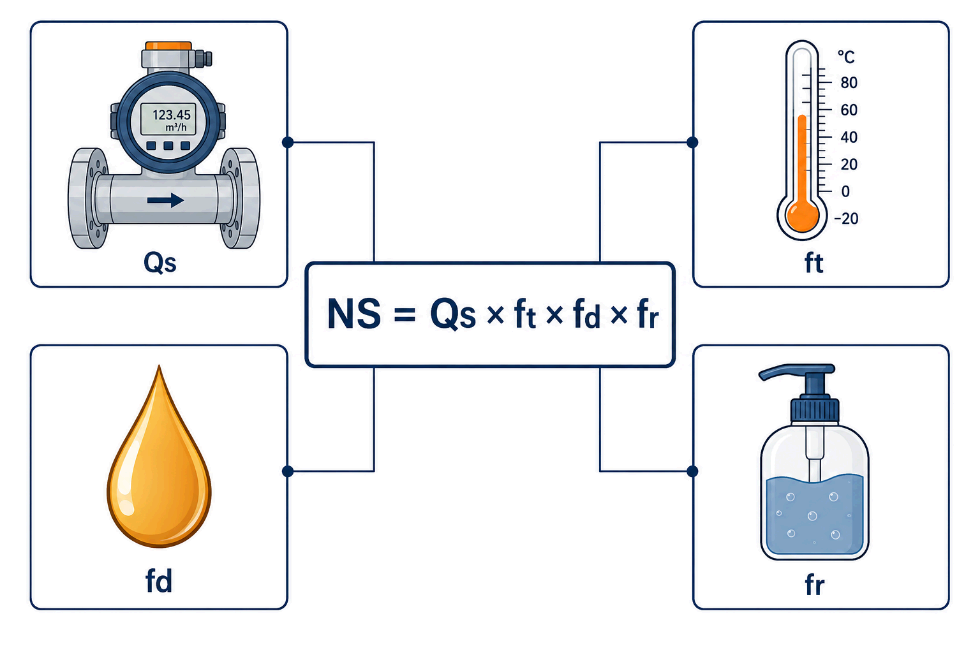
NS = Qs × ft × fd × fr
Where: Qs = maximum wastewater flow rate (L/s) ft = temperature factor (1.0 if inflow ≤ 60°C; 1.3 if > 60°C) fd = density factor for the grease type (1.0 for most cooking FOG; 1.5 for high-density fats) fr = detergent factor (1.0 no detergents; 1.3 detergents used; 1.5 for special cases such as hospitals)
Applying EN 1825 in Saudi Conditions
- Determine Qs either by fixture measurement (as in Method 1, converted to L/s) or by the meals-served method: Qs = (V × F) ÷ (3,600 × t), where V is meals per day, F is a facility factor, and t is service hours.
- Apply ft = 1.3 for most commercial kitchens — pot-wash and dishwasher discharge routinely exceeds 60°C, and high Saudi ambient temperatures slow FOG cooling.
- Apply fr = 1.3 in virtually all commercial kitchens, since detergents are always present.
- Round NS up to the next standard nominal size: NS 2, 4, 7, 10, 15, 20, 25.
NS to GRP Tank Capacity Conversion
| Nominal Size (NS) | Max Flow (L/s) | Typical Kitchen Scale | Indicative GRP Capacity |
|---|---|---|---|
| NS 2 | 2 | Café, small kitchen (< 200 meals/day) | 1,000–1,500 L |
| NS 4 | 4 | Restaurant (200–400 meals/day) | 2,000–3,000 L |
| NS 7 | 7 | Large restaurant, small hotel kitchen | 4,000–5,000 L |
| NS 10 | 10 | Hotel kitchen, food court cluster | 6,000–8,000 L |
| NS 15–25 | 15–25 | Central kitchens, catering plants | 10,000–20,000 L |
Saudi-Specific Sizing Considerations
Ambient temperature changes FOG behaviour. In Riyadh, Jeddah, and Dammam, summer soil and plant-room temperatures keep grease closer to its melting point. Liquid FOG separates by gravity more readily than solidified grease, but it also re-entrains more easily under turbulent flow — reinforcing the 30-minute retention minimum rather than relaxing it.
Municipal enforcement is capacity-aware. Amanah and Baladiya inspections of food establishments increasingly check for the presence and adequacy of grease pre-treatment. Undersized units documented in a drainage submission can delay connection approval.
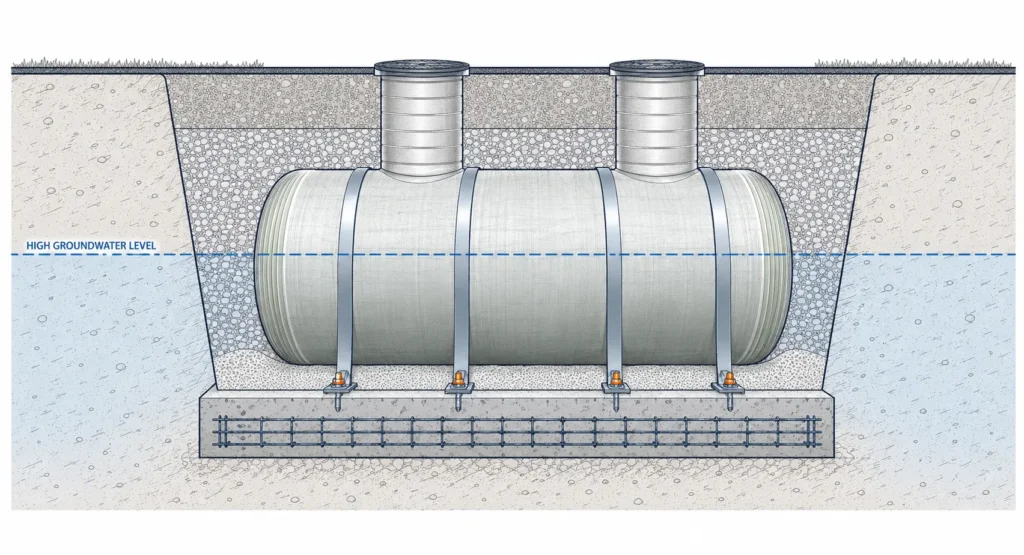
Water table and soil conditions affect the installation, not the sizing — but they affect the tank selection. Coastal Eastern Province and Jeddah sites with high water tables require anti-flotation anchoring and adequate wall stiffness in buried GRP units. Sizing and structural specification should be resolved together. For a broader treatment of buried tank decisions, see the guide on underground versus above-ground FRP tanks in Saudi Arabia.
GRP holds a specific advantage in grease service. Anaerobic decomposition of trapped FOG generates hydrogen sulphide, which converts to sulphuric acid at the tank crown — the mechanism that destroys concrete interceptors from the inside. GRP is immune to this attack, which is why concrete interceptors in grease duty routinely fail within 8–12 years while GRP units remain serviceable.
Quick Selection Table by Facility Type
Use this table for preliminary budgeting only — final sizing must follow Method 1 or Method 2 with actual fixture and flow data.
| Facility Type | Meals/Day (typical) | Recommended GRP Interceptor | Suggested Service Interval |
|---|---|---|---|
| Coffee shop / small café | < 150 | 500–1,000 L | Monthly |
| Standard restaurant | 150–400 | 2,000–3,000 L | Monthly |
| Large restaurant / broasted & grill | 400–800 | 4,000–5,000 L | 2–4 weeks |
| Hotel kitchen | 800–1,500 | 6,000–8,000 L | 2–4 weeks |
| Food court (shared unit) | 1,500–3,000 | 10,000–15,000 L | 2 weeks |
| Central production kitchen | 3,000+ | 15,000–20,000 L (or duty/standby pair) | Weekly–biweekly |
Common Sizing Errors and Their Consequences
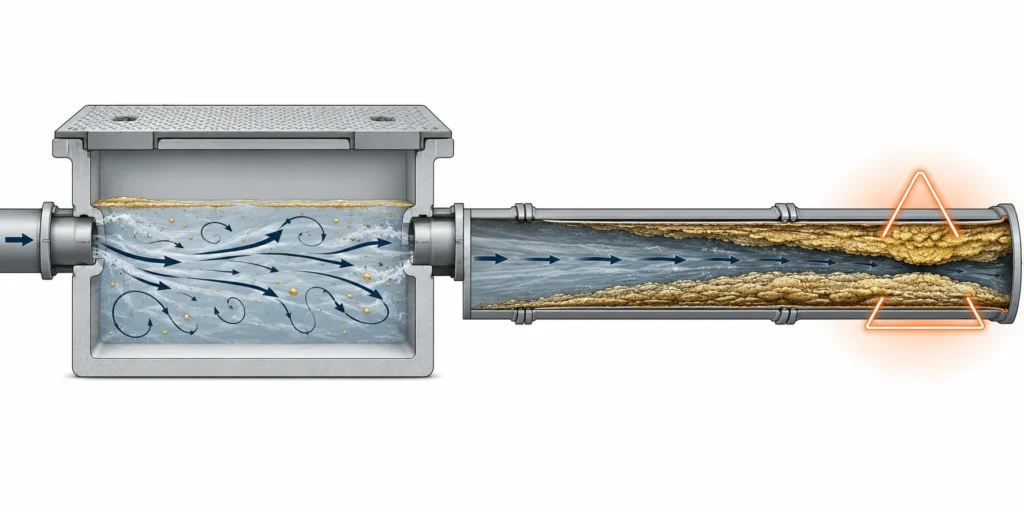
- Sizing on tank volume instead of retention at peak flow. A 5,000 L tank serving a 300 L/min kitchen provides only 16 minutes of retention — functionally undersized despite its nominal capacity.
- Ignoring the dishwasher. High-temperature, detergent-rich dishwasher discharge is the single largest emulsification source; omitting it understates both flow and the fr/ft correction factors.
- Connecting non-kitchen drainage. Routing sanitary or rainwater flows through the interceptor consumes retention capacity and violates drainage codes.
- No allowance for FOG storage volume. Between services, accumulated grease and settled solids occupy up to 25% of liquid volume. Sizing at the bare minimum forces impractically frequent pump-outs.
- Sizing without a commissioning check. Every installed unit should be water-tested for integrity before handover — the procedure is covered in the FRP hydrotest guide.
FAQs
1. What size grease trap do I need for a restaurant in Saudi Arabia? Most standard restaurants serving 150–400 meals per day require a 2,000–3,000 litre GRP gravity interceptor. The final size must be verified against peak fixture flow with a minimum 30-minute retention time, plus municipal requirements for your city.
2. How is grease trap size calculated? Two accepted methods exist: the fixture flow rate method (peak flow × 30 minutes retention) and the EN 1825 nominal size method (NS = Qs × ft × fd × fr). Both produce a required liquid capacity that is rounded up to the nearest standard tank size.
3. What is the minimum retention time for a grease interceptor? A minimum of 30 minutes hydraulic retention at peak design flow is the accepted engineering baseline for gravity separation of FOG. Shorter retention allows emulsified grease to pass through regardless of baffle design.
4. Should the dishwasher connect to the grease trap? Practice varies by municipality. Where connection is required, its rated discharge must be added to peak flow and the EN 1825 temperature factor (ft = 1.3) applied, since dishwasher discharge exceeds 60°C. Some authorities instead require a separate cooling/settling arrangement — confirm locally before design freeze.
5. Is GRP better than concrete for grease interceptors? For grease duty, yes. Hydrogen sulphide generated by decomposing FOG converts to sulphuric acid, which attacks concrete crowns and joints; GRP is chemically immune to this mechanism. GRP units are also one-piece, watertight, and 80–90% lighter, simplifying installation.
6. How often should a grease trap be emptied? When the combined grease and solids layer reaches 25% of liquid depth — typically every 2–4 weeks for restaurants and weekly to biweekly for central kitchens. The 25% rule should override any fixed calendar schedule.
7. Can one grease interceptor serve multiple restaurants in a food court? Yes, provided it is sized on the combined peak flow of all connected kitchens and access for servicing is maintained. Shared units of 10,000–15,000 litres are common in Saudi food court developments, usually with a formal maintenance agreement.
8. Do buried GRP grease traps need anchoring in Saudi Arabia? On high water table sites — common in coastal Eastern Province and parts of Jeddah — buried GRP tanks require anti-flotation anchoring to a concrete ballast slab. Inland sites with deep groundwater typically need only correct bedding and backfill.
Conclusion
Correct grease trap sizing protects the drainage network, keeps the facility compliant, and sets a realistic maintenance rhythm. The calculation itself is straightforward — the discipline lies in using real fixture data, applying the correction factors honestly, and rounding up rather than down.
For a project-specific sizing and quotation, share the following with Pioneers Fiberglass:
- Project location in Saudi Arabia
- Facility type and meals served per day (or full fixture schedule)
- Whether the unit will be buried or above ground
- Site conditions if relevant (soil type, water table, available footprint)
- Required capacity if already calculated, and project timeline
Contact Pioneers Fiberglass for a project-specific consultation →