

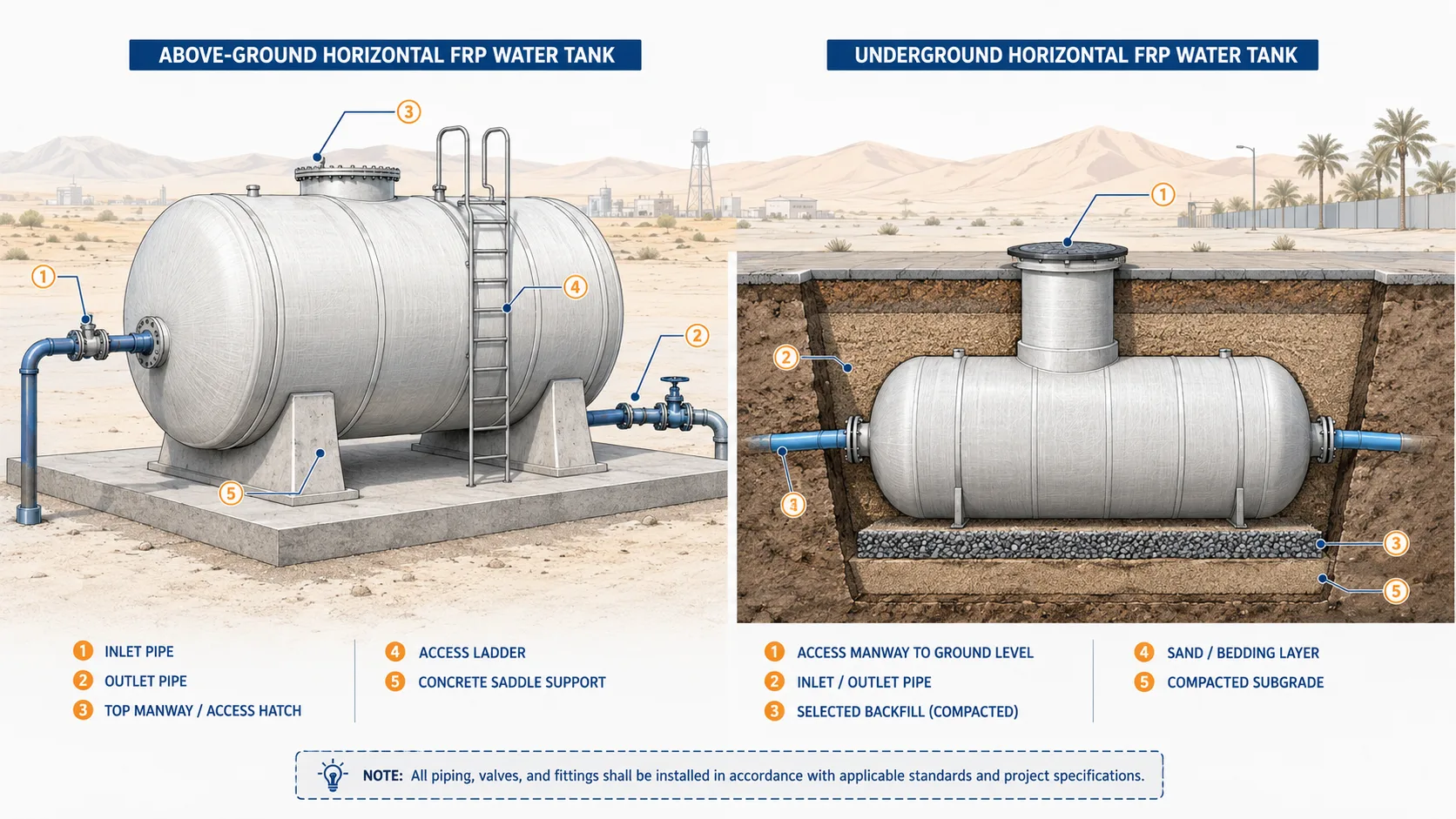
Underground vs Above-Ground FRP Water Tanks: Key Differences
This comparison helps project owners, consultants, and contractors understand the main differences between underground and above-ground FRP water tank installations in Saudi Arabia, including foundation design, access, groundwater risk, heat exposure, and maintenance.
Introduction
Underground vs Above-Ground FRP Water Tanks in Saudi Arabia require different design decisions for foundation, heat exposure, groundwater control, installation cost, and long-term maintenance.
Both options use the same base material — fiberglass reinforced plastic — but the structural design, wall construction, foundation requirements, installation process, and maintenance considerations are fundamentally different.
The correct choice depends on several factors specific to the project:
- Available space on the site
- Soil type and groundwater conditions
- Aesthetic or planning restrictions
- Seismic and traffic loading requirements
- Maintenance access needs
- Temperature control requirements
- Budget and lifecycle cost
In Saudi Arabia, both installation methods are common. Above-ground tanks are the default for most industrial, commercial, and residential water storage. Underground tanks are used when site space is limited, aesthetic restrictions apply, or the tank must be protected from extreme surface temperatures and UV exposure.
This article compares underground and above-ground FRP water tank installations, explains the engineering differences, and provides a practical selection guide for Saudi conditions.
Underground vs Above-Ground FRP Water Tanks: Key Differences
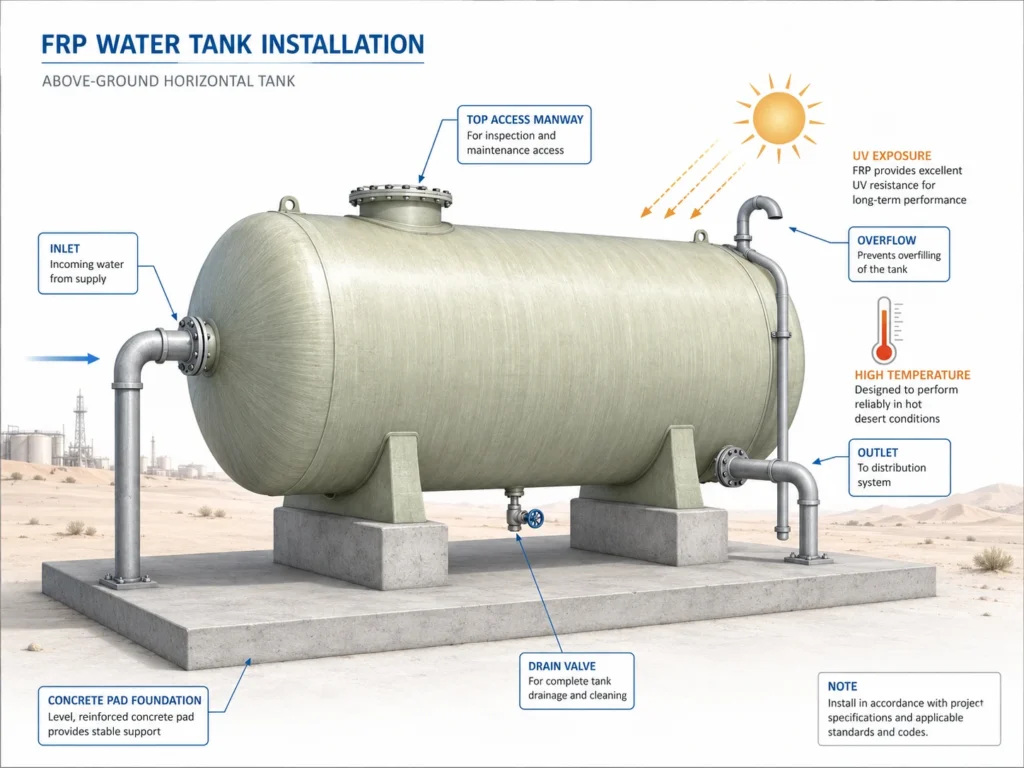
Above-ground installation is the most common method for FRP water tanks in Saudi Arabia. The tank sits on a prepared foundation at ground level or on an elevated platform.
Structural Design
Above-ground FRP tanks carry hydrostatic load (the weight of the stored water pushing outward) and wind loads. The tank wall is designed to resist internal pressure. For horizontal tanks, saddle supports distribute the tank weight and water load to the foundation.
For vertical tanks, the base is designed to support the full hydrostatic head. The wall thickness increases toward the bottom of the tank where pressure is highest.
Above-ground tanks do not need to resist external soil pressure — this simplifies the structural design compared to underground tanks.
Foundation Requirements
Above-ground tanks require a flat, level foundation that can support the full weight of the tank plus water. Common foundation types in Saudi Arabia include:
- Flat concrete pad — for vertical tanks
- Concrete saddles — for horizontal tanks (typically two saddles at specific spacing)
- Steel frame or platform — for elevated installations
- Compacted granular base with concrete ring beam — for large vertical tanks
The foundation must be designed by a structural engineer based on the tank weight, water volume, and local soil bearing capacity.
Advantages of Above-Ground Installation
| Advantage | Explanation |
|---|---|
| Easier inspection | Full visual access to tank surface for leak detection and condition monitoring |
| Simpler maintenance | Cleaning, repair, and recoating can be performed without excavation |
| Lower installation cost | No excavation, backfill, or dewatering required |
| Flexible relocation | Tank can be moved to a different location if needed |
| Simpler piping connections | All connections are accessible above ground |
| Faster installation | Foundation + placement + piping can be completed in days |
Disadvantages of Above-Ground Installation
| Disadvantage | Explanation |
|---|---|
| Higher UV exposure | Tank surface is exposed to direct sunlight — requires UV-stabilized gelcoat |
| Higher water temperature | Stored water may heat up in summer without insulation |
| Space consumption | Tank occupies usable site area at ground level |
| Visual impact | Tank is visible — may not meet aesthetic requirements for some sites |
| Wind load exposure | Tank must resist wind forces, especially in open areas |
Underground FRP Water Tanks
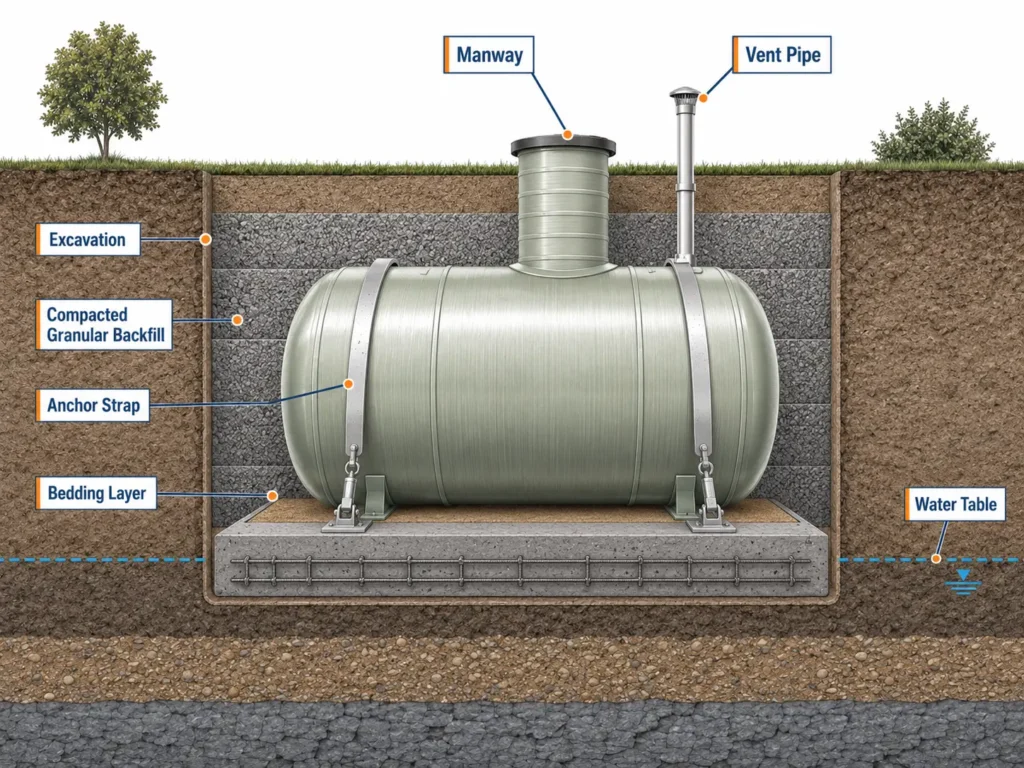
Underground (buried) installation places the FRP tank below ground level, fully or partially surrounded by backfill material. Only the access manway, vent, and piping connections extend above the surface.
Structural Design Differences
Underground FRP tanks face a completely different loading condition compared to above-ground tanks:
- External soil pressure — the weight and lateral pressure of the surrounding soil push inward on the tank wall
- Groundwater buoyancy — if the water table is high, an empty or partially filled tank can experience uplift forces (buoyancy) that try to push the tank out of the ground
- Traffic loads — if the tank is under a road, parking area, or driveway, vehicle loads are transmitted through the soil to the tank
- Backfill compaction loads — forces applied during backfill compaction must not damage the tank
These additional loads require a different — and typically heavier — structural design compared to an above-ground tank of the same capacity. The wall may be thicker, additional structural ribs or stiffeners may be added, and the overall laminate schedule must account for external pressure.
This means underground FRP tanks are not simply above-ground tanks placed in a hole. They are engineered specifically for buried service.
Soil Conditions in Saudi Arabia
Saudi Arabia presents several soil-related challenges for underground tank installation:
Sabkha soils — Salt-crusted, high-salinity soils found in coastal areas and inland basins. Sabkha is highly corrosive to steel and concrete but has minimal effect on FRP. However, sabkha soils have poor bearing capacity and may require ground improvement.
Sulfate-rich soils — Common across much of Saudi Arabia. Sulfate attacks concrete aggressively but does not affect FRP. This is one of the key advantages of FRP over concrete for underground water storage.
Rocky ground — In some areas, the ground is rocky with limited topsoil. Excavation is more expensive, and bedding material is needed to protect the tank from point loads against rock.
High water table — In coastal areas (Jeddah, Dammam, Jubail, Yanbu), the water table may be shallow. Anti-buoyancy measures (anchor straps, concrete hold-down slabs) are required to prevent an empty tank from floating upward.
Sandy soils — Common in desert areas. Sandy soils drain well but provide less lateral support than cohesive soils. Proper compaction of backfill is critical.
Installation Process for Underground FRP Tanks
Underground installation requires a defined sequence:
- Excavation — Dig the pit to the required dimensions, with clearance around the tank for backfill
- Dewatering — If groundwater is present, dewater the excavation before tank placement
- Bedding — Place a bedding layer of clean, compacted sand or pea gravel at the bottom of the pit (typically 150–300 mm thick) to provide uniform support
- Tank placement — Lower the tank into the pit using a crane, ensuring proper orientation and alignment
- Anti-buoyancy measures — Install anchor straps and/or concrete hold-down slab if required for high water table conditions
- Piping connections — Connect inlet, outlet, overflow, and vent piping
- Backfill — Fill around the tank with approved granular backfill material in controlled lifts (typically 300 mm layers), compacting each lift. The tank should be partially filled with water during backfill to resist compaction forces
- Surface restoration — Restore the ground surface, leaving only access points visible
Advantages of Underground Installation
| Advantage | Explanation |
|---|---|
| No UV exposure | Tank is fully shielded from sunlight — eliminates UV degradation |
| Cooler water temperature | Soil insulates the tank, keeping stored water cooler in summer |
| Space preservation | Ground surface above the tank remains usable |
| Aesthetic benefit | Tank is hidden — no visual impact on the site |
| Protection from vandalism | Tank is inaccessible from the surface |
| Lower wind load | No wind force on the tank structure |
Disadvantages of Underground Installation
| Disadvantage | Explanation |
|---|---|
| Higher installation cost | Excavation, bedding, backfill, dewatering, and crane work add cost |
| Harder to inspect | Visual inspection requires entering the tank through the manway |
| Harder to maintain | Cleaning and repair require confined-space entry protocols |
| Risk of buoyancy | Empty tank in high water table areas can float if not properly anchored |
| Piping access | Underground piping connections are harder to inspect and repair |
| Cannot be relocated | Tank is permanent once installed and backfilled |
| Heavier structural design | Additional wall thickness or stiffeners required for soil loads |
Direct Comparison: Underground vs Above-Ground
| Factor | Above-Ground | Underground |
|---|---|---|
| UV exposure | High — requires gelcoat + UV stabilizers | None — fully shielded by soil |
| Water temperature in summer | Higher — may require insulation | Lower — soil provides natural insulation |
| Installation cost | Lower | Higher (excavation, backfill, crane) |
| Structural design complexity | Standard | Higher (external soil pressure, buoyancy) |
| Inspection ease | Easy — full visual access | Difficult — confined space entry required |
| Maintenance ease | Easy — accessible from outside | Difficult — requires excavation for external access |
| Space usage | Occupies ground-level area | Ground surface remains usable |
| Visual impact | Tank is visible | Tank is hidden |
| Relocation possible | Yes | No |
| Lifecycle cost | Lower (installation + maintenance) | Higher (installation + maintenance) |
| Corrosion resistance to soil | N/A | Excellent — FRP resists sulfate, chloride, and sabkha |
FAQs
Can the same FRP tank be installed above ground or underground?
No. Underground tanks require a different structural design to resist external soil pressure and potential buoyancy forces. An above-ground tank placed underground without structural modification may collapse under soil load. Always specify the installation method when ordering — the manufacturer must design the tank accordingly.
Is FRP suitable for underground installation in Saudi Arabia’s soil conditions?
Yes. FRP is excellent for underground installation in Saudi Arabia because it resists sulfate attack, chloride corrosion, and sabkha conditions that damage concrete and steel. FRP does not corrode in contact with aggressive soils, making it a superior choice for buried service in KSA conditions.
What happens if an underground FRP tank is not anchored in a high water table area?
An empty or partially filled FRP tank is lighter than the water it displaces in saturated soil. Without anchoring, groundwater buoyancy can push the tank upward out of the ground — a phenomenon called flotation or buoyancy failure. This can damage piping connections, crack the surface above, and potentially destroy the installation. Anti-buoyancy anchoring is mandatory in high water table areas.
How long does an underground FRP tank last?
With proper installation (correct bedding, backfill, and anchoring), an underground FRP tank can last 25–30+ years. Because the tank is shielded from UV exposure, the gelcoat and surface laminate do not degrade from sunlight. The primary durability factors are resin quality, wall thickness, and installation quality.
Is underground installation more expensive than above-ground?
Yes, typically 30–60% more expensive when including excavation, dewatering, bedding, backfill, crane hire, and anti-buoyancy measures. However, the underground option may save costs elsewhere — by freeing surface space, eliminating the need for insulation, and removing visual impact concerns. The total project economics should be evaluated, not just the tank installation cost.
Can I drive vehicles over a buried FRP tank?
Only if the tank is specifically designed for traffic loading and installed at the correct depth with appropriate backfill and load distribution. Standard underground tanks are not rated for vehicle traffic. If vehicles will pass over the tank, this must be specified at the design stage so the manufacturer can provide a traffic-rated structural design.
What backfill material should be used around an underground FRP tank?
Clean, well-graded sand or pea gravel is the standard backfill material. Large rocks, construction debris, sharp objects, and cohesive clay should not be used — they can create point loads that damage the tank wall. Backfill should be placed in controlled lifts (typically 300 mm) and compacted uniformly on both sides of the tank.
Does an underground FRP tank need waterproofing?
No. FRP is inherently waterproof and does not absorb water or corrode in contact with groundwater. Unlike concrete tanks, FRP does not need external waterproof membranes or coatings. This is one of the significant advantages of FRP for underground installation.
Key Takeaways
Above-ground and underground FRP tank installations serve different project needs — they are not interchangeable configurations of the same tank design.
Above-ground installation is simpler, cheaper, easier to inspect and maintain, and suitable for most industrial and commercial sites where space and visual impact are not constraints.
Underground installation preserves surface space, eliminates UV exposure, keeps water cooler, and hides the tank visually — but requires heavier structural design, higher installation cost, and more complex maintenance access.
Underground FRP tanks must be specifically designed for buried service — external soil pressure, buoyancy, traffic loads, and backfill compaction forces must all be accounted for in the structural design.
FRP is an excellent material for underground installation in Saudi Arabia because it resists sulfate, chloride, and sabkha soil conditions that attack concrete and steel.
Anti-buoyancy anchoring is mandatory for underground tanks in high water table areas (coastal cities, areas with seasonal groundwater rise).
Always specify the installation method (above-ground or underground) when ordering an FRP tank — the manufacturer needs this information at the design stage.
Conclusion
Choosing between underground and above-ground installation is a project-level decision that affects tank design, cost, maintenance, and service life. The right choice depends on your site conditions, space constraints, and operational requirements.
Pioneers Fiberglass manufactures FRP water tanks for both above-ground and underground installation, engineered to Saudi Arabia’s soil and climate conditions. We can help evaluate your site requirements and recommend the optimal installation method.
To get a tailored recommendation, please share:
- Project location in Saudi Arabia
- Tank capacity required
- Available space and site layout
- Soil type and water table information (if known)
- Traffic loading requirements (if underground)
- Aesthetic or planning restrictions
- Budget parameters
Contact Pioneers Fiberglass for a site-specific consultation →