

Introduction
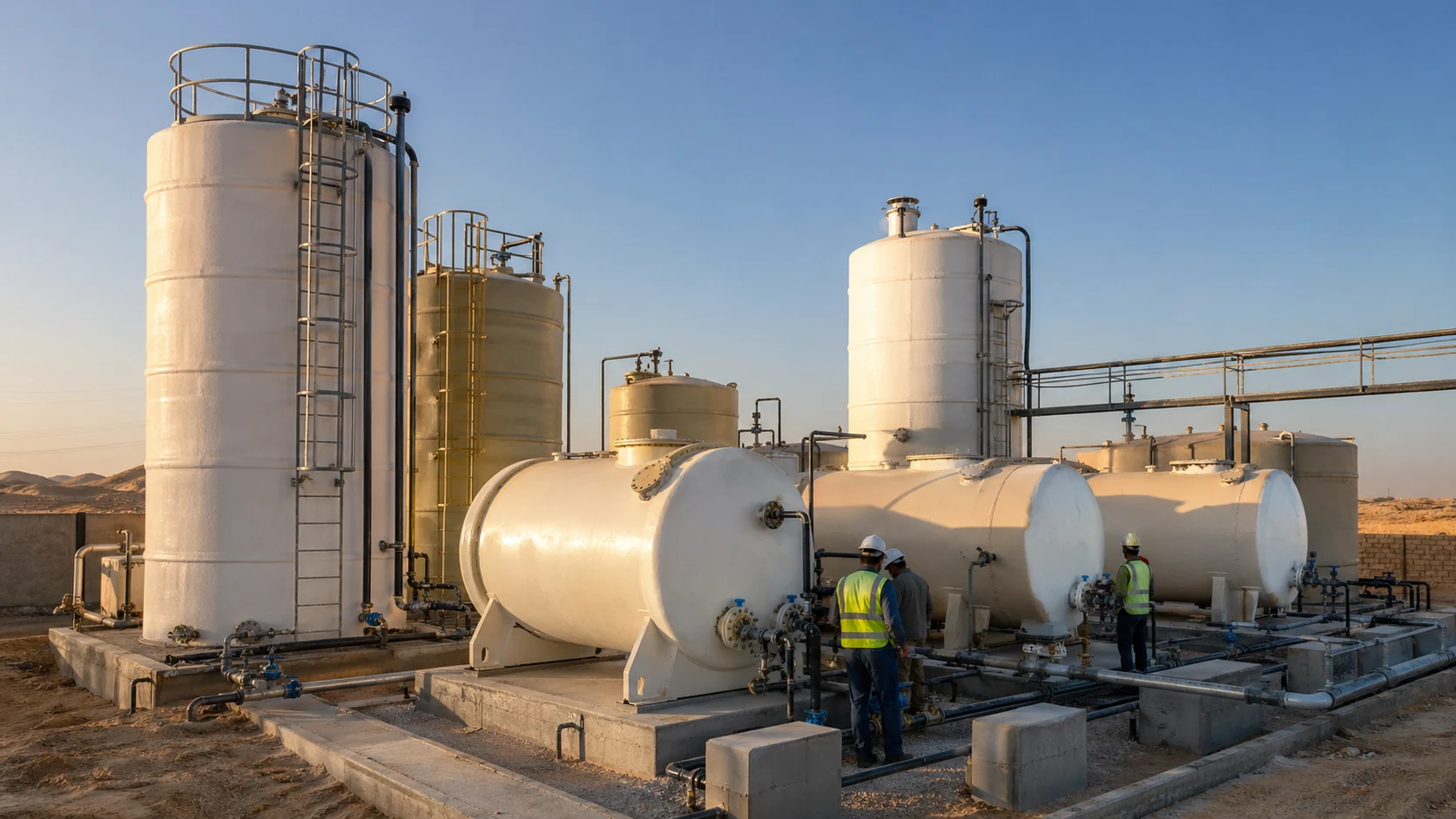
Fiberglass water tank price Saudi Arabia is one of the most searched questions among villa owners, contractors, factories, farms, and procurement teams across the Kingdom. Fiberglass — also known as FRP (Fiber Reinforced Plastic) or GRP (Glass Reinforced Plastic) — has become a leading water storage choice in KSA because the hot climate, hard water, and demanding industrial environments require tanks that resist corrosion, do not rust, handle high temperatures, and last for decades with minimal maintenance.
Fiberglass — also known as FRP (Fiber Reinforced Plastic) or GRP (Glass Reinforced Plastic) — meets these requirements. FRP tanks do not corrode like steel, do not deform under heat the way thin plastic tanks can, and can be manufactured to almost any size and specification. From a 500-liter rooftop tank for a villa to a 100,000-liter industrial reservoir, fiberglass works reliably across Saudi Arabia and the wider GCC region.
If you are sourcing tanks for a project, the first question is almost always the same: what is the fiberglass water tank price in Saudi Arabia? The honest answer is that pricing depends on several technical and commercial factors. This guide breaks them down so you can request an accurate quotation, avoid common procurement mistakes, and choose the right tank for your application.
Quick Answer
The fiberglass water tank price Saudi Arabia buyers receive is not a single fixed number. It is determined by capacity, tank type (vertical or horizontal, aboveground or underground), wall thickness, resin system, internal liner, fittings and accessories, installation requirements, delivery distance, and project specifications.
A small 1,000-liter rooftop fiberglass tank for a villa is in a very different price category from a 30,000-liter horizontal industrial tank with custom nozzles, manholes, and food-grade liner. Any indicative figures shared online should be treated as a starting point only — the final fiberglass water tank price in Saudi Arabia must be confirmed by a written quotation based on your actual specification.
In short, the fiberglass water tank price Saudi Arabia projects pay reflects the tank’s full specification, not just its capacity.
To request an accurate price, you can contact our engineering team with your tank capacity, application, and site location.
Fiberglass Water Tank Price Saudi Arabia: Key Cost Factors
Several technical and logistical factors influence the final cost of an FRP water tank. Understanding them helps you compare quotations fairly and avoid paying for features you do not need — or under-specifying a tank that will fail prematurely.
Tank Capacity
Capacity is the most obvious cost driver. Larger tanks require more raw material, more reinforcement layers, larger molds, and more labor. However, the relationship is not linear: the price per liter usually decreases as capacity increases, because fixed costs (handling, fittings, transport setup) are spread across a larger volume.
Vertical vs Horizontal Design
Vertical tanks are typically cheaper to manufacture for the same capacity because they use less floor space and simpler structural support. Horizontal tanks need additional saddle supports and reinforcement, especially at larger volumes, which adds to cost.
Aboveground vs Underground Installation
Underground FRP tanks must withstand soil pressure, groundwater loads, and possible vehicle traffic above. They need thicker walls, ribbed reinforcement, and sometimes anchor systems. Aboveground tanks are simpler and generally less expensive.
Wall Thickness and Structural Design
Wall thickness is engineered based on diameter, height, internal pressure, and external loads. A thin-walled tank may look identical to a thick-walled tank from outside but perform very differently over time. Reputable suppliers calculate calculate wall thickness based on standards such as BS 4994 or ASTM D3299 , and the price reflects that engineering work.
Resin Type and Laminate Quality
Standard isophthalic resins are common for general water storage. Vinyl ester or food-grade resins cost more but are essential for potable water, treated water, or chemically aggressive applications. The lamination schedule (chopped strand mat, woven roving, surface veil) also affects both performance and price.
Food-Grade or Water-Safe Inner Liner
For drinking water, the inner liner must be made from a food-grade resin compliant with potable water standards. This single specification can change the price meaningfully, but skipping it for drinking water is not an option.
Nozzles, Manholes, Flanges, Vents, Level Indicators, and Fittings
Every nozzle, flange, manhole, overflow, vent, drain, level gauge, and ladder adds material and labor cost. A bare tank is much cheaper than the same tank fully equipped for installation.
Single-Wall vs Double-Wall (Secondary Containment)
Double-wall tanks with secondary containment are required for some chemical and environmental applications. They roughly double the laminate work and inspection effort, which is reflected in pricing.
Delivery Distance and Site Access
Delivery from a Riyadh, Dammam, or Jeddah factory to a remote site in the Eastern Province, NEOM, or the southern regions adds transport and crane cost — especially for large horizontal or vertical tanks that need special trailers and offloading equipment.
Custom Drawings and Project Specifications
Project-specific drawings, consultant approvals, third-party inspection (TPI), and material test certificates (MTCs) are common for industrial and government projects. They add engineering time and documentation cost but are non-negotiable for serious procurement.
Common Fiberglass Water Tank Sizes in Saudi Arabia
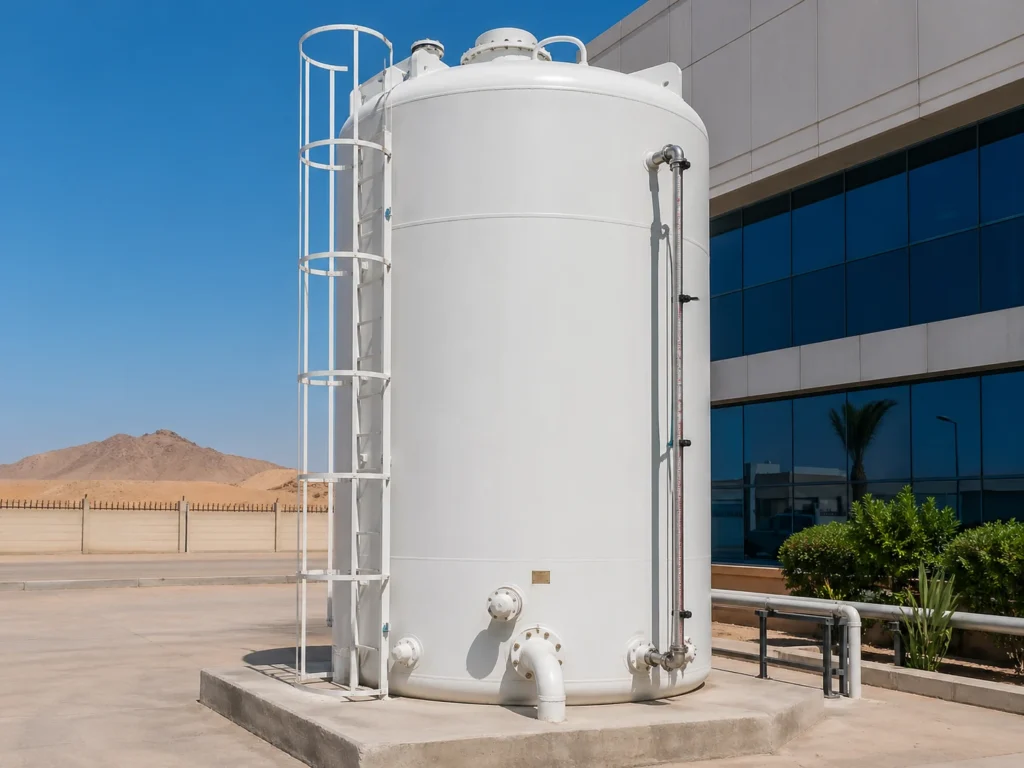
Fiberglass tanks can be manufactured in almost any size, but certain capacities are standard and widely used across the Saudi market.
| Capacity | Common Applications | Typical Tank Type | Notes for Buyers |
|---|---|---|---|
| 500 L | Small villas, rooftop top-up tanks, kiosks | Vertical | Often used as an auxiliary tank above main supply |
| 1,000 L | Villas, small offices, mosques | Vertical | Standard rooftop size in KSA |
| 2,000 L | Medium villas, small workshops | Vertical | Good balance of footprint and capacity |
| 3,000 L | Large villas, small commercial buildings | Vertical | Common in residential compounds |
| 5,000 L | Compounds, small farms, restaurants | Vertical | Popular for buildings with multiple users |
| 10,000 L | Villas with gardens, farms, small factories, commercial buildings | Vertical or Horizontal | Highly searched and widely used |
| 15,000 L | Farms, mid-size factories, schools | Vertical or Horizontal | Often paired with pump systems |
| 20,000 L | Industrial sites, agriculture, hotels | Horizontal common | Dimensions depend on site space |
| 30,000 L | Industrial water supply, dairy farms, treatment plants | Horizontal common | Custom nozzles typical |
| 50,000 L | Large factories, district cooling, fire water | Horizontal or vertical | Engineering drawings required |
| 100,000 L | Mega projects, infrastructure, fire reserves | Custom (usually sectional or large horizontal) | Often built to project specification |
Fiberglass Water Tank Price Saudi Arabia for 10,000 Liter Tanks: Why This Size Is Popular
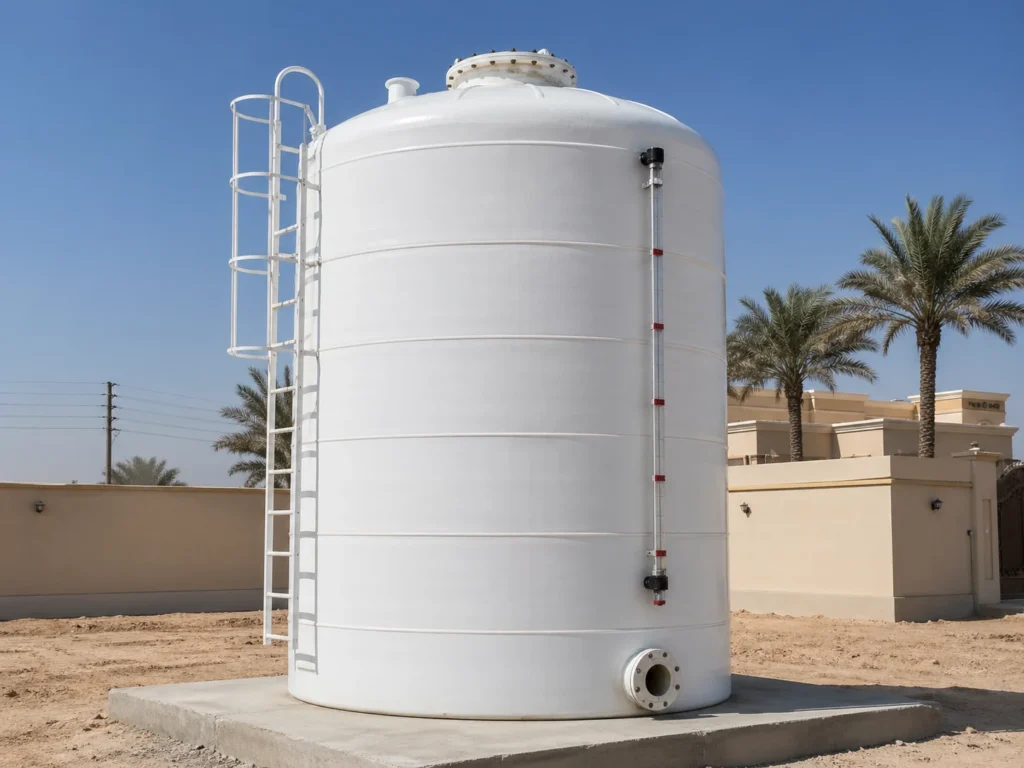
The 10,000-liter fiberglass tank is one of the most frequently quoted sizes in Saudi Arabia, and there are clear reasons for its popularity:
- It comfortably serves a medium-to-large villa with a garden and pool.
- It works for small commercial buildings, restaurants, mosques, and schools.
- It is widely used on farms for daily water supply, drip irrigation buffer storage, and livestock.
- It suits small factories that need a stable on-site water reserve.
- It can be placed as either a vertical or horizontal tank depending on available space.
The 10,000 liter fiberglass tank price varies based on whether it is vertical or horizontal, single or double wall, the number and size of nozzles, whether a food-grade liner is required, and the delivery location. A basic vertical tank for a villa is significantly cheaper than a horizontal industrial tank with custom flanged nozzles, manhole, ladder, and TPI documentation. For an accurate figure, the supplier needs your full specification — not just the capacity. For an accurate fiberglass water tank price Saudi Arabia at 10,000-liter capacity, the supplier needs your complete specification — not just the capacity.
Vertical vs Horizontal Fiberglass Water Tanks
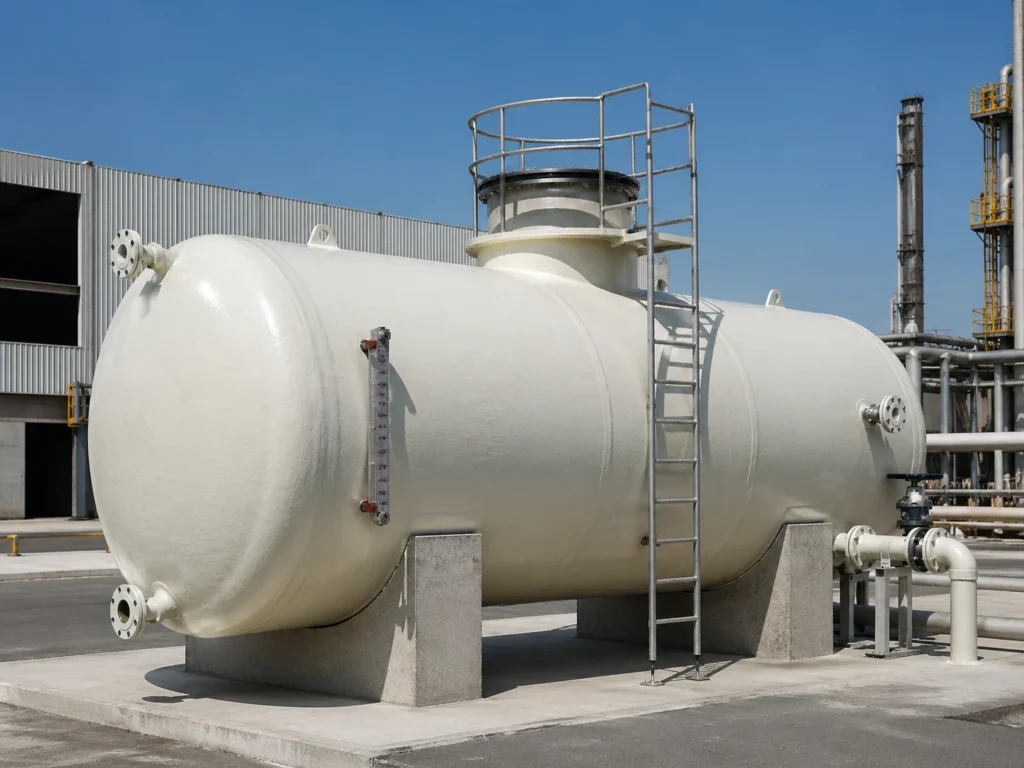
Choosing between vertical and horizontal is mainly about space, application, and access.
| Feature | Vertical FRP Tank | Horizontal FRP Tank |
|---|---|---|
| Footprint | Small (uses height) | Large (uses length) |
| Headroom required | High | Low |
| Installation | Concrete pad, sometimes anchoring | Saddle supports or cradle |
| Structural support | Self-supporting on flat base | Needs saddles, often two or more |
| Maintenance access | Top manhole, side fittings | Top manhole, end access easier |
| Transport | Easier for small/medium sizes | Needs special trailer for large sizes |
| Common use cases | Villas, rooftops, vertical plant rooms | Factories, farms, fire water, low buildings |
| Cost (same volume) | Generally lower | Slightly higher due to supports |
In Saudi villas and rooftop applications, vertical tanks are the default. In factories, farms, and industrial yards where space is horizontal but headroom is limited, horizontal tanks are often the better choice. Both designs influence the final fiberglass water tank price Saudi Arabia buyers receive, so the choice should match your site, not just your budget.
Aboveground vs Underground Fiberglass Tanks
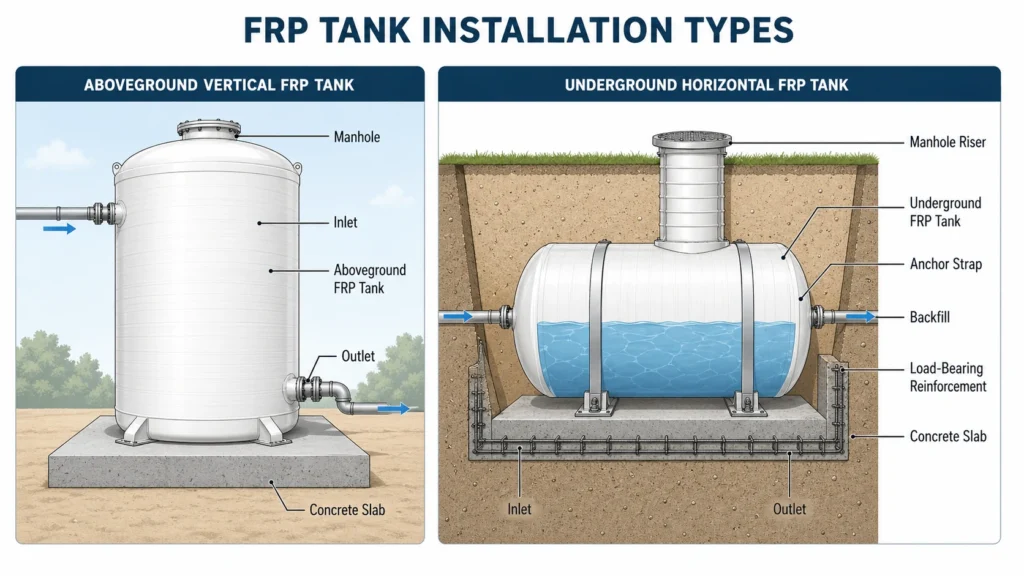
Aboveground tanks are generally easier and less expensive to install. They sit on a prepared concrete pad, are easy to inspect, and any leaks are visible immediately.
Underground tanks require more engineering. The walls must resist soil and groundwater pressure, and the design must consider whether vehicles will pass overhead. Anchor straps prevent the tank from floating when the surrounding soil is saturated. Excavation, backfill with proper bedding material, and a manhole riser to the surface all add to the installation cost.
For most Saudi villa, farm, and small industrial applications, aboveground tanks are the practical choice. Underground tanks are common where space is limited above ground, where the tank must be hidden for aesthetic reasons, or where the application (such as buried fire water reserves) requires it.
Installation method is one of the bigger drivers of the fiberglass water tank price Saudi Arabia projects ultimately pay.
FRP vs Plastic Water Tanks vs Steel Tanks
| Material | Advantages | Limitations | Best For |
|---|---|---|---|
| FRP / GRP (Fiberglass) | Corrosion-resistant, customizable size and fittings, long service life (often 20+ years), handles hot KSA climate, food-grade options available | Higher upfront cost than basic plastic, requires engineered design | Industrial sites, farms, large villas, custom projects, treatment plants |
| Plastic / PE | Low cost, lightweight, fast delivery in standard sizes | Limited capacity range, can deform under high heat, harder to repair, limited customization | Small rooftops, temporary use, low-budget applications |
| Steel (Galvanized / Coated) | High strength, structural rigidity | Susceptible to corrosion in hot/humid KSA conditions, heavier, requires coating maintenance | Fire water tanks (with coating), short-term industrial use |
| Concrete | Very long life when built correctly, fixed in place | Heavy, slow construction, prone to cracking and leaks if not maintained, harder to clean | Underground reservoirs, very large fixed installations |
There is no single “best” material — the right choice depends on capacity, location, budget, and how long the tank needs to last. For most industrial, agricultural, and commercial projects in Saudi Arabia, FRP offers the best balance of durability, customization, and lifetime cost. Plastic tanks remain popular for small standard sizes where price is the deciding factor.
How to Request an Accurate Fiberglass Water Tank Quotation
The fastest way to confirm the fiberglass water tank price Saudi Arabia suppliers can offer is to share your full specification upfront.
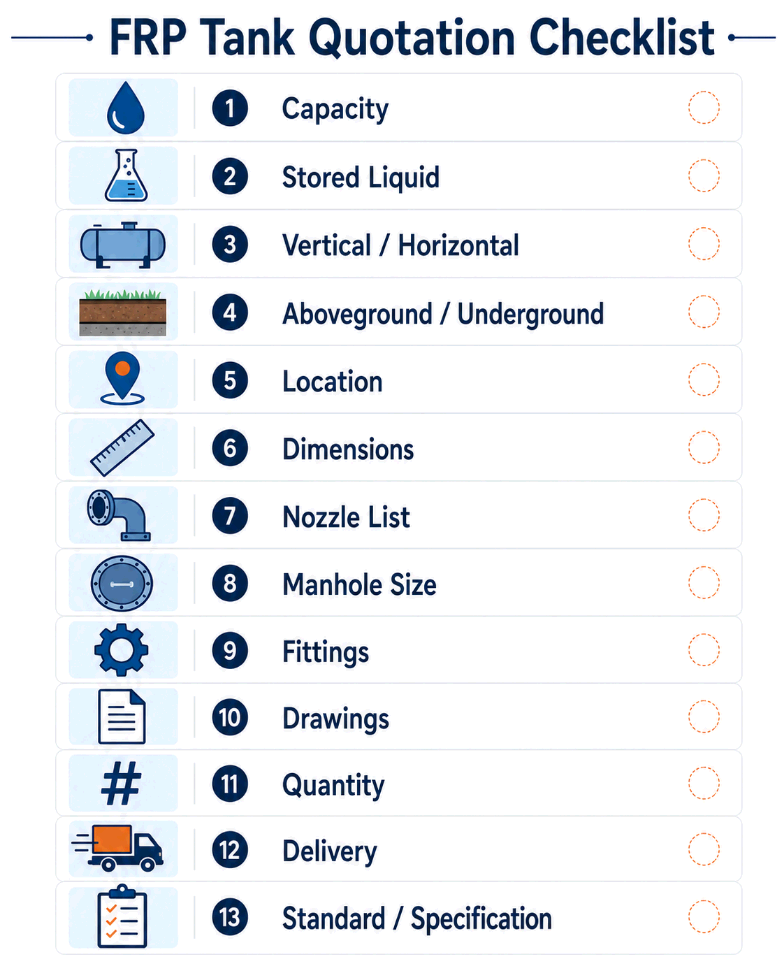
A vague inquiry — “How much for a 10,000 liter tank?” — usually gets a vague answer. The more detail you share, the more accurate the quotation. When you request a fiberglass tank quotation, include the following:
- Required capacity (in liters or cubic meters).
- Stored liquid: potable water, raw water, treated water, hot water, or another fluid.
- Tank type: vertical or horizontal.
- Installation: aboveground or underground.
- Site location (city or region in KSA) for delivery cost.
- Required dimensions, if there are space constraints.
- Nozzle sizes and locations: inlet, outlet, drain, overflow, vent.
- Manhole size (commonly 500 mm or 600 mm).
- Fittings and accessories: ladder, platform, level indicator, lifting lugs.
- Drawings or specification documents, if available.
- Quantity (single tank or multiple).
- Delivery requirement: ex-works, delivered, or installed.
- Consultant or client standard, if the project has one (e.g., Saudi Standards (SASO), Aramco, SWCC, NWC, municipality, or international standards).
Sharing this information upfront saves time and avoids back-and-forth. For repeat orders or project tenders, attaching previous drawings speeds the process further.
Common Mistakes Buyers Should Avoid
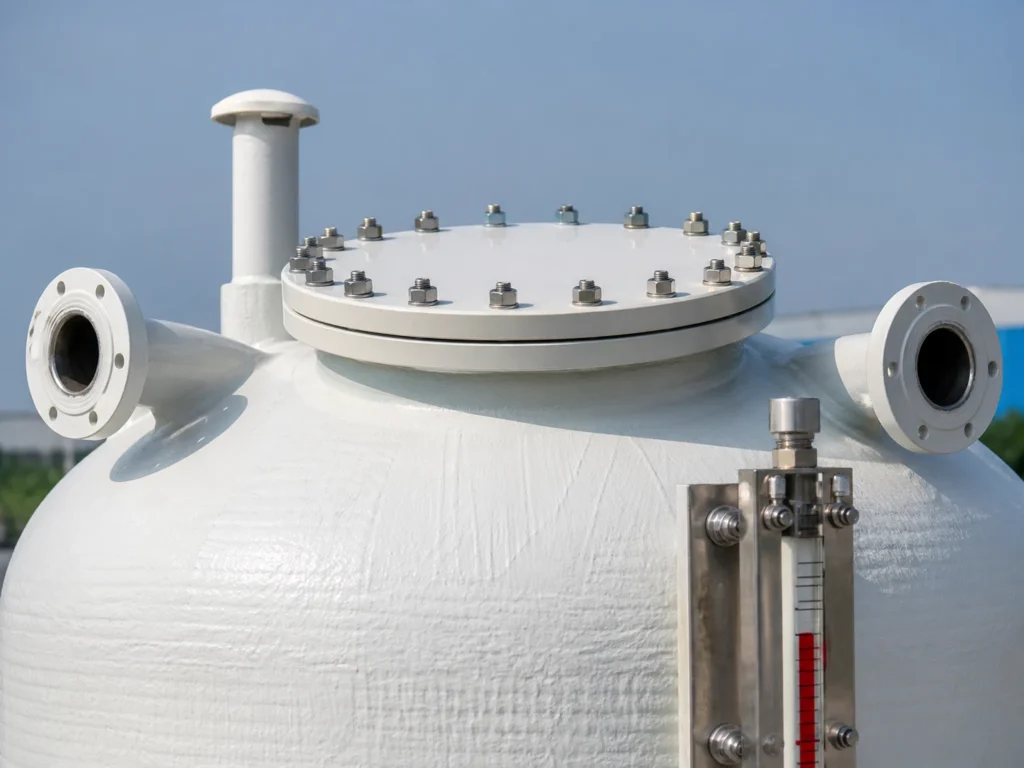
Procurement mistakes can be expensive and difficult to reverse. The most common ones include:
- Choosing only on lowest price. A tank that costs less today but fails in two years is the most expensive option.
- Not confirming resin and liner quality. Drinking water needs a food-grade inner liner — this is not optional.
- Skipping wall thickness and structural design checks. Two tanks of the same capacity can have very different lifespans.
- Not confirming nozzle orientation. Wrong nozzle position means costly rework or extra piping at site.
- Ignoring delivery and unloading. Large tanks need cranes and proper access; this should be planned, not improvised.
- Not asking for drawings before production. Approved drawings prevent disputes later.
- Skipping warranty and QA documents. Material test certificates, hydro-test reports, and warranty terms protect your investment.
- Comparing standard plastic tank prices with custom FRP industrial tanks. They are different products designed for different applications.
Why Choose a Local Fiberglass Tank Supplier in Saudi Arabia?
Working with a local FRP tank manufacturer in Saudi Arabia has clear advantages over importing:
- Faster communication in Arabic and English, in your time zone.
- Local manufacturing support, with site visits and engineering meetings when needed.
- Easier delivery anywhere in KSA — Riyadh, Jeddah, Dammam, Makkah, Madinah, NEOM, and remote project sites.
- Custom sizes and fittings without long international lead times.
- Better after-sales support for inspections, repairs, and replacement parts.
- Local climate expertise: materials and design are tuned for high temperatures, dust, and UV exposure.
- Easier site coordination with contractors, consultants, and project managers familiar with KSA standards.
As a Saudi-based manufacturer, Pioneers Fiberglass works directly with contractors, consultants, factories, farms, and procurement teams across the Kingdom. Our FRP and GRP product range covers water tanks, chemical tanks, diesel tanks, manhole covers, and custom fiberglass products built to project specification.
Frequently Asked Questions
What is the price of a fiberglass water tank in Saudi Arabia?
There is no single price. Cost depends on capacity, vertical or horizontal design, aboveground or underground installation, wall thickness, resin type, fittings, accessories, and delivery location. The most reliable way to know the fiberglass water tank price in Saudi Arabia is to request a written quotation based on your specification.
How much does a 10,000 liter fiberglass water tank cost?
The 10,000 liter fiberglass tank price depends on whether it is vertical or horizontal, single or double wall, the number of nozzles, the type of inner liner (standard or food-grade), and the delivery distance. A villa-grade vertical tank and a fully fitted industrial horizontal tank at the same capacity will sit at very different price points.
Is fiberglass better than plastic for water tanks?
For larger capacities, custom requirements, hot climates, and long-term industrial use, FRP generally outperforms plastic. Standard plastic tanks remain a valid choice for small, low-cost rooftop applications.
Are fiberglass tanks suitable for drinking water?
Yes, when manufactured with a food-grade inner liner that complies complies with potable water standards such as NSF/ANSI 61 for drinking water system components.. Always confirm this specification in writing before placing the order.
What sizes are available for FRP water tanks?
Common sizes range from 500 liters up to 100,000 liters and beyond. Anything outside the standard range can be made to order, including project-specific dimensions and shapes.
Can fiberglass tanks be installed underground?
Yes, but underground FRP tanks require thicker walls, ribbed reinforcement, anchor systems, proper bedding, and engineered installation. They cost more than aboveground tanks but suit applications where space is limited or the tank must be buried.
How long does a fiberglass water tank last?
A properly designed, manufactured, and maintained FRP water tank can last 20 years or more in Saudi conditions. Service life depends on resin quality, laminate thickness, UV protection, and maintenance.
What details are needed for a quotation?
Capacity, stored liquid, tank type, installation method, site location, nozzle and manhole requirements, fittings, quantity, delivery requirement, and any consultant or project specification.
Can FRP tanks be customized with nozzles and manholes?
Yes. Nozzle sizes, positions, flange types, manhole dimensions, ladders, platforms, level indicators, and lifting lugs are all customizable. Sharing a sketch or drawing with your inquiry helps the supplier match your exact requirements.
Conclusion
The fiberglass water tank price Saudi Arabia buyers pay reflects a technical decision as much as a commercial one. Capacity, configuration, fittings, resin system, and installation method all influence both performance and price. The buyers who get the best value are the ones who specify clearly, compare like-for-like quotations, and work with a supplier who understands KSA conditions and project requirements.
Contact Pioneers Fiberglass for a customized fiberglass water tank quotation in Saudi Arabia. Share your required capacity, site location, tank type (vertical or horizontal, aboveground or underground), and the fittings you need — our engineering team will respond with an accurate, detailed price based on your project. Whether you are sourcing for a single villa, a large farm, an industrial facility, or a multi-site project, we manufacture and deliver across the Kingdom and the wider GCC.